Band 5.5 IELTS Writing Task 1 Model Answer
Overall Band Score: 5.5 · IELTS Predictions Nov 2026 · 2026-11-26
IELTS Writing Task 1 question
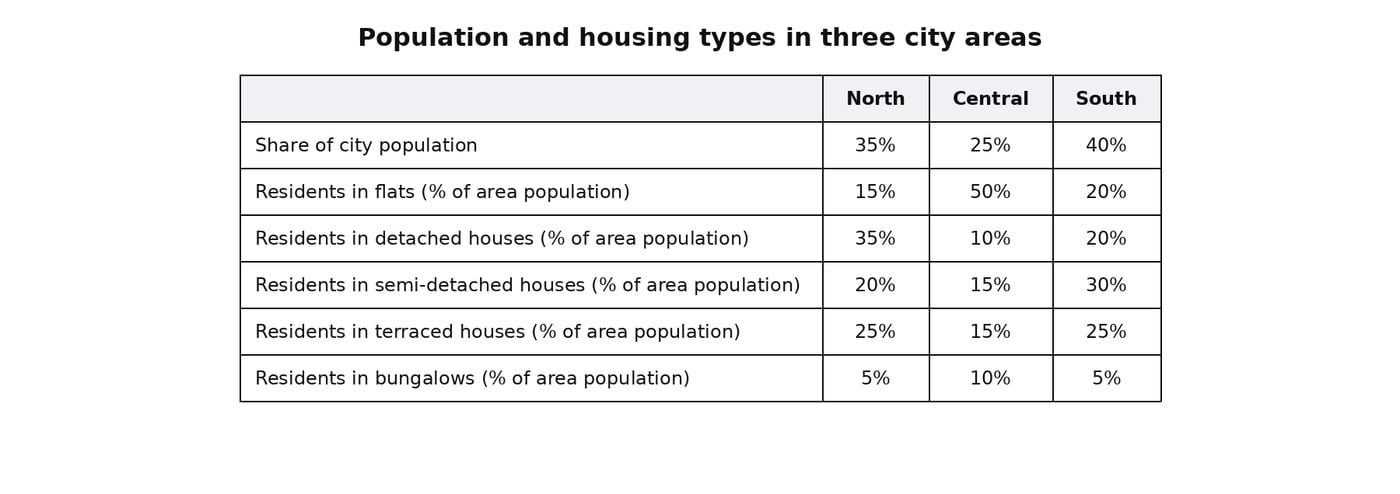
The table below shows each area's share of the city population and the percentages of its residents living in five types of home.
Summarise the information by selecting and reporting the main features, and make comparisons where relevant.
Student answer (Band 5.5)
The chart illustrates the percentage of city's population in three areas, alonf with the proportion of its residents in five different kinds of housing. Overall, the south has the largest share of city's population, while the central has the lowest. The flat accommodation is the most common in the central, whereas semi-detached home in the south. The detached housing is the popular in the north.
To begin with, 40% of population live in the south, while 35% are in the north. The central side has 25% of sharing. In flats, 15% record in the north, 50% in the central and 20% in the south. In detached, 35% of pupils take resident in the north, whereas 10% in the central as well as 20% in the south.
Looking for semi-detached homes, 20% settle in the north, 15% in the central and 30% in the south. The percentage of people live in the north as well as south is same and count for 25%. But 15% is in the central. Finally, bungalows is the least common housing type in three types area, respresenting 5%, 10% and 5% respectively.
AI examiner evaluation
| Criterion | Band |
|---|---|
| Task Achievement / Task Response | 6.0 |
| Coherence and Cohesion | 6.0 |
| Lexical Resource | 5.5 |
| Grammatical Range and Accuracy | 5.0 |
| Overall | 5.5 |
Task Achievement / Task Response: Band 6.0
You identify the main population pattern accurately: the South has the largest share (40%) and Central the smallest (25%). You also report the key housing figures for all five categories, including the concentration of flat residents in Central and detached-house residents in North. This covers the task and gives a relevant overview. However, some comparisons are less fully developed: for example, you do not clearly compare the leading housing type in each area, and the overview’s phrase “whereas semi-detached home in the south” is incomplete. The statement that bungalows are the least common “in three types area” is also imprecise, since they are the least common within each area, rather than across three housing types. A clearer overview and more precise comparisons would strengthen the report.
Coherence and Cohesion: Band 6.0
The response has a coherent overall arrangement: an introduction and overview are followed by details on population and housing, with the final paragraph covering the remaining categories. Sequencing phrases such as “To begin with,” “Looking for,” and “Finally” help signal movement through the data. However, some linking is mechanical, and the organisation could make comparisons easier to follow. The second paragraph groups population shares with flats and detached houses, while the next paragraph covers other housing types, but the reason for this division is not fully clear. References such as “the percentage of people live in the north as well as south” are also awkward and make the comparison less direct. Grouping the most notable figures by area or by housing type, and using clearer comparative links, would improve progression.
Lexical Resource: Band 5.5
You use relevant task vocabulary, including “proportion,” “detached,” “semi-detached,” “terraced,” and “bungalows,” so the reader can identify the categories being described. There is also some attempt to vary wording, for example “share” and “percentage.” However, several inaccurate or unnatural choices reduce precision: “the central side,” “25% of sharing,” “pupils take resident,” and “the detached housing is the popular” do not express the intended data naturally. Spelling slips such as “alonf” and “respresenting” also affect the overall control of vocabulary. Aim for standard collocations such as “accounted for,” “residents lived in,” and “the most common type of housing,” while checking spelling and word forms.
Grammatical Range and Accuracy: Band 5.0
You attempt a mixture of simple statements and longer comparisons, including clauses with “while” and “whereas,” and the main figures are generally understandable. However, grammatical control is uneven, with errors in articles, agreement, and sentence construction. For example, “percentage of city's population” needs a determiner, and “the central has the lowest” lacks a clear noun such as “share.” The fragment “whereas semi-detached home in the south” needs a complete clause, while “The percentage of people live” requires a relative or participial construction. In “bungalows is,” the plural subject also needs a plural verb. Practise building complete comparative sentences and checking subject–verb agreement, articles, and clause structure.
See this exact question answered at other band scores. The same prompt compared across bands.
Browse more IELTS Writing model answers or get your own writing scored by the same AI examiner.