Band 5.0 IELTS Writing Task 1 Model Answer
Overall Band Score: 5.0 · IELTS Predictions Nov 2026 · 2026-11-27
IELTS Writing Task 1 question
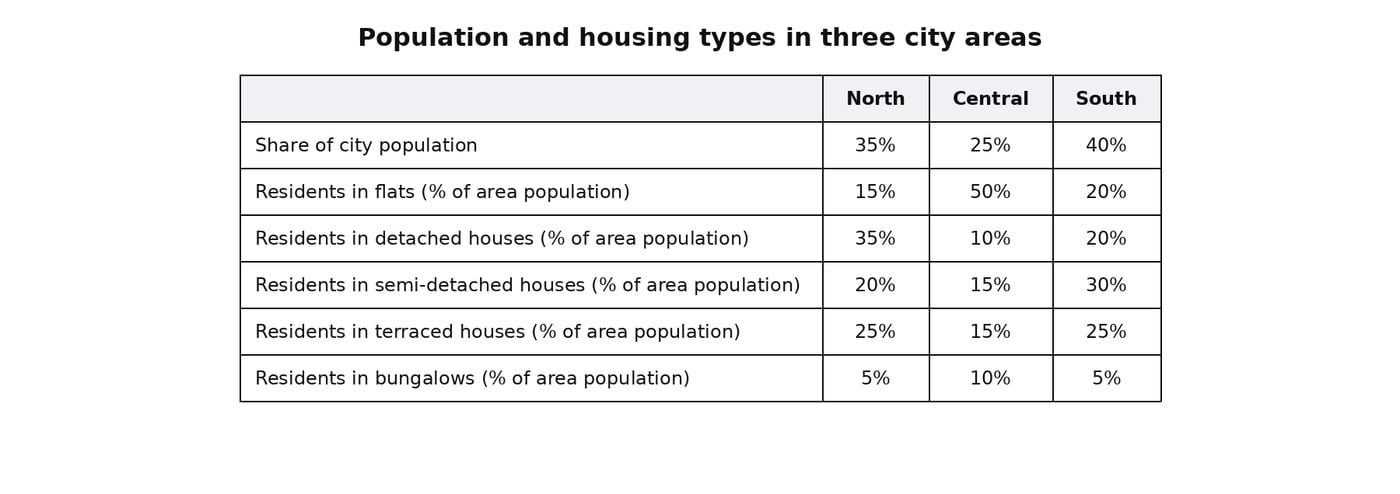
The table below shows each area's share of the city population and the percentages of its residents living in five types of home.
Summarise the information by selecting and reporting the main features, and make comparisons where relevant.
Student answer (Band 5.0)
The table illustrates three different area's share of the city population and the percentage of its residents living in five types of home.
Overall, percentage of residents in central area is highly populated comparatively with other two area's. However, northern and southern area are the least populated in the percentage of residents in bungalows.
To begin with, total share of the city pouplation in south is at 40% and in north it is 35% and in central area it is only 25%. However, central area residents in flats are increasingly populated with 50% while, in south and north it is only 20% to 15%. Percentage of detached houses in northern area is high with 35%, whereas, in south and central area's it is only 20% to 10%. Moreover, residents in semi-detached houses is highly populated in southern area compared with central and north area's had only 15% to 20%. Furthermore, residents in terraced houses and bungalows north and south areas are constant percentage with 25% to only 5% in bugalows. Lastly, central area is 15% in terraced houses and only 10% in bungalows.
AI examiner evaluation
| Criterion | Band |
|---|---|
| Task Achievement / Task Response | 5.5 |
| Coherence and Cohesion | 5.0 |
| Lexical Resource | 5.0 |
| Grammatical Range and Accuracy | 5.0 |
| Overall | 5.0 |
Task Achievement / Task Response: Band 5.5
You identify the table’s subject and report several relevant figures, including the population shares (South 40%, North 35%, Central 25%) and Central’s high proportion of flat residents (50%). You also compare detached housing and mention the other home types. However, the overview is unclear and partly inaccurate: Central is not the most populated area; it has the smallest population share, while South has the largest. The statement that North and South are “the least populated” in bungalows is also misleading, since both have 5%, compared with 10% in Central. Some comparisons are difficult to interpret, and the main patterns are not clearly summarised. Make the overview accurate, then select and report the strongest contrasts more precisely.
Coherence and Cohesion: Band 5.0
The response has a basic structure, with an introduction, an overview and a paragraph of details, and it moves through the housing categories in a generally understandable order. However, progression is weakened by repeated or mechanical linking words such as “However,” “Moreover,” “Furthermore” and “Lastly.” Some connections do not express a clear contrast, and the long detail paragraph combines many figures without grouping related patterns. For example, the sentence beginning “Furthermore, residents in terraced houses and bungalows…” is difficult to follow because it joins two categories and several areas unclearly. Organise the details into clearer comparisons—for instance, population shares and flats first, then the remaining housing types—and use linking phrases only where they clarify the relationship.
Lexical Resource: Band 5.0
You use relevant topic vocabulary, including “share of the city population,” “detached houses,” “semi-detached houses” and “terraced houses,” so the reader can recognise the categories being described. However, the range of reporting language is limited, and several collocations are unnatural or imprecise. Phrases such as “highly populated” and “increasingly populated” do not accurately describe percentages of residents in housing types; “the proportion of residents living in” would be more suitable. There are also spelling errors, including “pouplation” and “bugalows,” which reduce accuracy. Aim for precise terms such as “accounted for,” “represented” and “the highest proportion,” and check spelling carefully.
Grammatical Range and Accuracy: Band 5.0
You attempt both simple and more extended sentences, including comparisons introduced by “while” and “whereas.” However, complex sentences are often faulty, and errors in agreement, articles, plurals and sentence construction occur frequently enough to make some details hard to understand. For example, “residents in semi-detached houses is highly populated” has a subject–verb agreement problem and an unsuitable sentence structure, while “central area residents in flats are increasingly populated with 50%” is not grammatically well formed. The phrase “north and south areas are constant percentage” also lacks a clear grammatical relationship. Build shorter, accurate comparison sentences first, checking that each subject matches its verb and that each percentage is attached clearly to the relevant area.
See this exact question answered at other band scores. The same prompt compared across bands.
Browse more IELTS Writing model answers or get your own writing scored by the same AI examiner.