Band 5.0 IELTS Writing Task 1 Model Answer
Overall Band Score: 5.0 · Recent IELTS Exams (Canada & India) · 2026-11-08
IELTS Writing Task 1 question
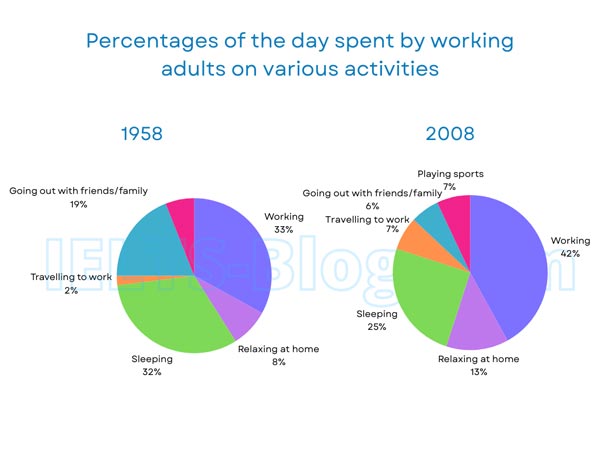
The pie charts below show how working adults in a particular country spent their time in 1958 and 2008.
Summarise the information by selecting and reporting the main features, and make comparisons where relevant.
* Note: these aren’t the original diagrams given in the test, they were recreated for the purpose of demonstration.
Student answer (Band 5.0)
The pie chart illustrates the significant diffirence how working adults used spent their time in 1958 and now in 2008.
Insum, The percentage of working time is the major portion in both the years. however, day spent in sleeping holding the second highest percentage with 32 in 1958 which was decreased to 25% in 2008.
In 1958, working hours set to be the peak activity continues with sleeping with 32%.Although there are some more activities considered such as going out with friends and families which hold the significant portion of 19% and relaxing at home was also a appropriate activitiy having 8%. On other hand there are some of quite activities such as playing and travelling which hold least percentage overall.
In 2008 there are significant changes happend where working adults increased their working time peaked to 42 %. On other hand sleeping time have reduced. Anyway relaxing and sport and other various acti
AI examiner evaluation
| Criterion | Band |
|---|---|
| Task Achievement / Task Response | 5.0 |
| Coherence and Cohesion | 4.5 |
| Lexical Resource | 5.0 |
| Grammatical Range and Accuracy | 5.0 |
| Overall | 5.0 |
Task Achievement / Task Response: Band 5.0
You identify the main pattern that working takes the largest share in both years and that sleeping declines, and you include several relevant figures, such as 19% for socialising in 1958 and 42% for working in 2008. However, the account is only partial: the 2008 discussion is cut off before its changes are clearly reported, and the overview does not capture the full range of key shifts. Some details are inaccurate or unclear: travelling was 2% in 1958, while sports was not listed for that year; in 2008, travelling and sports were both 7%. The statement that these were “quite activities” with the lowest shares is therefore misleading. Report the main comparisons accurately and complete the summary of both charts.
Coherence and Cohesion: Band 4.5
There is an attempt to organise the response into an introduction, an overview and separate paragraphs for each year, which gives the reader a basic framework. However, progression is weak: the final paragraph ends mid-thought (“relaxing and sport and other various acti”), leaving the 2008 information incomplete. Linking phrases such as “On other hand” and “Anyway” are either inaccurate or do not clearly show the relationship between ideas, while “Insum” and “however” are not consistently punctuated. The overview also repeats information rather than establishing a clear comparison. Use complete paragraphs, group related figures together, and connect the years with precise contrasts such as “whereas” or “by comparison.”
Lexical Resource: Band 5.0
The response uses some task-relevant vocabulary, including “percentage,” “peak activity,” “reduced,” and “significant changes,” so the topic is generally recognisable. However, the range and control are limited, and several word choices or collocations make the meaning awkward: “used spent their time,” “working hours set to be,” and “quite activities” are unclear or unsuitable. There are also noticeable spelling and word-form errors, including “diffirence,” “happend,” and “activitiy.” Aim for precise chart language and avoid repeating broad terms such as “significant.” For example, describe categories as “accounted for” a share and say that a proportion “rose” or “fell.”
Grammatical Range and Accuracy: Band 5.0
You attempt some longer sentences, including “Although there are some more activities considered such as going out…” and a comparison of sleeping across the two years. However, these complex attempts are often faulty, and many sentences have problems with verb forms, agreement, articles or sentence boundaries. For instance, “the percentage of working time is the major portion” does not form a clear comparison, and “sleeping time have reduced” has incorrect subject–verb agreement. Punctuation and capitalisation are also inconsistent, as in “Insum, The” and “however” after a full stop. Use shorter, complete sentences first, then add controlled comparisons; check that each subject matches its verb and that each sentence has a clear main clause.
See this exact question answered at other band scores. The same prompt compared across bands.
Browse more IELTS Writing model answers or get your own writing scored by the same AI examiner.