Band 5.0 IELTS Writing Task 1 Model Answer
Overall Band Score: 5.0 · Recent IELTS Exams (Canada & India) · 2026-11-08
IELTS Writing Task 1 question
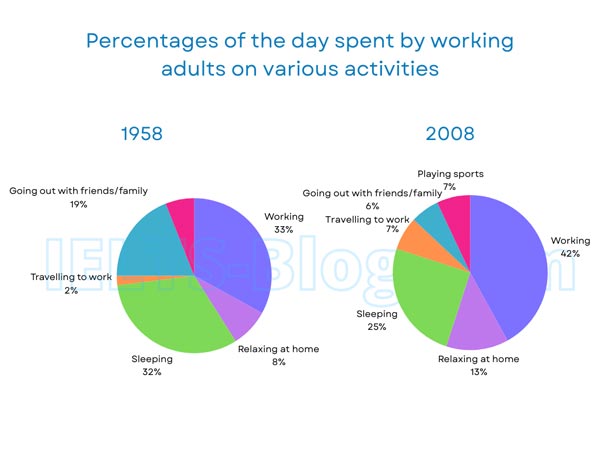
The pie charts below show how working adults in a particular country spent their time in 1958 and 2008.
Summarise the information by selecting and reporting the main features, and make comparisons where relevant.
* Note: these aren’t the original diagrams given in the test, they were recreated for the purpose of demonstration.
Student answer (Band 5.0)
"The pie charts illustrate the proportions of the day spent by working adults on different activities in 1958 and 2008.In 1958, 19% of adults spent their time were going out with friends and family. Travelling to work were accounted for 2%, while sleeping were represented 32%. Working were the largest activity, at 33%, whereas relaxing at home were accounted for 8%.In 2008, working increased to 42%,While sleeping decreased were25%. Relaxing at home were rising to 13%, and playing sports were accounted for 7%. However, going out with friends and family fell to 6%.Overall, working became the most common activity in 2008, whereas travelling to work had the smallest proportion in 1958. Playing sports was an additional activity in 2008.These are the varied activities on 1958.however,another activity involved in 2008 it was Playing sports.Other activities of goingout with frends/family,travelling to work,Sleeping,Relaxing at home and Working were remained same."
AI examiner evaluation
| Criterion | Band |
|---|---|
| Task Achievement / Task Response | 5.0 |
| Coherence and Cohesion | 4.5 |
| Lexical Resource | 5.5 |
| Grammatical Range and Accuracy | 5.0 |
| Overall | 5.0 |
Task Achievement / Task Response: Band 5.0
You report several key figures accurately, including work rising from 33% to 42%, sleep falling from 32% to 25%, and socialising dropping to 6%. You also identify sports as a new category in 2008. However, the response only partly fulfils the task: it does not clearly compare the overall pattern across both years, and the overview is weakened by saying travel was the smallest category in 1958 without noting that it rose to 7% in 2008, tied with sports. The final claim that the other activities “remained same” is inaccurate because their proportions changed. The response is also three words below the required minimum. A clearer overview and more accurate comparisons would make the summary more complete.
Coherence and Cohesion: Band 4.5
The response has a basic sequence, moving from 1958 figures to 2008 figures and then attempting an overview. This gives the reader some organisation, and contrast markers such as “whereas” and “However” show an effort to connect information. However, progression is disrupted by repeated or conflicting summary points: the final sentences repeat that sports was additional and then claim the other categories remained unchanged. Several transitions are awkwardly attached, as in “In 2008, working increased to 42%,While…”, and punctuation spacing makes the text harder to follow. Use separate, clearly planned paragraphs for the introduction, overview and comparisons, and avoid repeating information in the conclusion.
Lexical Resource: Band 5.5
You use relevant chart vocabulary, including “proportions,” “increased,” “decreased,” “fell,” and “activity,” so the topic is generally clear. There is some variation in how you describe changes, but several word combinations are inaccurate or unnatural: “spent their time were going out,” “were accounted for,” and “were represented” do not fit the intended meanings. “Varied activities” and “involved” are also vague in this context, while “goingout” and “frends” contain spelling or spacing errors. These issues make the description less precise and sometimes slow the reader. Aim for accurate reporting verbs and collocations, such as “accounted for,” “rose to,” and “the proportion of time spent on,” and check spelling and spacing carefully.
Grammatical Range and Accuracy: Band 5.0
You attempt both simple and more complex sentence patterns, including a comparison with “whereas,” but grammatical control is inconsistent. Errors occur in subject–verb agreement and sentence construction: “Travelling to work were accounted for 2%” and “Working were the largest activity” should use singular agreement or a different structure. The phrase “19% of adults spent their time were going out” combines incompatible verb patterns, and “sleeping decreased were25%” has an incorrect verb form and missing spacing. Punctuation also affects sentence boundaries, particularly where a full stop is followed immediately by “In 1958” and where clauses run together. Build reliable simple sentences first, then add comparisons with correctly formed clauses.
See this exact question answered at other band scores. The same prompt compared across bands.
Browse more IELTS Writing model answers or get your own writing scored by the same AI examiner.