Band 5.5 IELTS Writing Task 1 Model Answer
Overall Band Score: 5.5 · Recent IELTS Exams (Canada & India) · 2026-11-13
IELTS Writing Task 1 question
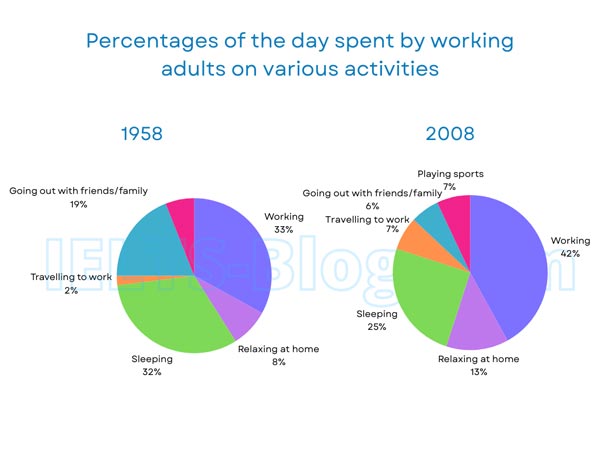
The pie charts below show how working adults in a particular country spent their time in 1958 and 2008.
Summarise the information by selecting and reporting the main features, and make comparisons where relevant.
* Note: these aren’t the original diagrams given in the test, they were recreated for the purpose of demonstration.
Student answer (Band 5.5)
The pie charts express spending time on various activities of working adults in a particular country. It represents the difference in 1958 and in 2008.
In both time period people have to work maximum time in 24 hour and it is increased by 9 percent. In 1958 people spend thier 32 percent of total time in slepping but it decreases to 25 percent in 2008. In 1958 people used to going out with friends and family but in 2008 people lose their interest in this sector and this portion decreased by 13 percent. But spending time for relaxing in home is increased ,in 1958 it was 8 percent but in 2008 it is 13 percent. At the same time the pie charts illustrate that people's tendency for spending time in traveling to work is incred by 5 percent. But spending time in sports is almost same in both time. Here is a little difference which is only 1 percent and the increasing demand shows in 2008.
AI examiner evaluation
| Criterion | Band |
|---|---|
| Task Achievement / Task Response | 5.5 |
| Coherence and Cohesion | 5.5 |
| Lexical Resource | 5.5 |
| Grammatical Range and Accuracy | 5.0 |
| Overall | 5.5 |
Task Achievement / Task Response: Band 5.5
You identify several important changes, including the rise in working time from 33% to 42%, the fall in sleeping from 32% to 25%, and the increase in commuting from 2% to 7%. However, the overview is not sufficiently clear: saying work took the “maximum time” in both years misses that going out was also a major activity in 1958, while sports appears only in 2008. There is also a factual error in stating that sports was “almost same in both time”; the chart gives no sports figure for 1958 and shows 7% in 2008. The 13% fall in going out is correct, but the response would be stronger with a concise overview of the largest shifts and more precise reporting of the categories.
Coherence and Cohesion: Band 5.5
The response follows a broadly sensible order, moving through work, sleep, socialising, relaxing and commuting, and uses linking words such as “but” and “at the same time” to connect comparisons. However, it is presented as one main block rather than being clearly divided into an introduction, overview and detail paragraphs. The sequence also feels like a list of individual figures, with no clear summary of the overall pattern before the details. Some links are awkward or unclear, particularly “Here is a little difference,” which does not clearly identify the comparison. Grouping the largest increases and decreases, and using a separate overview, would make the progression easier to follow.
Lexical Resource: Band 5.5
You use some relevant chart vocabulary, including “increased,” “decreased,” “portion” and “tendency,” so the reader can generally understand the comparisons. However, the range is limited and several choices are unnatural or imprecise, such as “lose their interest in this sector” for a decline in time spent going out, and “increasing demand” for a rise in the share of time devoted to sports. Spelling errors such as “thier,” “slepping” and “incred” are noticeable, and phrases like “relaxing in home” do not sound natural. Aim for precise, neutral descriptions of proportions and changes rather than interpreting people’s motives.
Grammatical Range and Accuracy: Band 5.0
You attempt both simple statements and longer comparisons, for example, “In 1958 people spend… but it decreases to 25 percent in 2008.” However, tense and verb-form errors occur frequently: “people spend” should be “people spent,” and “people used to going out” needs a different construction, such as “people spent time going out.” There are also problems with articles, agreement and sentence boundaries, as in “It represents the difference in 1958 and in 2008” and the run-on construction beginning “But spending time for relaxing…”. These errors sometimes make relationships between ideas harder to follow. Practise accurate past-tense reporting and build comparisons with controlled clauses and punctuation.
See this exact question answered at other band scores. The same prompt compared across bands.
Browse more IELTS Writing model answers or get your own writing scored by the same AI examiner.