Band 5.0 IELTS Writing Task 1 Model Answer
Overall Band Score: 5.0 · Recent IELTS Exams (Canada & India) · 2026-11-15
IELTS Writing Task 1 question
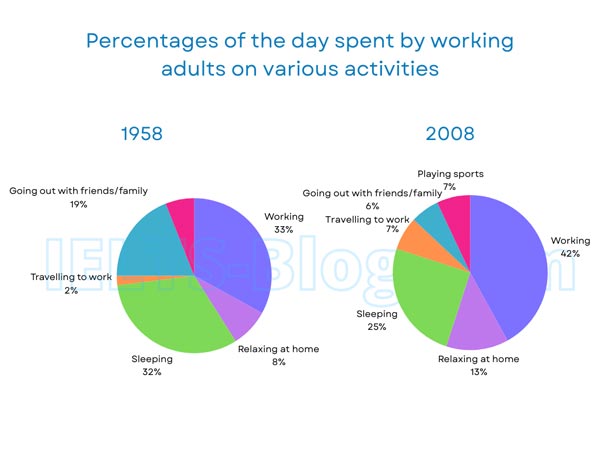
The pie charts below show how working adults in a particular country spent their time in 1958 and 2008.
Summarise the information by selecting and reporting the main features, and make comparisons where relevant.
* Note: these aren’t the original diagrams given in the test, they were recreated for the purpose of demonstration.
Student answer (Band 5.0)
this pie charts illustrates percentage on how the adults spend their time in 1958 and 2008. As what i've notice The 1958 adults have more less and more specific to do on how they spend on their free time so they have 19% going out with friends, 2% going out to work, 32% sleeping, 8% relax at home and lastly 33% working. they put much of time in working which is 32%. In comparison for the 2008 adults they have more things to do in their free time which is 6% going out with friends and family, 7% for sports, 42% working, 7% travelling to work, 25% sleeping, and 13% relaxing at home. 2008 adults now is exposed into sports and hobbies and the percentage of the working hours is increasing. Overall both is good and productive with their free time but the 2008 adults is way more have time for what they likes snd how they handle their free time.
AI examiner evaluation
| Criterion | Band |
|---|---|
| Task Achievement / Task Response | 5.5 |
| Coherence and Cohesion | 5.0 |
| Lexical Resource | 5.0 |
| Grammatical Range and Accuracy | 5.0 |
| Overall | 5.0 |
Task Achievement / Task Response: Band 5.5
You include figures for both years and identify several relevant changes, including the rise in working time from 33% to 42% and the fall in sleeping from 32% to 25%. However, the response mainly lists categories rather than selecting and comparing the most important features. The overview is unclear: “Overall both is good and productive” does not summarise the chart’s main pattern, and the claim that 2008 adults have more time for what they like is not clearly supported, since going out with friends and family falls sharply. There is also a factual misreading: 2% in 1958 is travelling to work, not “going out to work.” State the main shifts clearly, then support them with accurate comparisons.
Coherence and Cohesion: Band 5.0
The response follows a basic chronological order, discussing 1958 before 2008, and phrases such as “In comparison” help signal a contrast. However, the information is presented in one long paragraph, with little separation between the overview and supporting details. The opening, data lists and final opinion do not form a clear progression, and some links are confusing—for example, “they put much of time in working which is 32%” conflicts with the earlier figure of 33%. Repeated use of “so” and “and” also makes the writing feel list-like. Use a short introduction, a clear overview, and separate detail paragraphs organised around the main increases and decreases.
Lexical Resource: Band 5.0
You use enough basic vocabulary to identify the chart categories, including “working,” “sleeping,” “travelling to work” and “relaxing at home.” However, the range is limited and several expressions are imprecise or unnatural, which sometimes makes the intended comparison difficult to follow. For example, “more less and more specific to do” is unclear, while “exposed into sports and hobbies” does not accurately describe the chart, which only reports time spent playing sports. “Going out to work” also confuses commuting with working. Aim for precise chart language such as “accounted for,” “rose,” “declined” and “share of the day,” and avoid unsupported descriptions of people’s preferences.
Grammatical Range and Accuracy: Band 5.0
The response attempts some longer sentences and uses basic past and present forms, but sentence structures are limited and errors occur frequently enough to affect clarity. Examples include “this pie charts illustrates,” where the demonstrative, noun and verb do not agree, and “the 2008 adults is way more have time,” which has several problems with agreement and sentence construction. The sentence beginning “As what i've notice” is also not formed correctly, and punctuation and capitalisation are inconsistent. Practise accurate simple comparison sentences first, such as “Working rose from 33% in 1958 to 42% in 2008.” Then add controlled complex forms using “while” or “whereas,” checking subject–verb agreement and sentence boundaries.
See this exact question answered at other band scores. The same prompt compared across bands.
Browse more IELTS Writing model answers or get your own writing scored by the same AI examiner.