Band 6.0 IELTS Writing Task 1 Model Answer
Overall Band Score: 6.0 · Recent IELTS Exams (Canada & India) · 2026-11-18
IELTS Writing Task 1 question
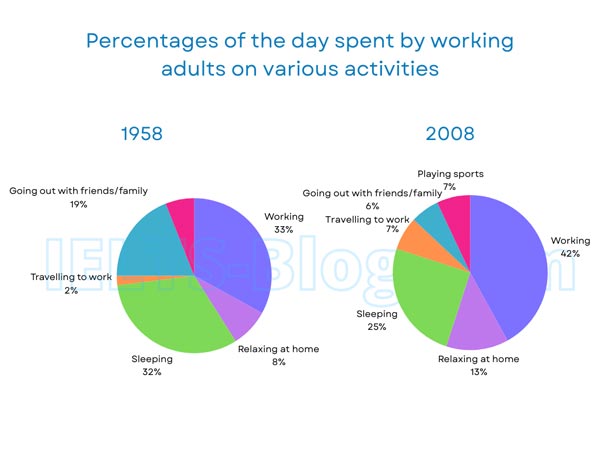
The pie charts below show how working adults in a particular country spent their time in 1958 and 2008.
Summarise the information by selecting and reporting the main features, and make comparisons where relevant.
* Note: these aren’t the original diagrams given in the test, they were recreated for the purpose of demonstration.
Student answer (Band 6.0)
These pie charts illustrate and compare the proportions of different activities done by working people in whole day in the year 1958 and 2008.
Overall, most of the adults spent most part of their day working. Sleeping also covered a large portion, while travelling to work took the least time in the former year.
In 1958, about 33% of the day was spent during work while this proportion increased to 42% in 2008. Adults relaxed at home which took almost 8% of their day in 1958, while in 2008 this percentage became 13%. About 32% of the day was spent sleeping in 1958 and travelling to work took the least time only about 2%. Going out with the family and friends took almost one fifth of the day making it to 19%.
In 2008. sleeping took the quarter of the day, while day spent travelling increased to 7% in 2008. The percentage decreased for going out with friends and family for the year 2008 taking almost 6% of the day. Playing sports remained the same and only took 7% of time in a day for both years.
AI examiner evaluation
| Criterion | Band |
|---|---|
| Task Achievement / Task Response | 6.0 |
| Coherence and Cohesion | 6.5 |
| Lexical Resource | 6.0 |
| Grammatical Range and Accuracy | 6.0 |
| Overall | 6.0 |
Task Achievement / Task Response: Band 6.0
You identify the main pattern that work took the largest share in both years and report several relevant figures accurately, including work (33% to 42%), sleeping (32% to 25%), and travel (2% to 7%). The comparison of socialising also captures its marked decline from 19% to 6%. However, the overview is incomplete: it does not mention the substantial fall in going out or the addition of sports in 2008. The statement that sports took 7% “for both years” is inaccurate, since the chart shows sports only in 2008. Some details are also less fully developed, particularly the 2008 activity profile. A more complete overview and careful checking of which categories appear in each year would make the summary more fully informative.
Coherence and Cohesion: Band 6.5
The response has a clear overall structure: an introduction, an overview, and separate descriptions of the two years. Information is generally easy to follow, and comparisons are signalled with words such as “while” and “increased.” This meets the expected level of coherent organisation. To make progression more consistently clear, group related changes together rather than moving between categories and years. For example, the 1958 paragraph reports work, relaxation, sleep, travel, and socialising, while the final paragraph returns to 2008 figures and ends with a comparison that is not supported by the chart. The opening overview could also preview the most important changes, giving the reader a clearer framework for the details that follow.
Lexical Resource: Band 6.0
You use an adequate range of task-related vocabulary, including “proportions,” “increased,” “decreased,” and “covered a large portion,” so the main comparisons are understandable. There are also attempts to vary phrasing, such as “spent during work” and “took almost one fifth.” However, some expressions are imprecise or unnatural, which limits the clarity and control of the vocabulary. “Spent during work” would be more naturally expressed as “spent working,” and “took the quarter of the day” as “accounted for a quarter of the day.” The phrase “remained the same” is misleading for sports because the chart gives no 1958 figure. Aim for precise chart language and avoid implying a comparison where the data do not provide one.
Grammatical Range and Accuracy: Band 6.0
You use a mix of simple and more complex sentence forms, including clauses joined with “while,” and most of the meaning remains clear. Some grammatical errors persist, however. In the introduction, “in whole day” needs an article and a more natural construction, such as “during a whole day.” The sentence beginning “Adults relaxed at home which took…” has an unclear clause structure; “Relaxing at home accounted for 8%” would be more controlled. The fragment-like transition “In 2008. sleeping…” also needs correct punctuation and capitalisation, for example, “In 2008, sleeping accounted for a quarter of the day.” Continue checking articles, sentence boundaries, and clause connections while retaining your attempts at complex sentences.
See this exact question answered at other band scores. The same prompt compared across bands.
Browse more IELTS Writing model answers or get your own writing scored by the same AI examiner.