Band 5.5 IELTS Writing Task 1 Model Answer
Overall Band Score: 5.5 · Recent IELTS Exams (Canada & India) · 2026-11-18
IELTS Writing Task 1 question
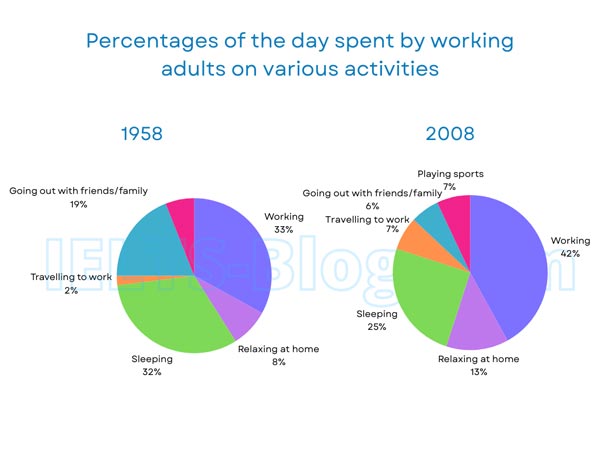
The pie charts below show how working adults in a particular country spent their time in 1958 and 2008.
Summarise the information by selecting and reporting the main features, and make comparisons where relevant.
* Note: these aren’t the original diagrams given in the test, they were recreated for the purpose of demonstration.
Student answer (Band 5.5)
The above pie charts illustrate the percentages of how adult people passed their time while working in the year 1958 to 2008.
overall, there are two main features. One of main features was the rate of sleeping and going out with families/friends decreased by 7% & 13% respectively. while all the other factors remained constant. the second one was one factor is added in 2008 the playing sports which contained 7%.
the first chart shows the percentages of various activities like outgoing with friends and family contained 19% likewise travelling has2% sleeping 32% and working 33%.in contrast, we can see that there was only one percent difference between slleping and working so,it means in 1958, people did work and sleeped that's why there was no establishment in 1958.
Furthurmore In 2008, we see that the difference between this is going large about 17% and we see in 2008 people make many things but relaxtion is going rise about 5%.and working bacomes 42% while decline in sleeping by 7%.
AI examiner evaluation
| Criterion | Band |
|---|---|
| Task Achievement / Task Response | 5.5 |
| Coherence and Cohesion | 5.5 |
| Lexical Resource | 5.0 |
| Grammatical Range and Accuracy | 5.0 |
| Overall | 5.5 |
Task Achievement / Task Response: Band 5.5
You identify several relevant changes, including the rise in working time from 33% to 42%, the fall in sleeping from 32% to 25%, and the addition of sports at 7% in 2008. However, the overview is incomplete and includes a major inaccuracy: “all the other factors remained constant,” although relaxing at home rose from 8% to 13% and travelling increased from 2% to 7%. The stated decreases for sleeping and socialising are also reversed: sleeping fell by 7 percentage points, while going out fell by 13. Some comparisons, such as the 1958 one-point gap between work and sleep, are relevant, but the discussion of what this “means” is unclear and unsupported. Select the main trends accurately and compare both years more systematically.
Coherence and Cohesion: Band 5.5
The response has a recognisable structure, with an introduction, an overview and paragraphs referring to each year. This gives the reader some organisation, and phrases such as “In contrast” and “Furthermore” attempt to connect ideas. However, progression is not consistently clear: the overview says other activities stayed constant, while later details describe changes in relaxation and work. Several sentences combine unrelated points or have unclear references, particularly “the difference between this is going large about 17%.” The repeated use of “we see” and “one main feature” also makes the linking mechanical. Organise the body around the most important increases and decreases, and use clear comparisons and references to connect the figures.
Lexical Resource: Band 5.0
You use some task-relevant vocabulary, including “percentages,” “decreased,” “contained,” and “decline,” so the reader can identify the general subject. However, the range is limited and several choices or collocations are inaccurate, which sometimes makes the meaning difficult to follow. For example, “adult people passed their time” is unnatural, “the difference … is going large” is unclear, and “there was no establishment” does not express a clear chart-related idea. Spelling errors such as “Furthurmore,” “slleping,” and “relaxtion” also reduce precision. Build a more accurate set of phrases for describing proportions and changes, such as “accounted for,” “rose by,” and “fell to,” and check spelling carefully.
Grammatical Range and Accuracy: Band 5.0
You attempt both simple and longer sentence forms, but control is inconsistent, and errors often make relationships between ideas hard to understand. Examples include “One of main features was,” “while all the other factors remained constant,” and “the difference between this is going large,” where sentence construction and clause connections are faulty. Verb forms are also problematic in “people did work and sleeped,” and punctuation and capitalisation are inconsistent, as in “overall” and “while” after full stops. These issues occur alongside some understandable basic statements, such as “working becomes 42%.” Practise forming complete comparison sentences with accurate past-tense verbs, and use full stops and commas to separate ideas clearly.
See this exact question answered at other band scores. The same prompt compared across bands.
Browse more IELTS Writing model answers or get your own writing scored by the same AI examiner.