Band 5.0 IELTS Writing Task 1 Model Answer
Overall Band Score: 5.0 · Recent IELTS Exams (Canada & India) · 2026-11-19
IELTS Writing Task 1 question
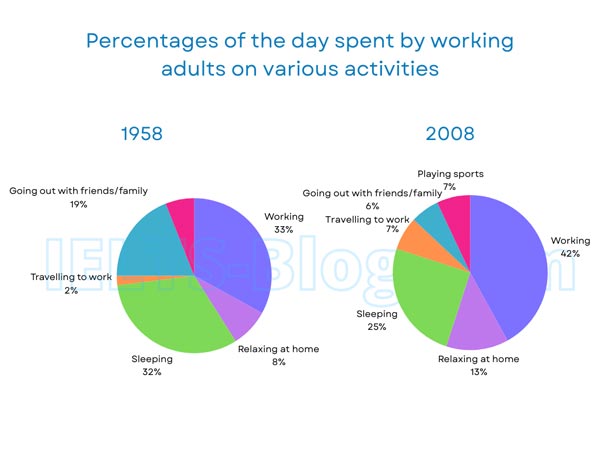
The pie charts below show how working adults in a particular country spent their time in 1958 and 2008.
Summarise the information by selecting and reporting the main features, and make comparisons where relevant.
* Note: these aren’t the original diagrams given in the test, they were recreated for the purpose of demonstration.
Student answer (Band 5.0)
The piechart illustrate the working adults in a particular country spent their time in 1958 and 2008.
Overall it is clear that working adults activity was the maximum in both chart, while other activities were minimum.
Fetching into details working adults activity was the highest accounted at 33% in 1958. followed by sleeping activity was the second highest activity accounted at 32% in 1958. When it comes on going out with friends/family it accounted at 19%andactivity activity it was the third greatest activity perfom by adults in 1958. moreover travelling to work accounted at 2% and it was noticed that relaxing at home8%.
Consideing the remaining details,the figure of working was colossal with 42%, just a head of going out with friends/family noticed at 6%. Analyzing playing sports and travelling to work was same at 7%. and when it come to sleeping activity was the second biggest activities did by adults in 2008 and relaxing at home were 13%.
AI examiner evaluation
| Criterion | Band |
|---|---|
| Task Achievement / Task Response | 4.5 |
| Coherence and Cohesion | 5.0 |
| Lexical Resource | 5.0 |
| Grammatical Range and Accuracy | 4.5 |
| Overall | 5.0 |
Task Achievement / Task Response: Band 4.5
You identify the two years and report several relevant figures, including work rising from 33% to 42%, sleep falling to 25%, and travel reaching 7% in 2008. However, the overview is inaccurate: work was the largest category in both years, but the other activities were not all “minimum”; sleeping was almost as high as work in 1958. The response also omits the important overall shift away from going out with friends or family, from 19% to 6%, and does not clearly compare the charts as a whole. Some details are unclear, such as “relaxing at home8%.” The response is 146 words, below the 150-word minimum; 13 words copied from the prompt were not counted. Add a concise, accurate overview and develop the key comparisons.
Coherence and Cohesion: Band 5.0
The response has a basic structure: an introduction, an overview, and separate discussion of figures from 1958 and 2008. This gives the reader some sense of how the information is grouped. However, progression within the paragraphs is uneven, and several linking expressions are either repetitive or do not clarify the relationship between ideas. For example, “moreover” introduces another figure without a clear comparison, while “Consideing the remaining details” is followed by a list that is difficult to follow. The long sentence beginning “When it comes on going out…” combines several points without clear punctuation. Organise each year’s figures in a consistent order and use simple, accurate comparisons to connect them.
Lexical Resource: Band 5.0
You use some task-relevant vocabulary, including “accounted,” “activity,” “figure,” and “going out with friends/family,” and you attempt more formal alternatives such as “colossal.” However, the range is limited and several choices are inaccurate or unnatural: “working adults activity,” “the third greatest activity perfom,” and “a just a head of” do not express the intended comparisons clearly. Spelling errors such as “Consideing” and “perfom,” along with joined words such as “19%andactivity,” also reduce clarity. Prefer precise chart language and familiar collocations rather than forcing uncommon words. For example, describe a category as “accounted for” a percentage, or say it was “slightly higher than” another figure.
Grammatical Range and Accuracy: Band 4.5
You attempt both simple statements and longer sentences, but control is inconsistent, and errors frequently affect clarity. Examples include “The piechart illustrate” (subject–verb agreement), “in both chart” (plural agreement), and “working adults activity was the maximum” (unclear grammatical construction). Sentence boundaries and punctuation are also problematic: “33% in 1958. followed by…” begins a fragment, while the final section joins clauses with a full stop before “and.” Articles, plurals, and verb forms are often missing or incorrect, as in “the second biggest activities did by adults.” Build accurate short sentences first, then combine related comparisons with a correctly formed clause. Check agreement, articles, and punctuation during revision.
See this exact question answered at other band scores. The same prompt compared across bands.
Browse more IELTS Writing model answers or get your own writing scored by the same AI examiner.