Band 5.5 IELTS Writing Task 1 Model Answer
Overall Band Score: 5.5 · Recent IELTS Exams (Canada & India) · 2026-11-19
IELTS Writing Task 1 question
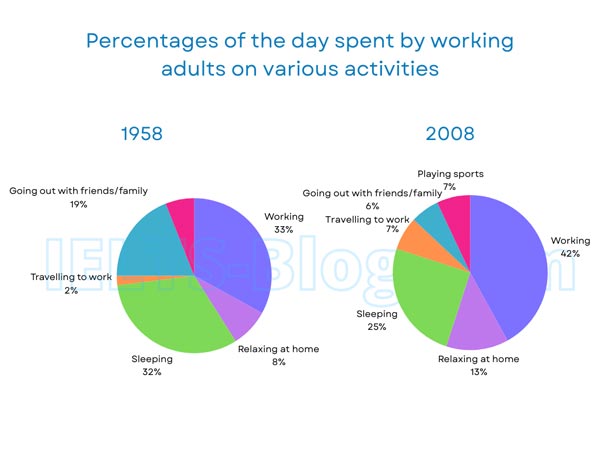
The pie charts below show how working adults in a particular country spent their time in 1958 and 2008.
Summarise the information by selecting and reporting the main features, and make comparisons where relevant.
* Note: these aren’t the original diagrams given in the test, they were recreated for the purpose of demonstration.
Student answer (Band 5.5)
The pie chart shows the proportionate of working adults and percentage of time they spend on different activities in 1958 and 2008.
Overall, they spend a lot of time on wook and sleep and least on travelling.
In 1958, Adults spend 33% of time on work and 32% in sleeping. While, in 2008 they spend 42% of time at work and 25% of time on speeling and earlier they spent 19% of time with friends / family which is now reducted upto 6%.
Simaltaniously, earlier 8% of people like to relax at home which is now increased upto 13%. Moreover, in 1958 people use to spent least time on travelling to work which was 2% were as in 2008, it increased up to 7%. In contraste, time spent on playing sports remain same throughout the period.
AI examiner evaluation
| Criterion | Band |
|---|---|
| Task Achievement / Task Response | 5.5 |
| Coherence and Cohesion | 5.5 |
| Lexical Resource | 5.0 |
| Grammatical Range and Accuracy | 5.0 |
| Overall | 5.5 |
Task Achievement / Task Response: Band 5.5
You identify the two years and report several key figures accurately, including the rise in working time from 33% to 42%, the fall in sleeping from 32% to 25%, and the sharp decline in socialising from 19% to 6%. The overview also notes that work and sleep take substantial shares and travelling is low. However, the response is under the required 150 words, so there is limited space to develop the comparison. More importantly, the statement that sports time “remain same throughout the period” is unsupported: sports appears only in 2008, at 7%, and is not listed for 1958. Include this category accurately and give a fuller overview of the main shifts to address the task more completely.
Coherence and Cohesion: Band 5.5
The response has a basic overall sequence: an introduction and overview are followed by details about work, sleep, socialising, relaxing and travel. This makes the main comparisons reasonably easy to locate. However, the progression is weakened by abrupt or awkward links, such as “While, in 2008” and “Simaltaniously,” and the final contrast about sports does not clearly connect to the preceding information. Several details are crowded into one long sentence, making relationships between the years less clear. Use separate, logically grouped paragraphs for the overview and comparisons, and connect each pair of figures directly. More accurate, less mechanical linking would make the organisation easier to follow.
Lexical Resource: Band 5.0
You use relevant task vocabulary such as “proportion,” “activities,” “increased,” and “reduced,” and the reader can generally understand the intended comparisons. However, the range is limited and several noticeable spelling and word-choice errors reduce precision: “proportionate” is not the right form here, while “wook,” “speeling,” “reducted,” and “Simaltaniously” are misspelled. Phrases such as “people like to relax” and “time with friends / family” are also less suitable for describing chart data. Choose concise, accurate reporting language and check spelling carefully. For example, describe the percentage of the day “spent relaxing at home” rather than what people “like” to do.
Grammatical Range and Accuracy: Band 5.0
You attempt both simple statements and longer comparisons, but control is inconsistent, especially when combining clauses. For example, “While, in 2008 they spend…” is an incomplete or incorrectly punctuated construction, and “which was 2% were as in 2008” joins clauses without a clear grammatical structure. Tense and agreement also need attention: the charts describe past years, so use past forms consistently, and “time spent on playing sports remain” requires a past-tense verb. There are also problems with articles and prepositions in phrases such as “in sleeping.” Practise building accurate comparison sentences, using forms such as “whereas” to join complete clauses.
See this exact question answered at other band scores. The same prompt compared across bands.
Browse more IELTS Writing model answers or get your own writing scored by the same AI examiner.