Band 5.0 IELTS Writing Task 1 Model Answer
Overall Band Score: 5.0 · Recent IELTS Exams (Canada & India) · 2026-11-20
IELTS Writing Task 1 question
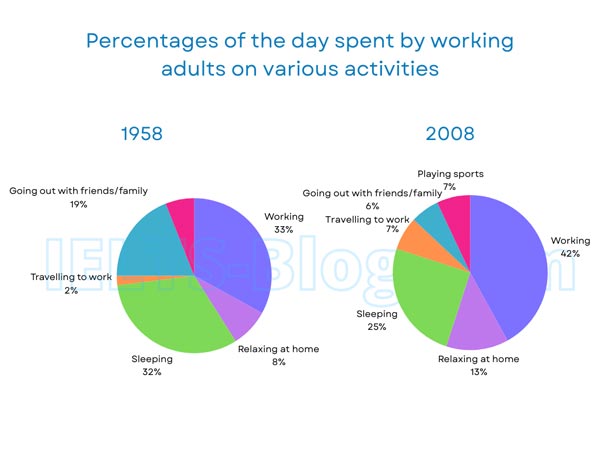
The pie charts below show how working adults in a particular country spent their time in 1958 and 2008.
Summarise the information by selecting and reporting the main features, and make comparisons where relevant.
* Note: these aren’t the original diagrams given in the test, they were recreated for the purpose of demonstration.
Student answer (Band 5.0)
PIE CHARTS ILLUSTRATES WORKING ADULTS IN A PARTICULAR COUNTRY SPENT THEIR TIME IN 1958 AND 2008
OVERALL,WORKING BEING MAJOR COMPONET IN BOTH THE YEAR IN CONTRAST TRAVELLING TO WORK IN 1958 HOLDING SMALLEST SHARE WHEREAS IN 2008 WAS GOING OUT WITH FRIENDS/FMAILY MAJOR CHANGES WAS SEEN IN SLEEPING .
IN 1958, WORKING WAS HOLDING LARGEST SHARE THAT IS 33 PERCENT WHICH ROSE TO 42 PERCENT HAVING SAME POSITION AMONG ALL, FOLLOWING SECOND PLACE HOLD BY SLEEPING WHICH DECREASE FROM 32 TO 25 PERCENTFUTHER IT WAS SEEN THAT RELAXING AT HOME HAS INCREASE BY 5 PERCENT
IN 1958 SMALLEST SHARE WAS OF TRAVELLING TO WORK BUT OVER YEARS IN 2008 GOING OUT WITH FRIENDS/FAMILY HOLD SMALLEST SHARE WHICH DECLIND BY 13 PERCENT WHICH SHOW INDIVIDUAL STRATED TRAVELLING TO WORK COMPARE TO GOING OUT WITH FRIENDS/FAMILY WHERE AS PLAYING SPORTS SHOWS SLIGHT CHANGES TO 7 PERCENT WHICH SHOWS CHANGES IN PARTTEN
AI examiner evaluation
| Criterion | Band |
|---|---|
| Task Achievement / Task Response | 5.5 |
| Coherence and Cohesion | 5.0 |
| Lexical Resource | 5.0 |
| Grammatical Range and Accuracy | 4.5 |
| Overall | 5.0 |
Task Achievement / Task Response: Band 5.5
You identify several important comparisons, including working as the largest category in both years, the rise in working from 33% to 42%, and the fall in sleeping from 32% to 25%. You also note that travelling to work was the smallest category in 1958 and going out with friends or family was smallest in 2008. However, the overview is unclear: the phrase “going out with friends/family major changes was seen in sleeping” does not clearly summarise the main shifts. Some details are inaccurate or incomplete: going out fell from 19% to 6%, a 13-percentage-point drop, while sports appears only in 2008, so it did not show “slight changes.” The response is 136 words, below the 150-word minimum; the 13 words copied from the prompt were not counted. Develop the overview and report the figures more precisely.
Coherence and Cohesion: Band 5.0
There is a basic attempt to organise the response into an opening, an overview and two detail paragraphs, and phrases such as “In 1958” and “whereas” help signal comparisons. However, progression is difficult to follow because several ideas are crowded into long, loosely connected sentences. For example, the second paragraph moves from working to sleeping and then relaxing without clear sentence boundaries, while the final paragraph combines the smallest categories, a possible explanation and sports. Linking expressions such as “following” and “whereas” are sometimes used inaccurately, and the overview does not clearly guide the reader through the main trends. Use shorter, complete sentences and group related comparisons together—for example, compare the increases in work, travel and home relaxation, then the decreases in sleep and socialising.
Lexical Resource: Band 5.0
You use some relevant chart vocabulary, including “largest share,” “smallest share,” “rose,” “decrease” and “percent,” so the reader can recognise the intended comparisons. However, the range is limited and several word choices or collocations are inaccurate, which sometimes makes the meaning hard to interpret. “Working being major componet” and “major changes was seen in sleeping” are not natural ways to describe the data, while “hold smallest share” is repeated. There are also noticeable spelling errors, including “declind,” “strated” and “partten.” Aim for precise, reusable expressions such as “accounted for,” “increased to,” “fell by,” and “the largest proportion.” Check spelling and use “percentage points” when describing the difference between two percentages.
Grammatical Range and Accuracy: Band 4.5
The response attempts some complex comparisons, for example, “which rose to 42 percent” and “whereas in 2008,” but control of sentence structure is weak. Many clauses are incomplete or joined without clear punctuation, as in “IN 1958, WORKING WAS HOLDING LARGEST SHARE THAT IS 33 PERCENT WHICH ROSE TO 42 PERCENT.” Verb forms and agreement are also frequently inaccurate: “working being,” “which decrease,” and “major changes was seen” need correction. Articles and sentence boundaries are often missing, and the all-capital presentation makes punctuation harder to read. Practise writing complete sentences with a clear subject and verb, such as “Working accounted for 33% in 1958 and rose to 42% in 2008.” Then check tense consistency and agreement.
See this exact question answered at other band scores. The same prompt compared across bands.
Browse more IELTS Writing model answers or get your own writing scored by the same AI examiner.