Band 5.0 IELTS Writing Task 1 Model Answer
Overall Band Score: 5.0 · Recent IELTS Exams (Canada & India) · 2026-11-21
IELTS Writing Task 1 question
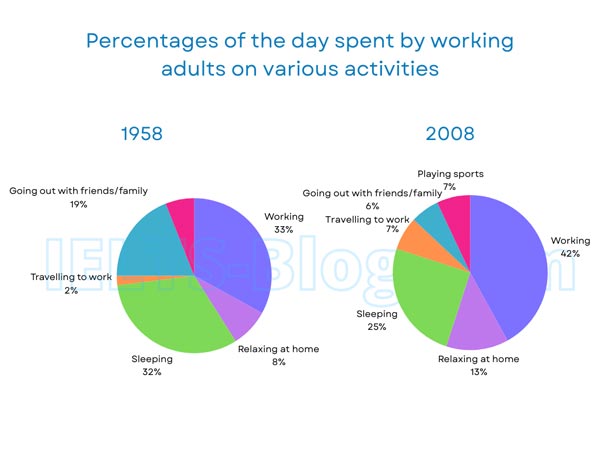
The pie charts below show how working adults in a particular country spent their time in 1958 and 2008.
Summarise the information by selecting and reporting the main features, and make comparisons where relevant.
* Note: these aren’t the original diagrams given in the test, they were recreated for the purpose of demonstration.
Student answer (Band 5.0)
The provided pie chart depicts breakdown of how working adults in a specific country spent their time in 1958 and 2008.
In 2008, adults worked almost half the fraction (42%) .While in 1958, they worked only 33% indicates that in 2008 people worked more. In 2008, adults who played support were 7%. On contrary, in 1958 adults did not played support at all. In 2008, adults who hanged out with family and friends are just 6%. Whereas in 1958, adults used to hang out more often around 19%. In 2008, adults who travelled to work were 7% whereas in 1958, the percentage of adults who travelled to work is just 2%. In year 2008, adults who used to sleep were quarter half the fraction (25%).In contrast , who adults used to sleep are more in 1958 around 32%. In 2008, adults who used to relax at home are 13% whereas adults who relaxed at home in 1958 are 8%.
AI examiner evaluation
| Criterion | Band |
|---|---|
| Task Achievement / Task Response | 5.0 |
| Coherence and Cohesion | 4.5 |
| Lexical Resource | 5.0 |
| Grammatical Range and Accuracy | 5.0 |
| Overall | 5.0 |
Task Achievement / Task Response: Band 5.0
You report several relevant figures accurately, including working (33% to 42%), sleeping (32% to 25%), and travel to work (2% to 7%). However, the response mainly lists individual categories rather than selecting and summarising the main features. It lacks a clear overview of the broad changes—for example, work became the largest share, while time spent with friends and family fell markedly. The statement that adults “did not played support at all” in 1958 is not supported by the chart: sports is shown only for 2008, so its earlier share should not be asserted as zero. A clearer overview and more careful treatment of the categories would make the report more complete and developed.
Coherence and Cohesion: Band 4.5
The response follows a generally understandable order, comparing 2008 with 1958 for each activity, and linking expressions such as “whereas” and “In contrast” help signal comparisons. However, the writing is presented as one long paragraph, with no distinct overview or grouping of the main changes. Repeated openings such as “In 2008, adults…” make the progression feel like a list, and some links are awkward or unclear, as in “In contrast, who adults used to sleep are more in 1958.” Organise the report into an introduction, an overview, and one or two comparison paragraphs. Group related increases and decreases rather than treating every category in the same repetitive pattern.
Lexical Resource: Band 5.0
You use relevant topic vocabulary, including “worked,” “travelled to work,” “relax at home,” and “percentage,” so the reader can identify the activities being compared. However, the range is limited and several choices are inaccurate or unnatural. “Played support” appears to be a mistaken form for “played sports,” while “hanged out” is not the appropriate expression here; use “spent time with friends and family” or “socialised.” Phrases such as “almost half the fraction” and “quarter half the fraction” are confusing and do not describe proportions naturally. Aim for precise chart language such as “accounted for,” “rose to,” and “fell to,” and check word forms and spelling before submitting.
Grammatical Range and Accuracy: Band 5.0
You attempt to connect comparisons in longer sentences, for example, “In 2008… whereas in 1958…,” but control is inconsistent, and many sentences contain errors that make the reader pause. Examples include “people worked more” following “33% indicates,” “adults did not played,” and the incomplete construction “In contrast, who adults used to sleep are more.” There are also problems with sentence boundaries and punctuation, such as the full stop before “While” and missing spaces after punctuation. Practise forming complete comparison sentences with consistent past-tense reporting: “The proportion working rose from 33% in 1958 to 42% in 2008.” Vary sentence patterns only after these basic structures are reliable.
See this exact question answered at other band scores. The same prompt compared across bands.
Browse more IELTS Writing model answers or get your own writing scored by the same AI examiner.