Band 5.5 IELTS Writing Task 1 Model Answer
Overall Band Score: 5.5 · Recent IELTS Exams (Canada & India) · 2026-11-23
IELTS Writing Task 1 question
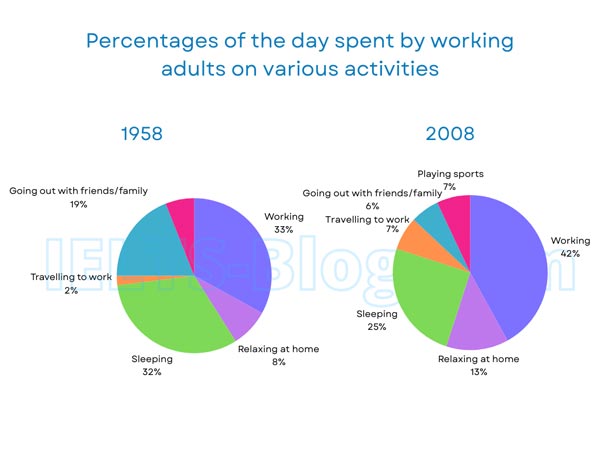
The pie charts below show how working adults in a particular country spent their time in 1958 and 2008.
Summarise the information by selecting and reporting the main features, and make comparisons where relevant.
* Note: these aren’t the original diagrams given in the test, they were recreated for the purpose of demonstration.
Student answer (Band 5.5)
The pie charts compares the proportion of time spent by working peples in a country in 1958 and 2008.
Overall, time spent on working was the highest share in both years whereas travelling to work was the lowest share, later on sports joined it. Time spent with family and friends fell significantly.
In 1958, the highest proportion of time spent by adults are on working at 33%, which rose to 42 % in 2008. While the lowest proportion of time was spent on travelling at 2% in 1958, which climbed at 7 % in 2008,sharing the same proporion with sports. Relaxing at home grew from 8% in 1958 t
AI examiner evaluation
| Criterion | Band |
|---|---|
| Task Achievement / Task Response | 5.0 |
| Coherence and Cohesion | 5.5 |
| Lexical Resource | 5.5 |
| Grammatical Range and Accuracy | 5.5 |
| Overall | 5.5 |
Task Achievement / Task Response: Band 5.0
You identify several important features accurately: working is the largest category in both years, its share rises from 33% to 42%, and travel increases from 2% to 7%. You also note the substantial fall in time spent with friends and family. However, the response is incomplete: it stops mid-sentence at “grew from 8% in 1958 t” and does not report the 2008 figure for relaxing, the change in sleeping, or the 2008 sports figure beyond the brief overview. The overview also calls travel the lowest share in 2008, although sports shares that 7% figure. The required minimum length is not met, which contributes to the limited and under-developed coverage. Complete the comparison and include the main changes across all categories.
Coherence and Cohesion: Band 5.5
The response has a recognisable structure: an introduction, an overview, and a paragraph beginning to compare the figures. This gives the reader a basic route through the information, and phrases such as “Overall” and “In 1958” help signal the stages of the description. However, the final paragraph ends abruptly, so the comparison has no clear conclusion or complete progression. Some linking is also awkward: “While the lowest proportion … at 2% in 1958, which climbed…” leaves the relationship between the clauses unclear. Develop the body into complete, logically grouped comparisons—for example, rising categories together and falling categories together—and use connectors only where their relationships are clear.
Lexical Resource: Band 5.5
You use relevant chart vocabulary, including “proportion,” “share,” “rose,” “climbed,” and “fell significantly,” which helps communicate the main trends. There is some repetition of “time spent” and “proportion,” and a few inaccurate or misspelled forms reduce precision, such as “peples” and “proporion.” The phrase “time spent with family and friends” is understandable, though the chart category is more precisely “going out with friends/family”; “later on sports joined it” is also an imprecise way to describe the 2008 category. Aim for accurate, consistent category labels and a wider range of comparison language, such as “accounted for,” “declined,” and “remained equal to.”
Grammatical Range and Accuracy: Band 5.5
You attempt both simple statements and more complex comparisons, as in “While the lowest proportion … at 2% in 1958, which climbed…”. However, control is uneven. The opening has a subject–verb agreement error (“charts compares”), and “the highest proportion … are on working” has an incorrect verb form and construction. The “While” clause is not smoothly integrated with the following clause, and the final sentence is incomplete, ending with “t”. These issues make parts of the response difficult to follow. Use complete sentences with a clear subject and verb, check agreement and tense, and punctuate comparisons so that each clause has a clear grammatical relationship.
See this exact question answered at other band scores. The same prompt compared across bands.
Browse more IELTS Writing model answers or get your own writing scored by the same AI examiner.