Band 5.5 IELTS Writing Task 1 Model Answer
Overall Band Score: 5.5 · Recent IELTS Exams (Canada & India) · 2026-11-24
IELTS Writing Task 1 question
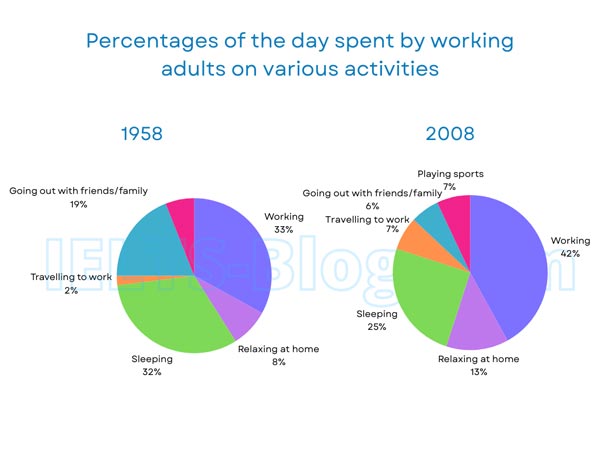
The pie charts below show how working adults in a particular country spent their time in 1958 and 2008.
Summarise the information by selecting and reporting the main features, and make comparisons where relevant.
* Note: these aren’t the original diagrams given in the test, they were recreated for the purpose of demonstration.
Student answer (Band 5.5)
The pie chart illustrates the proportion of working adults in a particular country spent their time in 1958 and 2008.
From and overall perspective it is quite evedent that working having the largest share of time spending while travelling to the work acceunted for the smallest protion.
In year 1958 working has higgest spenting by 33% and the secound higgest is sleeping that take 32% of time but going with friends/family take only 19% of the time,However in 2008 working persentage increce by 9% and goes to 42% while sleeping decline and reached 25%,going out with friends/family also get littledecline and goes to 6%.
Meanwhie,the rest of time spent like realaxing at home have 8% in 958 and goes to 13% in 2008.however,paling sports remanis same in both years at 7% but travelling to work time increas and goes 2% to 7% by 2008.
AI examiner evaluation
| Criterion | Band |
|---|---|
| Task Achievement / Task Response | 5.5 |
| Coherence and Cohesion | 5.5 |
| Lexical Resource | 5.0 |
| Grammatical Range and Accuracy | 5.0 |
| Overall | 5.5 |
Task Achievement / Task Response: Band 5.5
You identify the main contrast that work takes the largest share and commuting the smallest in 1958, and you report several accurate changes: work rises from 33% to 42%, sleep falls from 32% to 25%, and socialising drops from 19% to 6%. However, the overview is incomplete: commuting is not the smallest category in 2008, and sports is omitted from the overview despite appearing only in that year. The account also leaves out the 2008 sports figure and does not clearly compare all categories. The response is 131 words, below the required 150; the 13 words copied from the prompt were not counted. Develop the overview and include the key figures for every activity to address the task more fully.
Coherence and Cohesion: Band 5.5
The response has a basic overall structure: an introduction, a general statement, and paragraphs comparing the two years. The contrastive link “However” helps signal changes between 1958 and 2008, and “Meanwhile” introduces the remaining activities. However, progression is not consistently clear because several comparisons are crowded into long sentences, with weak or missing punctuation—for example, “time,However in 2008…” and “25%,going out…”. The final paragraph also combines relaxing, sports and commuting without a clear organising principle, and the reference to sports being the same in both years is confusing because it is listed only for 2008. Use separate, clearly punctuated comparisons and organise the categories by increases and decreases.
Lexical Resource: Band 5.0
You use some relevant task vocabulary, including “proportion,” “largest share,” “decline,” and “increas[e],” so the reader can generally understand the comparisons. However, the range is limited and several inaccurate spellings or word choices make the report less clear, such as “evedent,” “higgest,” “spenting,” and “littledecline.” Some phrases are also unnatural for chart description: “working having the largest share of time spending” and “sleeping that take 32%.” Aim for precise, conventional expressions such as “accounted for,” “rose to,” and “fell to,” and check spelling carefully. More accurate collocations and a wider range of comparison language would make the description clearer and more appropriate to an academic report.
Grammatical Range and Accuracy: Band 5.0
You attempt to connect ideas in longer sentences using “while,” “but,” and “however,” but control is inconsistent, and many clauses lack a complete or correctly formed structure. For example, “working having the largest share” needs a finite verb, while “working has higgest spending by 33%” does not express the comparison grammatically. Tense and agreement are also unreliable in “sleeping that take 32%” and “working persentage increce.” Punctuation errors, especially missing spaces after commas and full stops, further interrupt reading. Practise accurate simple comparison patterns first—“Work accounted for 33% in 1958 and rose to 42% in 2008”—then combine them with subordinate clauses. This will improve accuracy while retaining sentence variety.
See this exact question answered at other band scores. The same prompt compared across bands.
Browse more IELTS Writing model answers or get your own writing scored by the same AI examiner.