Band 6.0 IELTS Writing Task 1 Model Answer
Overall Band Score: 6.0 · Recent IELTS Exams (Canada & India) · 2026-11-25
IELTS Writing Task 1 question
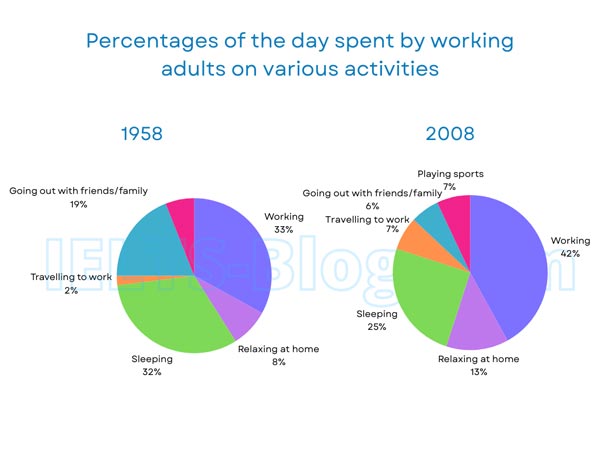
The pie charts below show how working adults in a particular country spent their time in 1958 and 2008.
Summarise the information by selecting and reporting the main features, and make comparisons where relevant.
* Note: these aren’t the original diagrams given in the test, they were recreated for the purpose of demonstration.
Student answer (Band 6.0)
The given pie chart demonstrates the percentage of time spent by employed adults in different activities of a certain country in two different years ten years apart from each other.
Overall, working covers majority of their total time while sleeping remains as the second most time consumed activity. On the other hand, the percentage of time spent playing remained the same during both the years.
Firstly, during 1958, the maximum time was spent on working being 33% followed by sleeping at 32%. Likewise, 19% of time was used to go out with family and friends and only 2% time was spent travelling to work.
Finally, in 2008, 42% of the time was spent working and less time was allocated for sleeping being 25% compared to the year 1958 the year. The adults also spent 13% of their time relaxing at home and spent only 6% time going out with family and friends. The time spent travelling to work anf playing sport were same at 7%.
AI examiner evaluation
| Criterion | Band |
|---|---|
| Task Achievement / Task Response | 6.0 |
| Coherence and Cohesion | 6.0 |
| Lexical Resource | 6.0 |
| Grammatical Range and Accuracy | 6.0 |
| Overall | 6.0 |
Task Achievement / Task Response: Band 6.0
You identify several important figures accurately, including working at 33% in 1958 and 42% in 2008, sleeping at 32% and 25%, and travel at 2% and 7%. You also note the sharp fall in going out, from 19% to 6%, and the 2008 figures for relaxing and sport. However, the overview contains a significant misreading: playing sport is shown only in 2008, at 7%, so it cannot be said to have remained the same in both years. The overview also says sleeping is the second-largest activity, although going out ranks above it in 1958. To strengthen the response, make the overall comparisons accurate and include the rise in relaxing at home as a key change.
Coherence and Cohesion: Band 6.0
The response has a clear overall arrangement: an introduction, an overview, and separate descriptions of the two years. This makes the information easy to follow, and sequencing expressions such as “Firstly” and “Finally” help signal the shift between years. However, the organisation is somewhat mechanical, and the overview’s claim about playing being unchanged does not connect logically with the later statement that sport is 7% in 2008. The phrase “compared to the year 1958 the year” also interrupts the flow, while the final sentence combines two separate comparisons. Grouping the main increases and decreases across both years would create a more coherent progression and make comparisons clearer.
Lexical Resource: Band 6.0
You use an adequate range of task-related vocabulary, including “percentage,” “allocated,” “relaxing at home,” and “travelling to work,” so the chart’s activities are generally clear. There are also attempts at more formal phrasing, such as “the maximum time was spent on working.” Some word choices and collocations are less natural, however: “covers majority of their total time” and “second most time consumed activity” are awkward, and “time was used to go out” is imprecise. The spelling slip “anf” and the singular “sport” in “playing sport” also reduce accuracy. Aim for concise, conventional chart language such as “accounted for,” “the largest share,” and “spending time socialising.”
Grammatical Range and Accuracy: Band 6.0
You use a mix of simple and more complex forms, including the opening sentence with “while” and comparisons such as “less time was allocated for sleeping.” Most of the meaning remains understandable, but some grammatical errors and awkward constructions are present. For example, “covers majority” needs an article (“covers the majority”), and “followed by sleeping at 32%” would be clearer as “followed by sleeping, at 32%.” The phrase “compared to the year 1958 the year” is incomplete and needs restructuring, while “only 6% time” requires “only 6% of the time.” Check articles, prepositions, and sentence boundaries, and vary the sentence patterns while keeping comparisons grammatically complete.
See this exact question answered at other band scores. The same prompt compared across bands.
Browse more IELTS Writing model answers or get your own writing scored by the same AI examiner.