Band 5.5 IELTS Writing Task 1 Model Answer
Overall Band Score: 5.5 · Recent IELTS Exams (Canada & India) · 2026-11-26
IELTS Writing Task 1 question
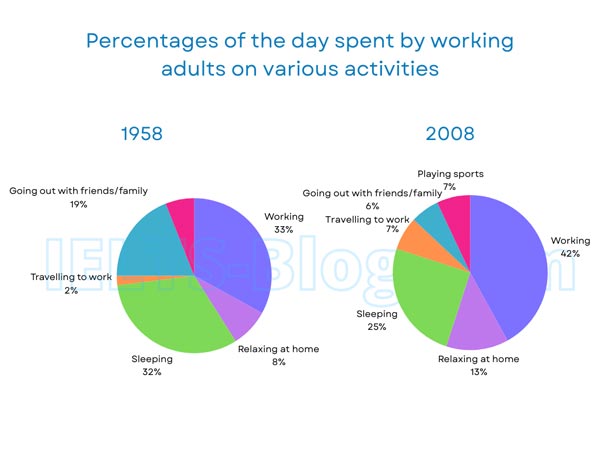
The pie charts below show how working adults in a particular country spent their time in 1958 and 2008.
Summarise the information by selecting and reporting the main features, and make comparisons where relevant.
* Note: these aren’t the original diagrams given in the test, they were recreated for the purpose of demonstration.
Student answer (Band 5.5)
The pie chart illustrates how working adults in a particular country spent their time in 1958 and 2008.
Overall, adults spent their most of the time in work in both years. Sleeping accounts the second largest proportion, which is more that half the wokring while, travelling to work and playing sportrs represents less than half the sleeping and working, which making them considerably greater than the other acticivities.
In 2008, adults spent less times as percentage only 6% in going out with family/friends compare to 1958, where it was 19%, making it noticable change while, they spent more time in traveling to work and relaxing at home in 2008 compare to 1958.
Sleeping and wokring proportion difference was only 1 percetage points in 1958, while its change significiantly in 2008 and became 17%.
Together, sleeping and wokring shares 65 percetage of total proportion in 1958 in other hand 67% in 2008. As the pie chart didn't provide any proportion of playing sports times in 1958 so we can't compare that with 2008 playing sports times.
AI examiner evaluation
| Criterion | Band |
|---|---|
| Task Achievement / Task Response | 5.5 |
| Coherence and Cohesion | 5.5 |
| Lexical Resource | 5.0 |
| Grammatical Range and Accuracy | 5.0 |
| Overall | 5.5 |
Task Achievement / Task Response: Band 5.5
You identify the main comparison that working takes the largest share in both years, and you include several relevant figures, such as the combined sleeping-and-working shares of 65% and 67%. However, the overview is partly inaccurate: sleeping is not the second-largest category in 2008, as relaxing at home (13%) exceeds sleeping (25%)? In fact, sleeping remains second at 25%, while relaxing is 13%; the more important issue is that the overview’s claim about travelling and sports being less than half of sleeping and working is unclear and does not capture the main changes. You report the fall in socialising and rises in commuting and relaxing, but omit the substantial rise in working and the introduction of sports in 2008. Select and compare the key changes more clearly, with accurate wording.
Coherence and Cohesion: Band 5.5
The response has a recognisable structure: an introduction, an overview, and paragraphs containing comparisons and combined figures. This gives the reader some organisation, and the final paragraph adds a relevant comparison. However, progression is not consistently clear because several ideas are crowded into long, awkward sentences. For example, the overview joins claims about sleeping, commuting and sports with “while” and “which,” making the relationships difficult to follow. The paragraph beginning “In 2008” also combines the fall in going out with increases in two other activities without clearly separating the comparisons. Use one main point per sentence, group the largest changes together, and use linking expressions only where the relationship is clear.
Lexical Resource: Band 5.0
You use some task-relevant vocabulary, including “proportion,” “percentage points,” “accounts,” and “compare,” and you attempt to describe change with “significantly.” However, the range and control are limited, and repeated or inaccurate wording sometimes makes the meaning difficult to understand. Examples include “spent less times as percentage,” “noticable change,” and “represents less than half the sleeping and working.” There are also frequent spelling errors, such as “wokring,” “sportrs,” “acticivities,” and “percetage,” which reduce clarity and precision. Practise accurate forms of common chart language and use natural collocations, such as “the proportion spent on” and “rose from … to …,” rather than assembling phrases word by word.
Grammatical Range and Accuracy: Band 5.0
You attempt both simple statements and more complex comparisons, including a sentence contrasting the difference between sleeping and working across the two years. However, complex structures are often faulty, and errors occur frequently enough to make some sentences hard to interpret. For instance, “Sleeping accounts the second largest proportion” lacks the required preposition and has an inconsistent tense, while “which making them” is not a complete grammatical construction. In “Together, sleeping and wokring shares,” the plural subject requires a plural verb. Articles, verb forms and sentence boundaries also need attention. Build accuracy with shorter comparison sentences first, then combine them using correctly formed clauses such as “whereas” or “while.”
See this exact question answered at other band scores. The same prompt compared across bands.
Browse more IELTS Writing model answers or get your own writing scored by the same AI examiner.