Band 6.0 IELTS Writing Task 1 Model Answer
Overall Band Score: 6.0 · IELTS Predictions Nov 2026 · 2026-11-09
IELTS Writing Task 1 question
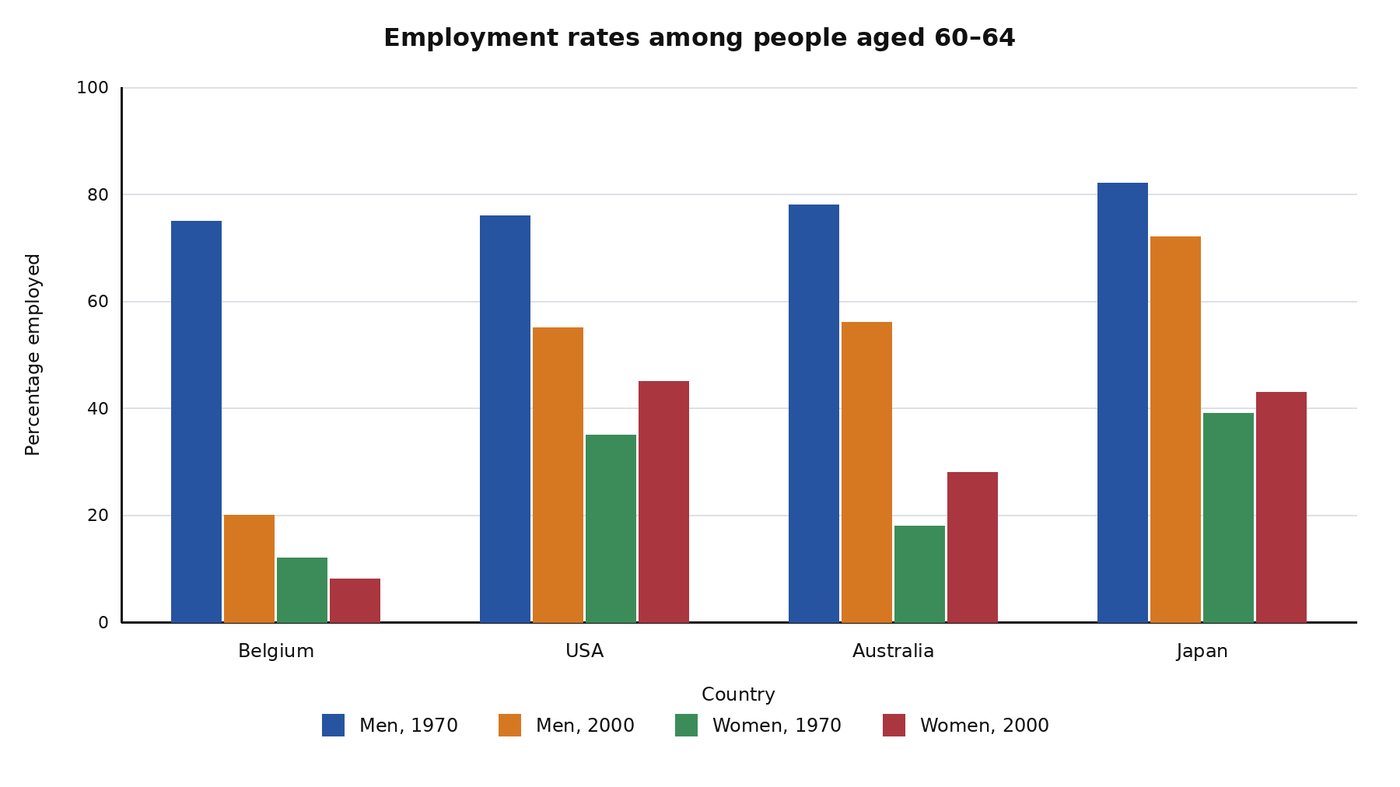
The bar chart below compares the percentages of men and women aged 60–64 who were employed in Belgium, the USA, Australia and Japan in 1970 and 2000.
Summarise the information by selecting and reporting the main features, and make comparisons where relevant.
Student answer (Band 6.0)
The bar illustrates the proportion of employed aged(60-64) men and women in four different countries between 1970 and 2000.
Overall, Initially men accounted for the largest number in all four countries and the number decreased over the time,while the women listed as lowest number at first and rose over time except Belgium.
In belgium, almost 75% men were employed in 1970 where the USA employment rate for the men started at almost 78%,in Belgium the number of men employee fell to nearly 20% in 2000 whereas the number of USA men employee fell yet the rate was nearly triple from the Belgium employment. Australia showed a similar trend the number began at approximately 79% in 1970 and decreased to about 58% in 2000. Japan experienced a little fall from all countries from nearly 82% in 1970 to 72% in 2000.
For the female employee,The USA, Australia and japan experienced rise in women employment.Nearly 38 to 45%, 18 to 30% and 38 to 43% from 1970 to 2000 respectedly.The number for Belgium accounted for less than 20% in 1970 and decreased to less than 10% in 2000.
AI examiner evaluation
| Criterion | Band |
|---|---|
| Task Achievement / Task Response | 6.5 |
| Coherence and Cohesion | 6.5 |
| Lexical Resource | 5.5 |
| Grammatical Range and Accuracy | 5.0 |
| Overall | 6.0 |
Task Achievement / Task Response: Band 6.5
You identify the main overall pattern: men’s employment was higher than women’s in every country, and women’s rates rose everywhere except Belgium. You also report several useful figures, including Japan’s decline from about 82% to 72% and Belgium’s fall to around 20% for men. This covers the task well, though some comparisons are less fully or accurately developed. For example, the USA men’s rate began at about 76%, not 78%, and the women’s figures for Australia and Japan are slightly overstated, though the broad trends are correct. The overview’s phrase “largest number” is also imprecise for percentages. To strengthen the response, compare the countries more directly and distinguish clearly between the highest and lowest rates rather than relying mainly on separate descriptions.
Coherence and Cohesion: Band 6.5
The response has a clear overall structure: an introduction, an overview, a paragraph about men, and a final paragraph about women. This makes the main progression easy to follow, and the country-by-country details are generally grouped sensibly. However, some linking and referencing are awkward or mechanical. The long sentence beginning “In belgium” joins several comparisons with commas, making the relationship between Belgium and the USA harder to track. “For the female employee” also does not connect smoothly to the preceding paragraph, and “respectedly” does not clearly signal the order of the figures. The overview’s opening “Overall, Initially” contains competing transitions. Use shorter comparison sentences and clearer links such as “By contrast” or “Meanwhile” to make the progression more fluent.
Lexical Resource: Band 5.5
You use a reasonable range of task-related vocabulary, including “proportion,” “employment rate,” “decreased,” and “experienced a rise,” so the reader can understand the main trends. However, several word choices and collocations are imprecise or unnatural, which limits clarity and flexibility. “The largest number” and “lowest number” should refer to rates or percentages, while “men employee” and “female employee” are not natural ways to describe the groups. “The women listed as lowest” is also unclear, and “respectedly” is an incorrect form where “respectively” is needed. There are spelling and capitalisation slips in “belgium” and “japan.” Aim for consistent, accurate terms such as “employment rate,” “male workers,” and “female workers,” and check spelling before finishing.
Grammatical Range and Accuracy: Band 5.0
You attempt both simple and more complex sentence forms, including comparisons across countries and time periods. The meaning is usually recoverable, but grammatical control is uneven, and errors sometimes make relationships between figures difficult to follow. For example, “the women listed as lowest number at first” lacks a clear verb structure, while “the number of men employee fell” has problems with noun form and agreement. The sentence beginning “In belgium” is a run-on, with several clauses joined only by commas. There are also punctuation and spacing problems, such as “time,while” and “For the female employee,The.” Use complete, shorter sentences, check subject–verb agreement and articles, and punctuate clauses carefully. This would make your comparisons much easier to read.
See this exact question answered at other band scores. The same prompt compared across bands.
Browse more IELTS Writing model answers or get your own writing scored by the same AI examiner.