Band 5.0 IELTS Writing Task 1 Model Answer
Overall Band Score: 5.0 · IELTS Predictions Nov 2026 · 2026-11-11
IELTS Writing Task 1 question
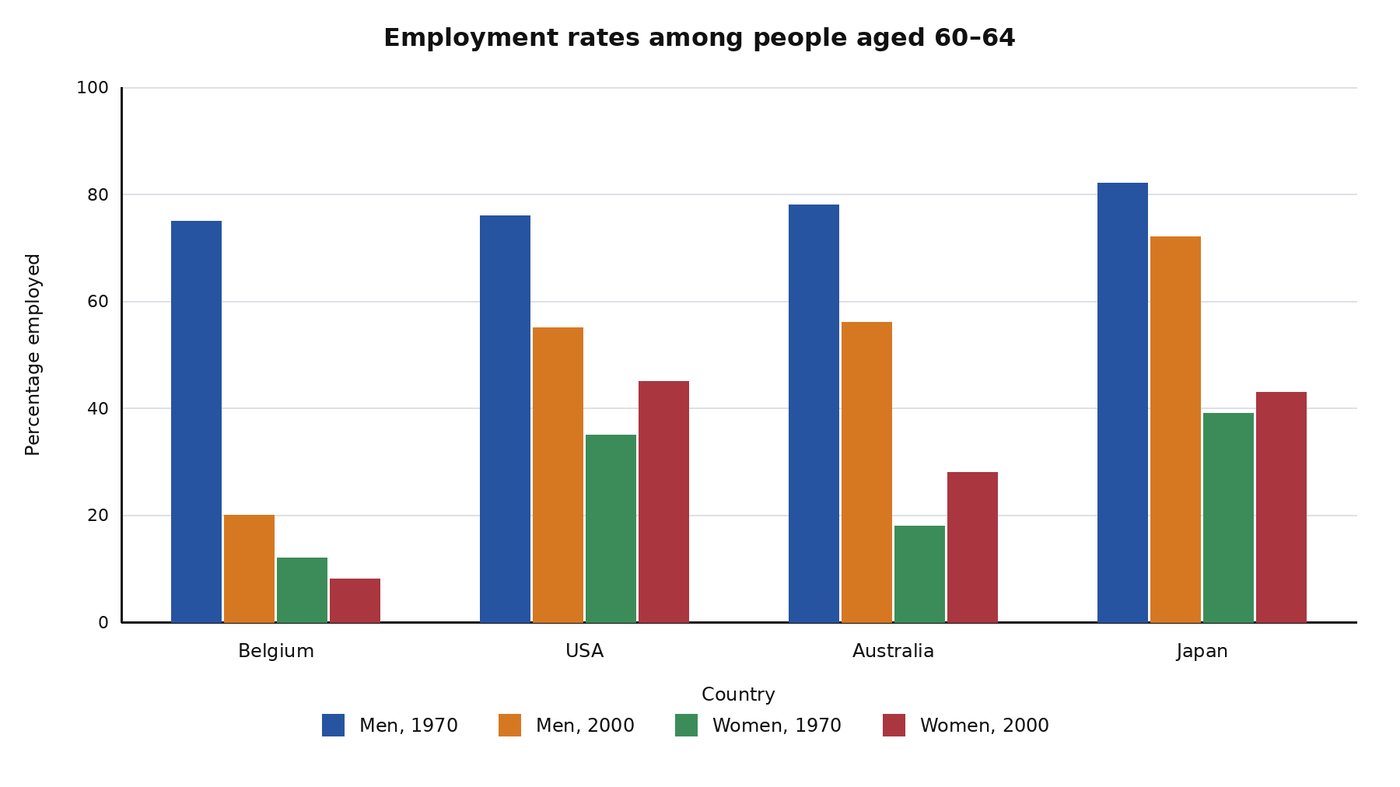
The bar chart below compares the percentages of men and women aged 60–64 who were employed in Belgium, the USA, Australia and Japan in 1970 and 2000.
Summarise the information by selecting and reporting the main features, and make comparisons where relevant.
Student answer (Band 5.0)
The bar chart compares the proportion of men and women employment rates among people aged 60-64 accross four different coutries, namely Belgium, USA, Australia and Japan between 1970 and 2000.
Overall, it is clear that Japan showed the highest proportion of employment rates among people, while Belgium had lowest rate of proportion, in both years. Meanwhile, women emplyment rates contributed lower as compared to men in all countries.
To begin with Japan, it had the highest proportion of emplyeed men and women about 82% and
AI examiner evaluation
| Criterion | Band |
|---|---|
| Task Achievement / Task Response | 3.5 |
| Coherence and Cohesion | 5.0 |
| Lexical Resource | 5.5 |
| Grammatical Range and Accuracy | 5.5 |
| Overall | 5.0 |
Task Achievement / Task Response: Band 3.5
The response identifies the chart’s subject and gives a relevant overview: Japan is described as having the highest employment and Belgium the lowest, while women’s rates are said to be below men’s. However, the report is very incomplete and does not develop these observations with meaningful comparisons across the four countries or both years. It begins to mention Japan’s figures, but the sentence ends after “about 82% and”, leaving the comparison unfinished; most of the chart is therefore not reported. The response also contains only 85 words, below the required 150. To improve, complete the account with selected figures and key changes, such as the sharp fall in men’s employment in Belgium and the general rise in women’s rates outside Belgium.
Coherence and Cohesion: Band 5.0
There is a basic organisational framework: an introduction is followed by an overview and the start of a detail paragraph, with “Overall” and “To begin with” signalling the stages. This gives the reader some sense of how the report is intended to proceed. However, the response stops mid-sentence, so there is no completed progression through the data and no concluding detail. The overview’s claims are not followed by supporting comparisons, and the final “and” leaves the relationship between the two Japanese figures unresolved. Develop a clear sequence—for example, compare men’s figures first, then women’s—and use linking phrases to connect specific comparisons rather than relying mainly on paragraph-opening markers.
Lexical Resource: Band 5.5
The response uses some relevant chart vocabulary, including “proportion,” “employment rates,” “highest,” and “lowest,” and the country names make the topic clear. However, word choice and collocation are often awkward or repetitive: “proportion of men and women employment rates” is not a natural phrase, and “women employment rates contributed lower” does not clearly express the intended comparison. There are also noticeable spelling errors, including “accross,” “coutries,” “emplyment,” and “emplyeed.” These issues reduce precision, although the general subject remains understandable. Use concise, standard expressions such as “employment rate among men” and “women’s rate was lower,” and check spelling carefully before finishing.
Grammatical Range and Accuracy: Band 5.5
The response attempts a mix of sentence forms, including the introductory clause “The bar chart compares…” and the overview beginning “Overall, it is clear that…”. Most of the intended meaning can be followed, but grammatical control is uneven. In “the proportion of men and women employment rates,” the noun relationship is not formed correctly; “women emplyment rates contributed lower as compared to men” also lacks a clear grammatical construction. The final sentence is incomplete: “about 82% and” has no second figure or completed clause. Aim for direct, complete comparisons, such as “In Japan, 82% of men were employed in 1970, compared with 72% in 2000.” Proofread for sentence completion and consistent, accurate structures.
See this exact question answered at other band scores. The same prompt compared across bands.
Browse more IELTS Writing model answers or get your own writing scored by the same AI examiner.