Band 4.0 IELTS Writing Task 1 Model Answer
Overall Band Score: 4.0 · IELTS Predictions Nov 2026 · 2026-11-11
IELTS Writing Task 1 question
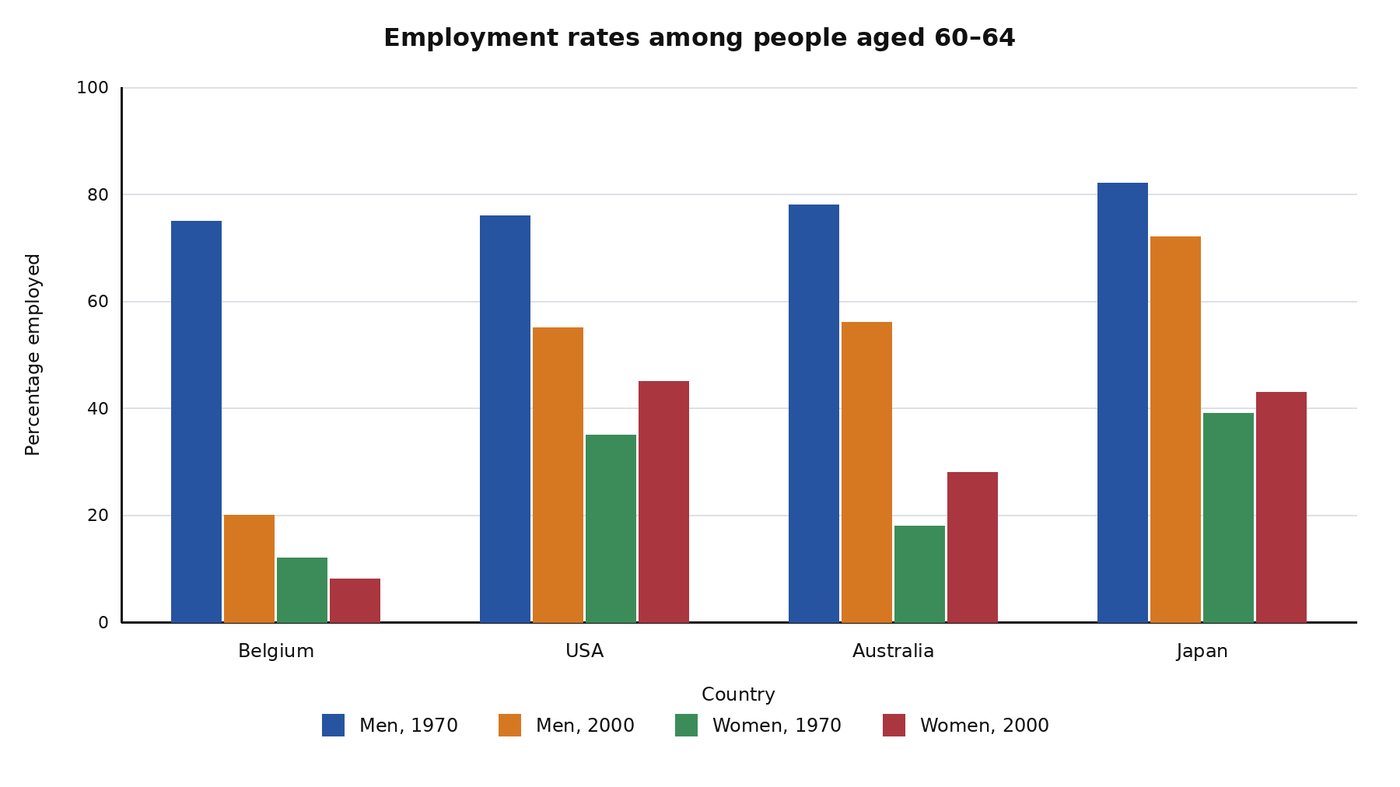
The bar chart below compares the percentages of men and women aged 60–64 who were employed in Belgium, the USA, Australia and Japan in 1970 and 2000.
Summarise the information by selecting and reporting the main features, and make comparisons where relevant.
Student answer (Band 4.0)
The bar chart compares the proportion of men and women of age group 60-64 employed in four distinct countries- Belgium, the USA, Australia and Japan in 1970 and 2000.
Overall, it os noticeable that the USA women accounted for large share in employment, whereas men in Belgium shows least employment rates initially accounted for the largest share.
In 1970, Belgium men are at highest rate of employment which was 75%, compared to 82% from Japan. Belgium employment
AI examiner evaluation
| Criterion | Band |
|---|---|
| Task Achievement / Task Response | 3.0 |
| Coherence and Cohesion | 3.5 |
| Lexical Resource | 5.5 |
| Grammatical Range and Accuracy | 4.5 |
| Overall | 4.0 |
Task Achievement / Task Response: Band 3.0
The opening identifies the chart’s subject and all four countries, and you attempt an overview. However, the overview is unclear and partly inaccurate: Belgium’s men had the lowest rate in 2000, not initially, while Japan had the highest male rate in 1970. The claim that US women accounted for a large share is not supported as a main overall feature without comparison; Japan had the highest female rate in both years. The response stops mid-sentence at “Belgium employment” and reports almost none of the chart’s key comparisons or changes. It is also 83 words below the required minimum, which leaves the task substantially incomplete. To improve, give a clear overview and compare the main figures and trends for both sexes across the two years.
Coherence and Cohesion: Band 3.5
There is a basic attempt to organise the response: an introductory sentence is followed by an overview and then a detail paragraph beginning “In 1970”. This gives the reader some sense of the intended progression. However, the response is too short and ends abruptly, so the information is not developed into a coherent account. The overview’s comparison is difficult to follow, particularly “men in Belgium shows least employment rates initially accounted for the largest share,” and the final fragment does not complete its point. Use separate, purposeful paragraphs for the overview and the main comparisons, and connect figures with clear contrasts such as “whereas” or “by comparison.”
Lexical Resource: Band 5.5
You use relevant chart vocabulary, including “proportion,” “employed,” “employment rates,” and “compared to,” and the country names are clear. This gives you a useful foundation for describing statistical information. However, some word combinations are imprecise or unnatural, such as “of age group 60-64,” “large share in employment,” and “at highest rate of employment.” The phrase “distinct countries” is also less suitable than a straightforward term such as “four countries.” Aim for accurate collocations used in chart descriptions, including “the employment rate among men,” “accounted for the highest proportion,” and “stood at.” Check spelling as well: “noticeable” is misspelled in the overview.
Grammatical Range and Accuracy: Band 4.5
The response includes both a simple opening sentence and a more complex overview beginning with “Overall,” so there is some attempt to vary sentence structure. Meaning is generally recoverable, but grammatical control is inconsistent. For example, “men in Belgium shows” has a subject–verb agreement error, and “Belgium men are at highest rate” has problems with article use and sentence construction. The comparison “which was 75%, compared to 82% from Japan” is also awkwardly formed, and the final sentence is incomplete. Practise building complete comparison sentences with accurate tense and agreement, for example, “The rate for Belgian men stood at 75%, compared with 82% in Japan.”
See this exact question answered at other band scores. The same prompt compared across bands.
Browse more IELTS Writing model answers or get your own writing scored by the same AI examiner.