Band 4.5 IELTS Writing Task 1 Model Answer
Overall Band Score: 4.5 · IELTS Predictions Nov 2026 · 2026-11-11
IELTS Writing Task 1 question
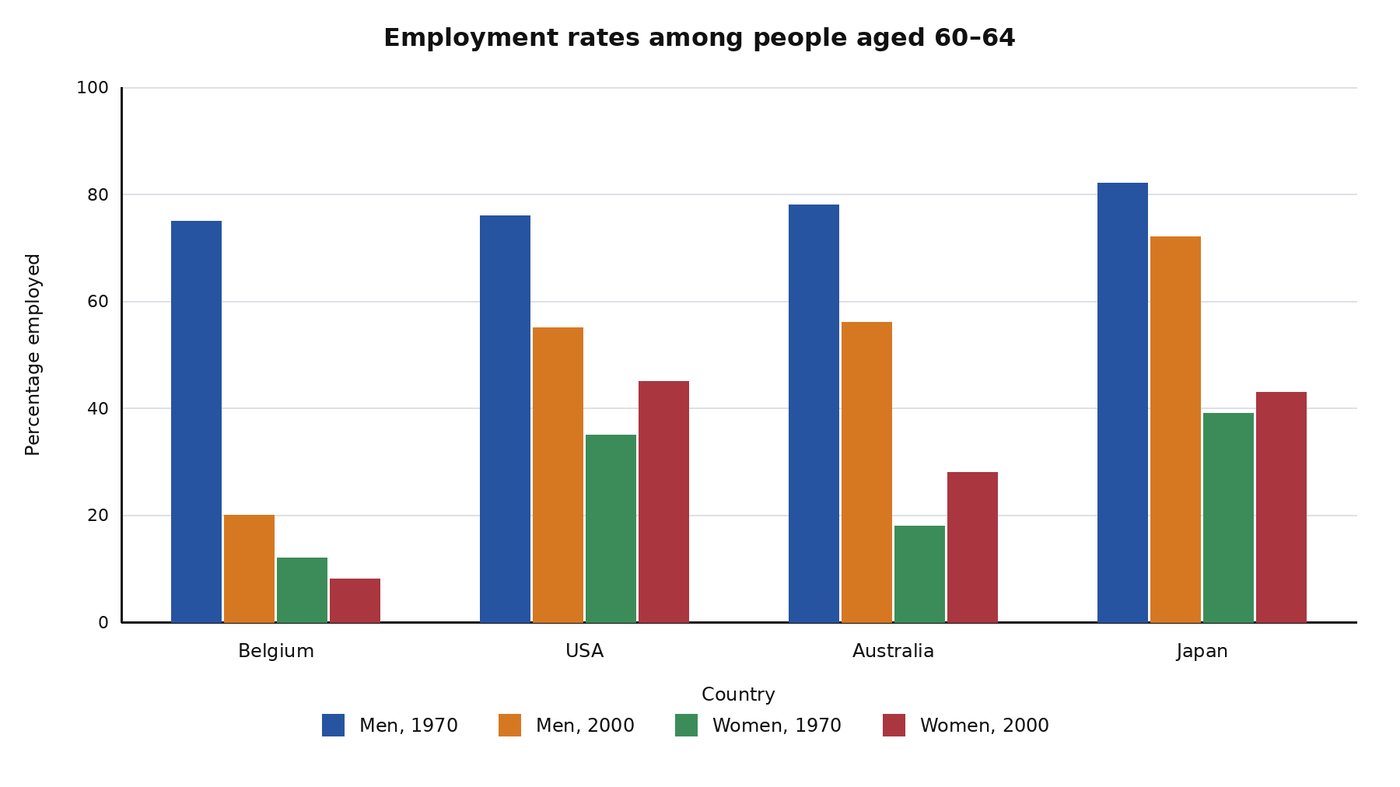
The bar chart below compares the percentages of men and women aged 60–64 who were employed in Belgium, the USA, Australia and Japan in 1970 and 2000.
Summarise the information by selecting and reporting the main features, and make comparisons where relevant.
Student answer (Band 4.5)
The bar chart compares the proportion of men and women in the age group 60-64 employed in four distinct countries: Beligum, the USA, Australia and Japan between 1970 and 2000.
Overall, it is noticeable that the men from all four countries had witnessed highest rate employement. Furthermore, while Beligan men accounted for the largest rate of employment in 1970 it eventually fall in 2000, whereas beligan women are least employed. Japan showed highest rate of employment in both.
In 1970, Japan empoyment was 81%, which dipped to 72% in 2000, whereas women are intially at 40% which rose steadily to peak temporarily at 43% in 2000. Belgium experienced interrupted rate throughout the period beligan women rate of employment was around 10% which declined to 5% in 2000.
The USA, rate of employment men was
AI examiner evaluation
| Criterion | Band |
|---|---|
| Task Achievement / Task Response | 3.5 |
| Coherence and Cohesion | 4.0 |
| Lexical Resource | 5.0 |
| Grammatical Range and Accuracy | 5.0 |
| Overall | 4.5 |
Task Achievement / Task Response: Band 3.5
You identify the chart’s subject and give an overview that notes Japan’s high employment and the very low figures for Belgian women. However, the account is substantially incomplete: the USA and Australia are barely covered, and the final sentence about US men stops before giving any information. Some details are also inaccurate: Belgian men were not the highest in 1970 (Japan was), and Belgian women fell from about 12% to 8%, rather than from around 10% to 5%. The overview’s claim that Japan had the highest rate in both years is too broad, since this is true for men but not women in 1970. The response also falls 16 words short of the required minimum. Include the main comparisons for all four countries and both years, using accurate figures.
Coherence and Cohesion: Band 4.0
There is a basic structure: an introduction, an overview, and paragraphs describing selected data. Linking words such as “Overall,” “Furthermore,” and “whereas” help signal relationships between points. However, progression is limited because the response moves from a general overview to Japan and Belgium, then begins discussing the USA but ends mid-sentence. Australia is not integrated into the account, so the comparison across countries is difficult to follow. Some connections are also unclear, as in “Belgium experienced interrupted rate throughout the period beligan women rate…” Organise the details into clear comparisons—for example, men across the four countries, followed by women—and complete each paragraph before moving on.
Lexical Resource: Band 5.0
You use some relevant chart vocabulary, including “proportion,” “accounted for,” “declined,” and “rose,” and these choices show an attempt to describe trends rather than simply list figures. However, the range is limited and several spelling or word-choice errors reduce clarity: “Beligum,” “Beligan,” “empoyment,” and “intially.” Phrases such as “highest rate employement” and “interrupted rate” are not natural collocations, while “peak temporarily” is awkward for describing a value that rose from 40% to 43%. Use precise, standard terms such as “employment rate,” “increased,” and “fell,” and check spelling carefully. More varied but accurate language would make the comparisons clearer.
Grammatical Range and Accuracy: Band 5.0
The response attempts both simple and complex sentences, including a contrast with “while” and a comparison using “whereas.” Some sentence patterns communicate the intended trend, but frequent errors make parts difficult to interpret. For example, “the men from all four countries had witnessed highest rate employement” has problems with article use and sentence construction, and “The USA, rate of employment men was” is incomplete. Tense and agreement are also inconsistent: “it eventually fall” should use a past-tense verb, and “women are intially” does not match the past-time context. Aim for complete sentences with a consistent past tense, such as “In Japan, the male employment rate fell from 82% in 1970 to 72% in 2000.”
See this exact question answered at other band scores. The same prompt compared across bands.
Browse more IELTS Writing model answers or get your own writing scored by the same AI examiner.