Band 6.0 IELTS Writing Task 1 Model Answer
Overall Band Score: 6.0 · IELTS Predictions Nov 2026 · 2026-11-26
IELTS Writing Task 1 question
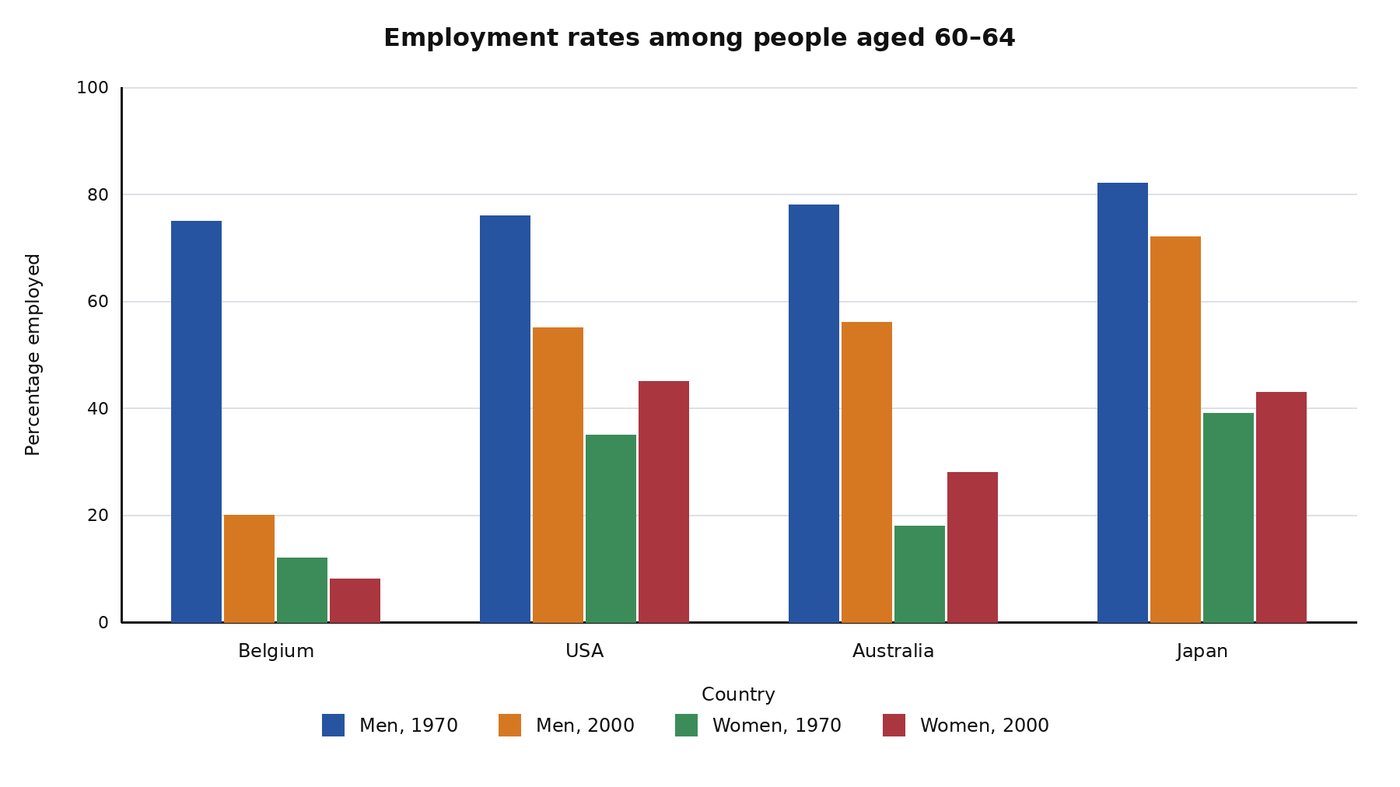
The bar chart below compares the percentages of men and women aged 60–64 who were employed in Belgium, the USA, Australia and Japan in 1970 and 2000.
Summarise the information by selecting and reporting the main features, and make comparisons where relevant.
Student answer (Band 6.0)
The given bar chart illustrates the change in percentages of employment rates among people aged 60-64 across four countries namely Belgium, the USA, Australia and Japan in 1970 and 2000.
Overall, men showed the highest proportion than women in all countries. Over the third decade, the men percentage experienced a decline, while women surged drastically in every countries except, Belgium which showed a slight fall in percentage.
In 1970, The men proportion were almost the same in every countries, with little over 80% in Japan and slightly below 80% in the others. The highest proportion of women was seen in Japan with 38% followed by the USA with nearly 35% and Australia with 19%. Belgium had the lowest women accounting just at 14%.
By 2000, there was a gradual reduction in men's proportion where Japan had 75% men, followed by Australia and the USA each accounting 50% and Belgium had only 20% men working. In case of women, in the USA, women increased to 45%, followed by Japan with 42% and Australia with 30%. In contrast, women proportion declined to 14% in Belgium by 2000.
AI examiner evaluation
| Criterion | Band |
|---|---|
| Task Achievement / Task Response | 6.5 |
| Coherence and Cohesion | 6.5 |
| Lexical Resource | 6.0 |
| Grammatical Range and Accuracy | 5.5 |
| Overall | 6.0 |
Task Achievement / Task Response: Band 6.5
You provide a clear overview of the main contrast: men’s employment was higher in every country, and women’s rates generally rose while Belgium was the exception. The country-by-country details are mostly relevant and support this summary. However, some figures and trends are misreported: men in Australia and the USA were about 56% and 55% in 2000, not 50% each; Japan’s figure was about 72%, rather than 75%. More importantly, men’s rates did not decline gradually in every country: Belgium fell sharply from about 75% to 20%, while the other declines were smaller. Belgium’s women’s rate was about 8% in 2000, not 14%. More precise reporting of these key differences would make the account more fully developed.
Coherence and Cohesion: Band 6.5
The response is arranged in a sensible sequence: an introduction, an overview, then separate paragraphs for 1970 and 2000. This makes the comparison easy to follow, and linking expressions such as “Overall,” “By 2000,” and “In contrast” help signal the direction of the discussion. Some cohesion is less controlled, however. The overview’s “Over the third decade” is unclear, and “while women surged drastically in every countries except, Belgium” makes the relationship between the trends difficult to process. The final paragraph also shifts between men and women without consistently marking the comparison. Use clearer time references and parallel phrasing, and group related figures more deliberately, to create smoother progression.
Lexical Resource: Band 6.0
You use an adequate range of task-related vocabulary, including “proportion,” “decline,” “increased,” and “accounting for,” so the main comparisons remain understandable. There are also attempts at more formal reporting language. However, several choices are inaccurate or unnatural: “men percentage,” “women surged drastically,” and “the highest proportion of women was seen” do not express the data as naturally as standard chart language. “Gradual reduction” is also misleading for Belgium’s sharp fall. These issues do not prevent understanding, but they limit precision and flexibility. Choose collocations such as “employment rate,” “rose,” “fell sharply,” and “stood at,” and avoid repeating “proportion” when “rate” is more exact.
Grammatical Range and Accuracy: Band 5.5
You attempt a mix of simple and more complex sentences, including comparisons with “while” and “where,” and most of the message is understandable. Some grammatical errors remain, particularly with agreement, articles, and sentence construction. For example, “The men proportion were” has both an unnatural noun phrase and incorrect agreement; “in every countries” should use a singular form after “every”; and “Belgium which showed” needs clearer punctuation and sentence structure. The phrase “women accounting just at 14%” also has an incomplete grammatical pattern. Review subject–verb agreement and build comparisons in complete, parallel clauses. Greater accuracy in these recurring patterns would strengthen control while preserving your range.
See this exact question answered at other band scores. The same prompt compared across bands.
Browse more IELTS Writing model answers or get your own writing scored by the same AI examiner.