Band 5.5 IELTS Writing Task 1 Model Answer
Overall Band Score: 5.5 · IELTS Predictions Nov 2026 · 2026-11-24
IELTS Writing Task 1 question
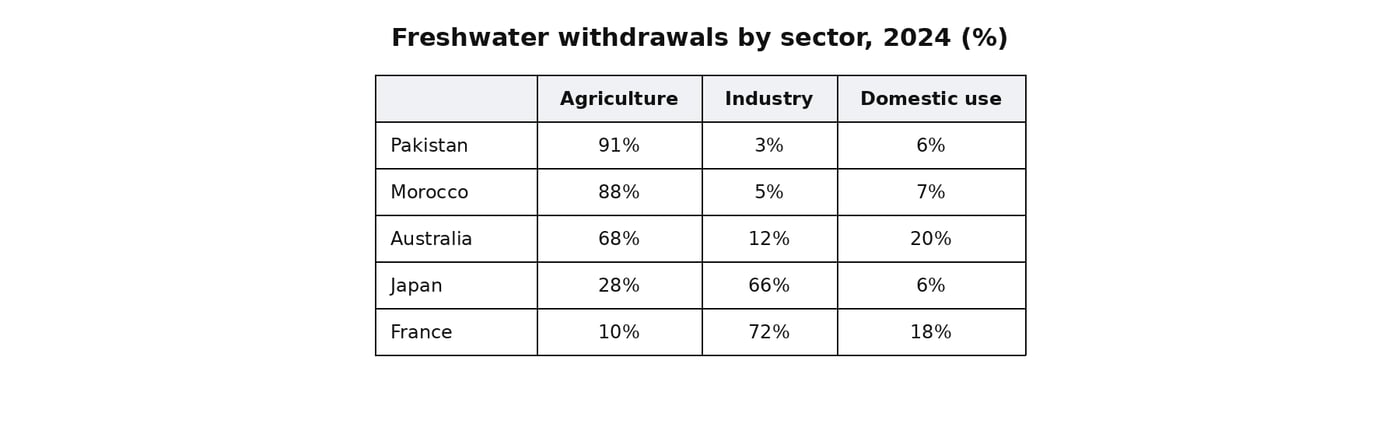
The table below gives information about the proportions of water used by different sectors in five countries in 2024.
Summarise the information by selecting and reporting the main features, and make comparisons where relevant.
Student answer (Band 5.5)
The chart provided gives data regarding the share of water used by various sectors in five places across the world in 2024.
We can significantly notice that, agriculture has taken more water compared to other sector in 3 countries Pakisytan,Morocco and Australia.Whereas, for Japan and France the scenario is different.Additionally after agriculture the another resource where water is used effeciently is domestic use.
To begin with, we can evidiently observe that each country used about 100% of their fresh water.Where Pakistan shared 91% for agriculture, 3% for industry and remaining 6% was used for domestic use.Morocco used 88% for agriculture, 5% for industry and the rest 7% for domestic use.Australia used 68% for agriculture, 12% for industry and 20% for domestic use. It spent the higgest percentage of water used for domestic used.Japan spent only 28% for agriculture,66% for industry and the last % for domestic use.Lastly France used the lowest amout for agriculture 10%,highest for industry 72% and second highest for domestic use 18%
AI examiner evaluation
| Criterion | Band |
|---|---|
| Task Achievement / Task Response | 6.0 |
| Coherence and Cohesion | 6.0 |
| Lexical Resource | 5.5 |
| Grammatical Range and Accuracy | 5.0 |
| Overall | 5.5 |
Task Achievement / Task Response: Band 6.0
You identify the main contrast accurately: agriculture accounts for the largest share in Pakistan, Morocco and Australia, while industry leads in Japan and France. Most figures are also reported correctly, including the high agricultural shares in Pakistan and Morocco and France’s 72% industrial use. However, the overview is weakened by the claim that domestic use is the next-largest sector after agriculture; this is not true across the table, since industry dominates in Japan and France. The final Japan figure is also left incomplete as “the last %,” so domestic use is not clearly reported. To strengthen the response, give a concise overview of the contrasting sector patterns and ensure every comparison is supported by complete, accurate figures.
Coherence and Cohesion: Band 6.0
The response has a recognisable structure: an introduction, an overview, and a paragraph reporting country figures. The sequence from Pakistan and Morocco to Australia, Japan and France is easy to follow, and transitions such as “To begin with” and “Lastly” help signal movement through the data. However, the overview and detail paragraph do not connect fully: the generalisation about domestic use conflicts with the later figures for Japan and France. Some linking is also mechanical, and punctuation around country names and figures makes parts of the paragraph run together. Grouping the three agriculture-led countries and then the two industry-led countries would make the comparisons clearer and create more purposeful progression.
Lexical Resource: Band 5.5
You use relevant task vocabulary, including “share,” “sector,” “agriculture,” “industry” and “domestic use,” and phrases such as “highest percentage” help communicate comparisons. However, several word choices and collocations are inaccurate or awkward: “used efficiently” does not mean that water was allocated to a sector, and “the another resource” is unsuitable here. “Spent” is also less precise than “used” for water, while “the last %” is unclear. Spelling errors such as “Pakisytan,” “effeciently,” “evidiently,” “higgest” and “amout” are noticeable. Aim for precise reporting verbs and standard comparative phrases, and proofread spelling carefully.
Grammatical Range and Accuracy: Band 5.0
You attempt both simple statements and longer sentences with contrast, as in “Whereas, for Japan and France the scenario is different.” However, control is uneven, and several sentence structures are incomplete or incorrectly joined. “Where Pakistan shared 91%...” is a dependent clause presented as a sentence, while “We can significantly notice that, agriculture...” has an unnecessary comma and an awkward clause structure. The sentence beginning “Japan spent only 28%...” ends with the incomplete phrase “the last % for domestic use.” Punctuation is also inconsistent, particularly around country names and between figures. Practise complete clauses, accurate comma use, and parallel sentence patterns when listing sector percentages; these will make the data easier to understand.
See this exact question answered at other band scores. The same prompt compared across bands.
Browse more IELTS Writing model answers or get your own writing scored by the same AI examiner.