Band 6.0 IELTS Writing Task 1 Model Answer
Overall Band Score: 6.0 · IELTS Predictions Nov 2026 · 2026-11-09
IELTS Writing Task 1 question
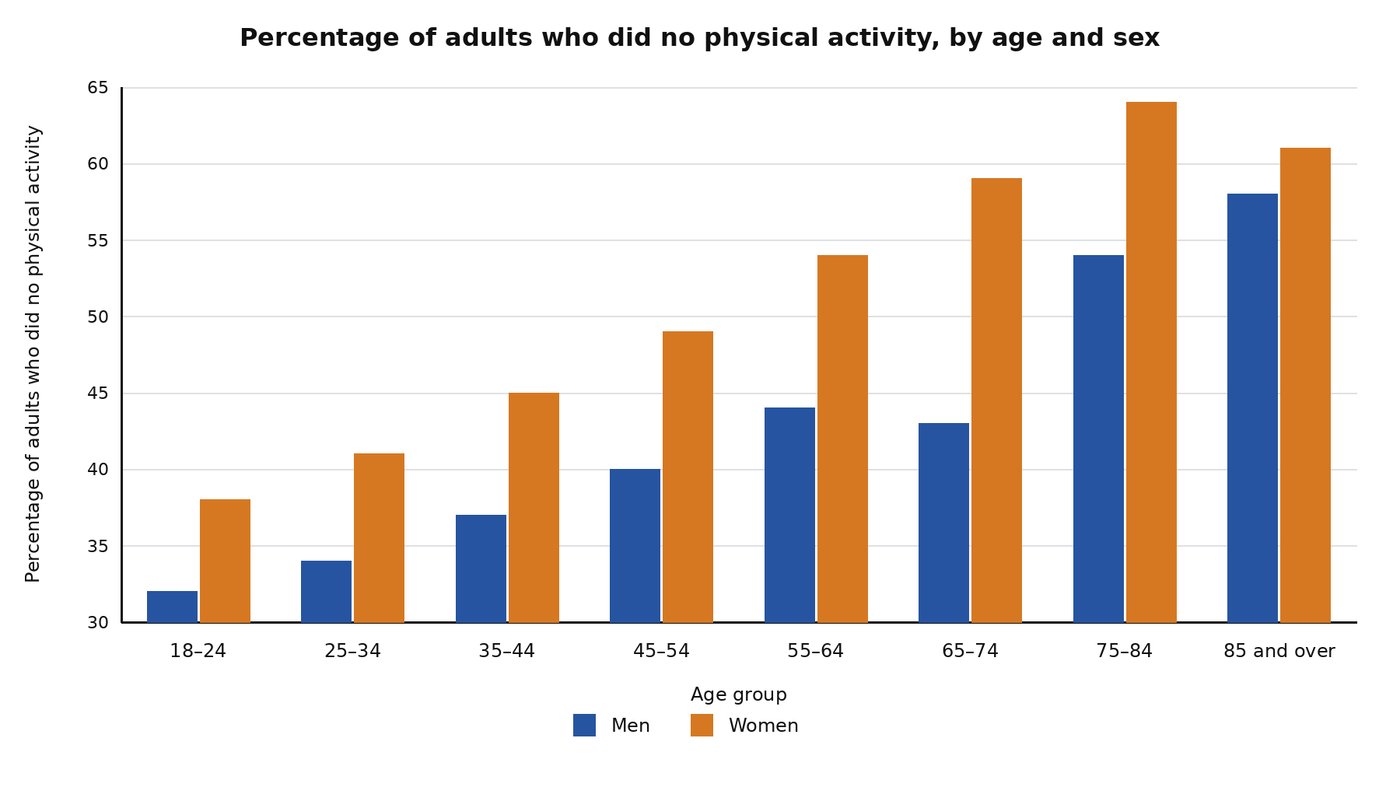
The bar chart below compares inactivity rates across age groups and between the sexes among adults in Australia in 2005.
Summarise the information by selecting and reporting the main features, and make comparisons where relevant.
Student answer (Band 6.0)
The bar chart compares the percentage of Australian adults who did no physical activity by age and gender in 2005.
Overall, the graph shows that women inactivity rate increased substantially with the age and was maximum at the ages of 75-84. Similarly, the no work rate of men also increased but less considerably compared with women ones and was highest at the ages of 85 and over.
The younger adults aged 18-24 were accounted for the most working individuals with only 32% men and 37% women were unemployed. People aged 25-34 had higher inactivity rate of 34% for men and 42% for women. Moving forward, proportion of middle aged male and female between 35 and 44, who did not no physical activity were 37% and 45% respectively. The men inactivity rate increased from 40% to 44% with the ages of 45 to 64, before decreasing to 43% at the age of 65 to 74. However, the inactivity rate of women increased consistently from 48% to 64% with the ages of 45 to 84 years. The men inactivity rate again started increasing from 43% to 58% with the ages of 65 to 85 and over.
AI examiner evaluation
| Criterion | Band |
|---|---|
| Task Achievement / Task Response | 6.0 |
| Coherence and Cohesion | 6.5 |
| Lexical Resource | 6.0 |
| Grammatical Range and Accuracy | 5.5 |
| Overall | 6.0 |
Task Achievement / Task Response: Band 6.0
You identify the chart’s subject and provide a clear overview of the broad age-related rise in inactivity, including the different peaks for men and women. Most figures are close to the chart, and you correctly note the slight fall in men’s rate from 55–64 to 65–74. However, the overview says women’s rate was highest at 75–84, whereas it falls from about 64% there to 61% among those aged 85 and over. Some descriptions also confuse inactivity with employment: the 18–24 group were not “the most working individuals,” and inactivity does not mean people were “unemployed.” The main trends are relevant, but more precise interpretation and a fully accurate overview would strengthen the report.
Coherence and Cohesion: Band 6.5
The response has a clear overall structure: an introduction, an overview, and a body that moves through the age groups. The sequence from younger to older adults makes the data reasonably easy to follow, and linking expressions such as “Similarly,” “Moving forward,” and “However” help signal relationships. This is a coherent arrangement, though some transitions feel mechanical or do not precisely describe the relationship between the figures. The final sentence repeats the men’s trend already covered in the preceding sentence, while the women’s figures for the oldest group are not reported. Grouping the data into clearer comparisons—such as the overall sex difference and the contrasting oldest-age trends—would make progression more purposeful and cohesion less repetitive.
Lexical Resource: Band 6.0
You use a sufficient range of chart-related vocabulary, including “percentage,” “increased,” “decreasing,” “consistently,” and “proportion,” so the main comparisons can be understood. There are also attempts at more formal phrasing, such as “inactivity rate.” However, several word choices or collocations are inaccurate: “no work rate” and “unemployed” misrepresent physical inactivity, while “working individuals” gives the opposite impression. Phrases such as “women inactivity rate” and “men inactivity rate” are also awkwardly formed, and “was maximum” is not natural in this context. Aim for consistent, precise terms such as “the proportion of inactive adults” and “the rate among women”; this will improve accuracy without requiring more elaborate vocabulary.
Grammatical Range and Accuracy: Band 5.5
You attempt both simple and complex sentence forms, including a contrast introduced by “However” and a relative clause in “who did not no physical activity.” The overall meaning is generally recoverable, but some grammatical errors remain. For example, “women inactivity rate increased” needs a possessive or article, and “with the age” is an inaccurate singular construction in several places. In “were accounted for,” the verb pattern is incorrect, while “were 37% and 45% respectively” does not fit smoothly with the preceding clause. The phrase “did not no physical activity” also contains an incorrect verb construction. Check agreement, articles, and verb patterns, and simplify sentences when needed to keep comparisons accurate.
See this exact question answered at other band scores. The same prompt compared across bands.
Browse more IELTS Writing model answers or get your own writing scored by the same AI examiner.