Band 6.0 IELTS Writing Task 1 Model Answer
Overall Band Score: 6.0 · IELTS Predictions Nov 2026 · 2026-11-09
IELTS Writing Task 1 question
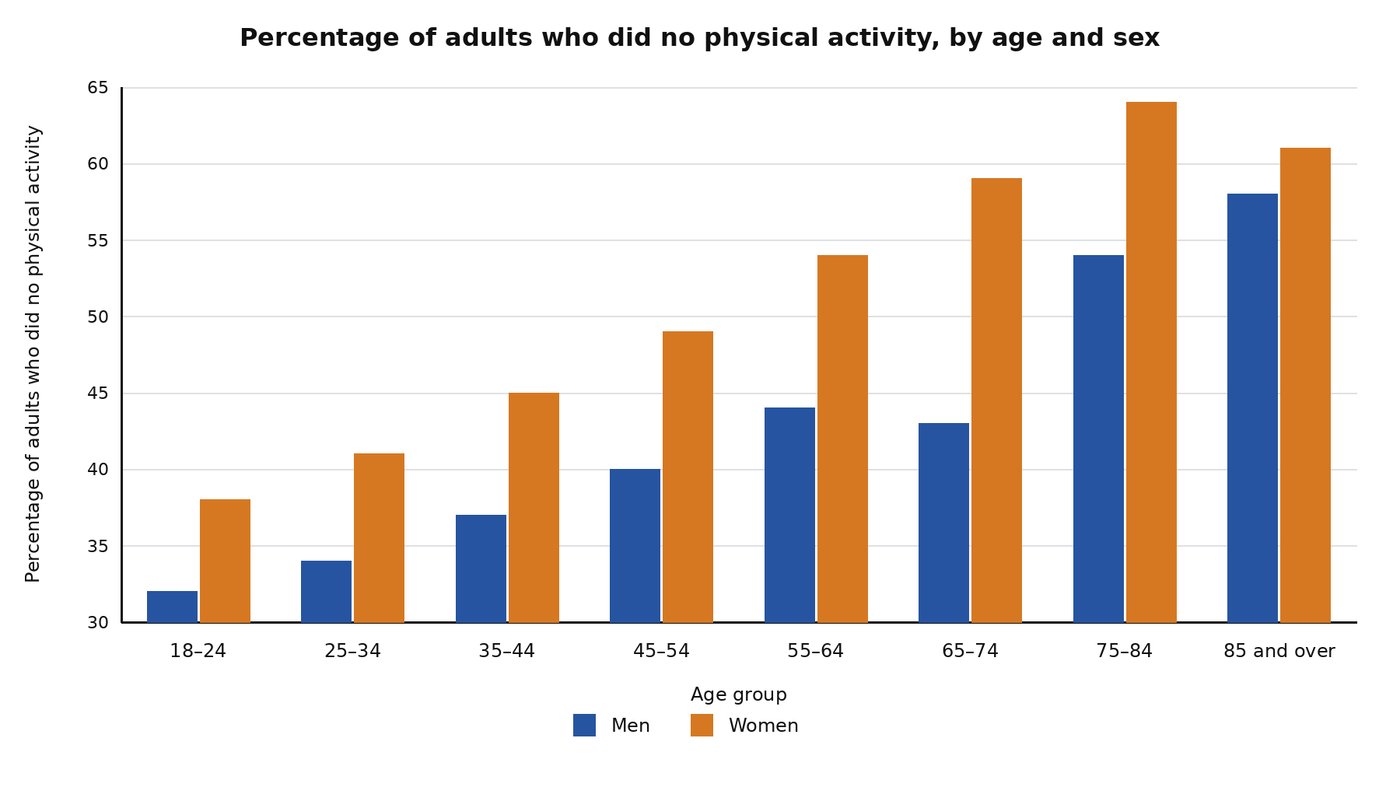
The bar chart below compares inactivity rates across age groups and between the sexes among adults in Australia in 2005.
Summarise the information by selecting and reporting the main features, and make comparisons where relevant.
Student answer (Band 6.0)
The bar chart illustrates inactivity rates of individuals, by age groups and genders among adults, in Australia in 2005.
Overall, women aged 75-84 had the highest percentage of adults who were inactive in physical activity; whereas men aged 18-45 had the lowest proportion.
In 2005, the highest record of adult who did no physical activity was women aged 75-84 accounted for 64% compared to men of the same age bracket at 54%. This was followed by the women aged 85 and over, and women aged 65-74 at 62% and 59% respectively. Meanwhile, the lowest rate of inactive women were aged 18- at 43%.
The highest figures in men who were not physically inactive recorded at 63% aged 85 and more, while the lowest precentage was aged 18-24 accounted for 32%. Compared to women, men had the lowest rate in being inactive in physical activity acrossage groups, while women had the highest record.
AI examiner evaluation
| Criterion | Band |
|---|---|
| Task Achievement / Task Response | 6.5 |
| Coherence and Cohesion | 6.5 |
| Lexical Resource | 6.0 |
| Grammatical Range and Accuracy | 5.5 |
| Overall | 6.0 |
Task Achievement / Task Response: Band 6.5
You identify the chart’s subject and give an overview that recognises the broad contrast between women’s higher inactivity and men’s lower figures. Several comparisons are supported with data, including the 64% figure for women aged 75–84 and the 32% low for men aged 18–24. However, some key details are inaccurate: the highest female rate is 64%, not 62% for women aged 85 and over, and the lowest female rate is 38% for ages 18–24, not 43% for an incomplete “18-” group. The male peak is 58%, rather than 63%. The overview also says men aged 18–45 had the lowest proportion, although the chart’s lowest group is men aged 18–24. More precise reporting and a clearer account of the age trends would strengthen coverage.
Coherence and Cohesion: Band 6.5
The response has a recognisable structure: an introduction, an overview, and separate paragraphs for the female and male figures. Linking expressions such as “Overall,” “Meanwhile,” and “Compared to women” help signal relationships between points. The progression is generally understandable, but the final comparison repeats the broad claim that women have higher rates without adding a specific comparison, and “This was followed by” makes the ranking of the next figures slightly awkward. Some references, such as “the highest record,” are not precise enough to make the relationship between the data and the claim immediately clear. Grouping the age trends more systematically and using comparisons to connect the two sexes would make the organisation more fluent and less repetitive.
Lexical Resource: Band 6.0
You use a reasonable range of task-related vocabulary, including “inactivity rates,” “proportion,” “age bracket,” and “physically inactive,” so the main topic is clear. There are also attempts to vary wording rather than repeat “percentage” throughout. However, several choices are unnatural or imprecise for describing chart data: “highest record” and “lowest rate of inactive women” are awkward, while “the highest figures in men” does not express the intended comparison naturally. “Acrossage” is misspelled, and “precentage” is also incorrect. Aim for standard collocations such as “the highest proportion of men” and “the rate among women,” and check spelling carefully. These improvements would make the vocabulary more precise and controlled.
Grammatical Range and Accuracy: Band 5.5
You attempt a mix of simple statements and more complex comparisons, including the overview clause joined with “whereas” and the sentence beginning “Compared to women.” Meaning is generally recoverable, but some sentence structures and grammatical relationships are not controlled. For example, “women aged 75-84 accounted for 64%” needs a clearer subject, such as “the rate among women aged 75–84 was 64%”; similarly, “The highest figures in men … recorded” lacks a correctly formed verb structure. The phrase “the lowest rate of inactive women were aged” also has an agreement and construction problem. Work on forming complete clauses and matching subjects with verbs, while retaining the range of sentence patterns you are attempting.
See this exact question answered at other band scores. The same prompt compared across bands.
Browse more IELTS Writing model answers or get your own writing scored by the same AI examiner.