Band 5.5 IELTS Writing Task 1 Model Answer
Overall Band Score: 5.5 · IELTS Predictions Nov 2026 · 2026-11-11
IELTS Writing Task 1 question
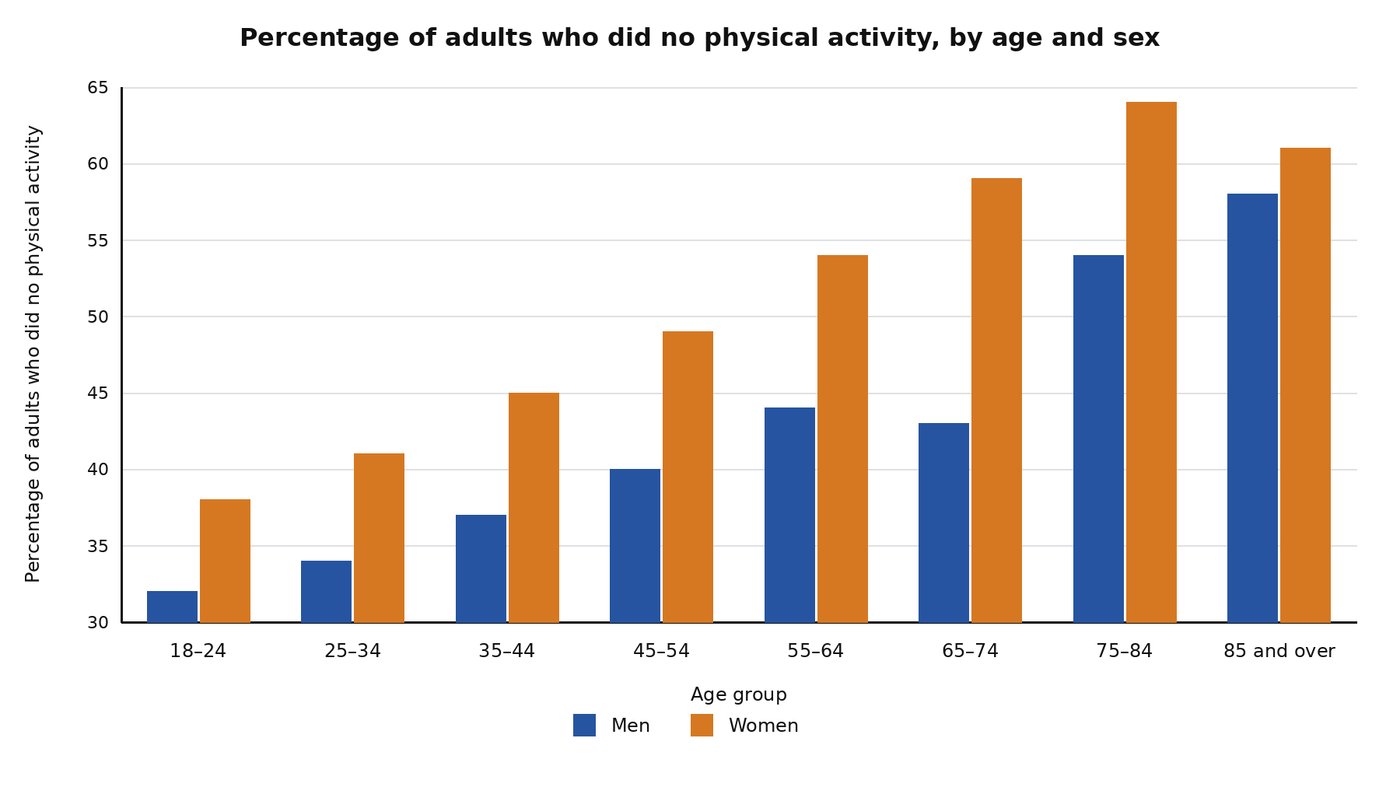
The bar chart below compares inactivity rates across age groups and between the sexes among adults in Australia in 2005.
Summarise the information by selecting and reporting the main features, and make comparisons where relevant.
Student answer (Band 5.5)
The bar chart illustrates the inactivity rates across age groups and between the sexes among adults in Australia in 2005.
Overall, it is clear that women have participated more in physical activity across all the age goups. Whereas, men have participated the lowest over the periods. The highest percentage was recorded by women in the age group of 75-84. Similarly, men recorded the highest in the age group of 85 and over.
Looking first at men, who aged between 18-24 participated the lowest by 32%, age 25-34 by 34% an age 35-44 by 37% followed by age 45-54 by 39%. As it, can be seen men participation went slightly up across the age groups untill the age group 55-64 where it got a slightly declined from 43% to 42%. However it got a dramatic increased by 54% in 75-84 age group and 58% in the final age group of 85 and over.
In contrast, women recorded the highest percentage over the periods. In age group 18-24 38% of women participated, 25-34 age group by 41%, 35-44 age group by 45%. It can be seen that the women percentage gradually increased over the age groups but after the age group of 75-84, it got a slight decline for the first time by 64% to 61% in 85 and over age group.
AI examiner evaluation
| Criterion | Band |
|---|---|
| Task Achievement / Task Response | 5.5 |
| Coherence and Cohesion | 6.0 |
| Lexical Resource | 5.5 |
| Grammatical Range and Accuracy | 5.0 |
| Overall | 5.5 |
Task Achievement / Task Response: Band 5.5
You identify the chart’s subject and give an overview of the broad age-related rise, including the peak for women at 75–84 and for men aged 85 and over. However, the overview contains a key misinterpretation: higher inactivity does not mean women “have participated more” in physical activity; women’s inactivity rates are higher than men’s in every age group. Some figures are also inaccurate: men aged 65–74 are about 43%, not a decline to 42% from 43%, and the 55–64 figure is about 44%, not 43%. The women’s account omits the later age-group values until the final comparison. Select the main contrasts accurately and describe inactivity rather than participation to make the report more complete and clear.
Coherence and Cohesion: Band 6.0
The response has a clear overall arrangement: an introduction, an overview, and separate paragraphs for men and women. Phrases such as “Looking first at men” and “In contrast” help signal the shift between groups, and the information generally follows the age sequence. However, some connections are awkward or unclear, as in “Whereas, men have participated the lowest over the periods,” which does not form a complete contrast with the preceding sentence. The men’s paragraph also moves between a list of figures and a trend description, with some repetition. Grouping the data into broader age ranges and using clearer links between comparisons would make the progression smoother and cohesion less mechanical.
Lexical Resource: Band 5.5
You use relevant chart vocabulary, including “inactivity rates,” “percentage,” “age group,” “recorded,” and “gradually increased,” so the topic is generally understandable. However, several word choices and collocations are inaccurate or repetitive. “Participated” describes taking part in activity, whereas the chart measures people who did no activity; this reverses the meaning. Phrases such as “men participation” and “dramatic increased” are also not natural forms, and “over the periods” is vague. Spelling slips such as “goups” and “untill” further reduce control. Build a more precise range around inactivity and change, and check word forms and spelling before finishing.
Grammatical Range and Accuracy: Band 5.0
You attempt both simple and more complex sentences, including a contrast with “Whereas” and a clause beginning “It can be seen that.” However, complex structures are often faulty, and errors occur frequently enough to make some sentences difficult to follow. For example, “Looking first at men, who aged between 18-24 participated…” lacks a correctly formed clause, while “As it, can be seen men participation went…” has misplaced punctuation and an unclear grammatical structure. There are also problems with articles and verb forms in “In age group 18-24 38% of women participated” and “it got a slightly declined.” Practise complete sentence patterns for reporting figures, and check subject–verb structure, tense, and punctuation.
See this exact question answered at other band scores. The same prompt compared across bands.
Browse more IELTS Writing model answers or get your own writing scored by the same AI examiner.