Band 6.0 IELTS Writing Task 1 Model Answer
Overall Band Score: 6.0 · IELTS Predictions Nov 2026 · 2026-11-11
IELTS Writing Task 1 question
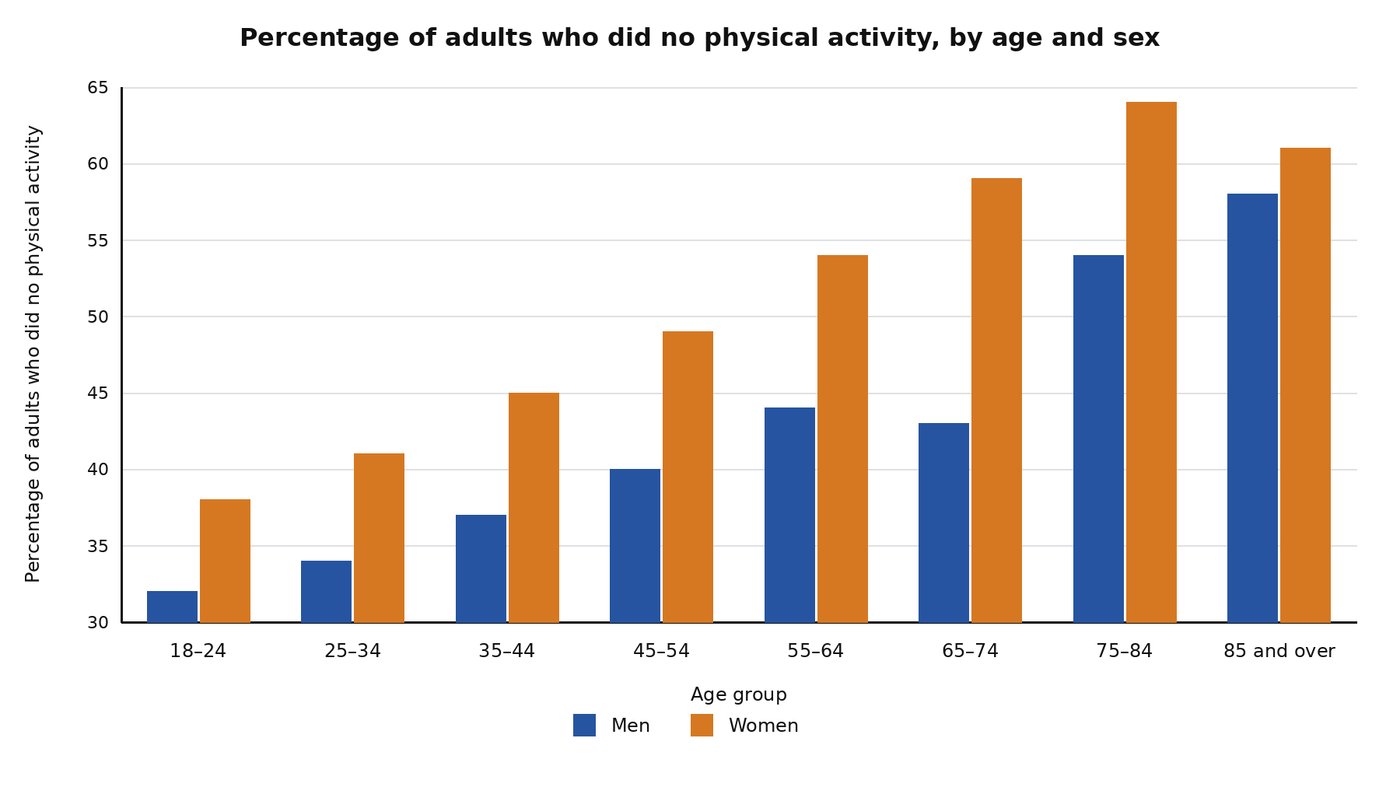
The bar chart below compares inactivity rates across age groups and between the sexes among adults in Australia in 2005.
Summarise the information by selecting and reporting the main features, and make comparisons where relevant.
Student answer (Band 6.0)
The bar chart illustrates the sedentary rates of several age age groups and two genders who did no physical acitivity in Australia in 2005.
Overall, it is evident that older age womens have the most contribution in not doing physical activity, whilst the younger male group have the least.
In the contexts of women group, women of 84 years has the highest proportion in not engaging in physical activity with approximately 65%, whilst the proportion marginally fell for the same gender in 85+ age group and stands at around 62%. The women gender continues to follow a rise in their proportion throughout the period.
Men, on the other hand, has a steadiy rise in their percentages without following a significant decline in any age group throughout the year. Younger men has a fewer percentage of around 32% of physical inactivity, the percentage linearly increased upto the age group of 55-66 and stands at nearly 45%, then follows a marginal decline by 2-3% and fells to around 42%. Age group of 85 and over have a slight difference among both genders, men of this age group have approximately 60% of physical inacitivity and womens showed around 62%.
AI examiner evaluation
| Criterion | Band |
|---|---|
| Task Achievement / Task Response | 6.5 |
| Coherence and Cohesion | 6.5 |
| Lexical Resource | 6.0 |
| Grammatical Range and Accuracy | 5.5 |
| Overall | 6.0 |
Task Achievement / Task Response: Band 6.5
You identify the main pattern that inactivity generally rises with age and correctly note that women have higher rates than men in most groups. The overview also captures the highest female figure among ages 75–84 and the slight fall for women aged 85 and over. However, some details are inaccurate or unclear: the women’s peak is about 64%, not 65%; men aged 55–64 are around 44%, rather than 45% for “55–66”; and the final male figure is about 58%, not 60%. The statement that women’s rate rises “throughout” needs qualification because it falls in the oldest group. The key features are present, but more precise reporting and clearer comparisons would strengthen coverage.
Coherence and Cohesion: Band 6.5
The response has a recognisable structure: an introduction, an overall summary, and separate discussion of women and men. The contrastive link “Men, on the other hand” helps signal the shift between groups, and the information generally follows the age sequence. Some progression is less smooth because the overview and body repeat the same highest/lowest comparisons, while the final sentence returns to the oldest group after the age-by-age account. References such as “the same gender” and “this age group” are understandable but sometimes awkward or imprecise. Grouping the figures into clearer trends—for example, the steady rise to older ages and the late female decline—would make the organisation more purposeful and cohesion less repetitive.
Lexical Resource: Band 6.0
You use a reasonable range of task-related vocabulary, including “sedentary rates,” “proportion,” “decline,” and “physical activity,” so the chart’s subject is clear. There are also attempts at more formal phrasing, such as “marginally fell.” However, several choices are inaccurate or unnatural: “most contribution” does not describe the highest rate, “women gender” is awkward, and “percentage linearly increased” is not a natural collocation here. Spelling slips in “acitivity,” “steadiy,” and “inacitivity” also reduce accuracy. Choose direct, precise expressions such as “the highest proportion of inactive adults” and “the rate rose steadily”; this would improve flexibility and control without making the wording more complicated.
Grammatical Range and Accuracy: Band 5.5
You attempt a mix of simple and complex sentences, including clauses with “whilst” and “on the other hand,” and the main comparisons are usually understandable. Some grammatical errors remain, particularly with agreement and sentence construction: “older age womens have” and “Younger men has” should use matching plural subjects and verbs, while “Men … has” also needs agreement. The phrase “women of 84 years” is not formed naturally, and “the percentage linearly increased upto the age group” has an unclear grammatical relationship between the increase and the age category. There is some control of longer structures, but checking subject–verb agreement and simplifying unclear clauses would make the sentences more consistently accurate.
See this exact question answered at other band scores. The same prompt compared across bands.
Browse more IELTS Writing model answers or get your own writing scored by the same AI examiner.