Band 5.5 IELTS Writing Task 1 Model Answer
Overall Band Score: 5.5 · IELTS Predictions Nov 2026 · 2026-11-13
IELTS Writing Task 1 question
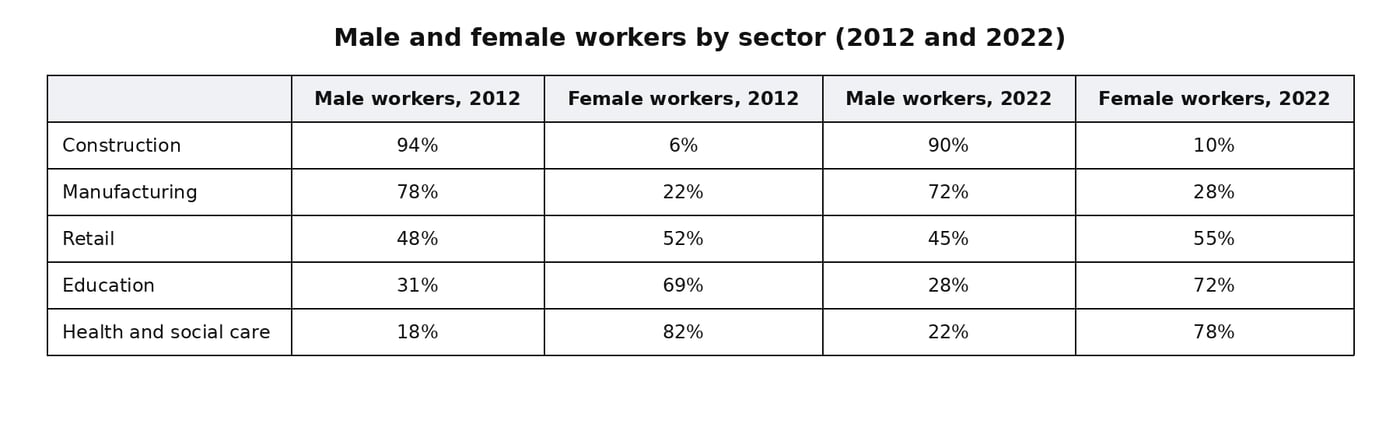
The table below shows the percentages of male and female workers across five employment sectors in 2012 and 2022.
Summarise the information by selecting and reporting the main features, and make comparisons where relevant.
Student answer (Band 5.5)
The Table compares men and women workers percentage across five employment sectors construction, manufacturing, retail, education and health and social care, in the years 2012 and 2022. Overall, in construction and manufacturing male workers was dominant over female worker in both years.
but in other three sectors female workers has their impact on male workers.
In year 2012, construction workers male was 94% while female workers was only 6%. but in year 2022, male workers lessen to 90% while female rose to 10%. manufacturing plays similar role, where male workers are 78% and feamle was 22% in year 2012 but it fell to 72% for males and rosen for 28% females in the year 2022.
Retail workers in the year 2012 was 48% for male while 52% for females but in the year 2022 the female workers rose to 55% while male decline to 45%.
education and health care has the great role of female workers. where the role of male workers in 2012 is 31% and 18% only but on the other hand, female has the percentage of 69% and 82%. in the year 2022 male workers fell to 28% in education but show a gradual increase in health care to 22% while female workers increase in both sectors to 77% and 78%
AI examiner evaluation
| Criterion | Band |
|---|---|
| Task Achievement / Task Response | 6.0 |
| Coherence and Cohesion | 5.5 |
| Lexical Resource | 5.5 |
| Grammatical Range and Accuracy | 5.0 |
| Overall | 5.5 |
Task Achievement / Task Response: Band 6.0
You cover all five sectors and compare the two years, with a clear overview that men predominated in construction and manufacturing while women had higher shares in the other sectors. Most figures are reported accurately, including the changes in construction, manufacturing and retail. However, the overview could identify the broader pattern more precisely: female representation rose in four sectors, while health and social care was the exception, falling from 82% to 78%. The final sentence gives the 2022 education figure as 77%, whereas the table shows 72%, and the phrase “has their impact” does not clearly describe the female majority. More precise selection and reporting of the main trends would make the summary more complete and clear.
Coherence and Cohesion: Band 5.5
The response has a generally sensible order: it introduces the table, gives an overview, and then discusses the sectors in related groups. This helps the reader follow the comparisons. However, paragraphing and progression are not consistently controlled: the overview breaks after “both years,” and the next line begins with a lower-case “but,” while the final paragraph combines education and health care in a long, crowded sequence. Linking words such as “but” and “while” are repeated, and some references, including “the role” and “their impact,” are unclear. Grouping the sectors into clearer paragraphs and using more precise transitions and references would make the organisation smoother and less mechanical.
Lexical Resource: Band 5.5
You use enough topic vocabulary to describe the table, including “employment sectors,” “percentage,” “decline,” and “increase.” The meaning is generally recoverable, but several word choices and collocations are inaccurate or unnatural, such as “male workers was dominant,” “female workers has their impact,” and “manufacturing plays similar role.” There are also spelling errors, including “feamle” and “rosen,” and some repetition of “workers” and “role.” These issues make the description less precise and occasionally slow the reader, although the main comparisons remain understandable. Aim for standard chart language and accurate forms, for example, “accounted for,” “share,” and “remained higher than.”
Grammatical Range and Accuracy: Band 5.0
You attempt both simple and more complex comparisons, using clauses with “while,” “but,” and “where,” and the overall meaning can usually be followed. However, errors in agreement and sentence construction are frequent enough to limit accuracy: “male workers was dominant,” “female workers has,” and “construction workers male was” have incorrect or awkward grammatical patterns. Some sentences are joined or punctuated poorly, particularly the opening overview and the final long sentence, and sentence-initial “but” is not properly integrated. There is some control of past-tense reporting, but forms shift between past and present, as in “plays” and “are” alongside “fell.” Practise consistent past-tense descriptions and shorter, correctly punctuated comparisons.
See this exact question answered at other band scores. The same prompt compared across bands.
Browse more IELTS Writing model answers or get your own writing scored by the same AI examiner.