Band 5.5 IELTS Writing Task 1 Model Answer
Overall Band Score: 5.5 · IELTS Predictions Nov 2026 · 2026-11-13
IELTS Writing Task 1 question
The table below shows the percentages of male and female workers across five employment sectors in 2012 and 2022.
Summarise the information by selecting and reporting the main features, and make comparisons where relevant.
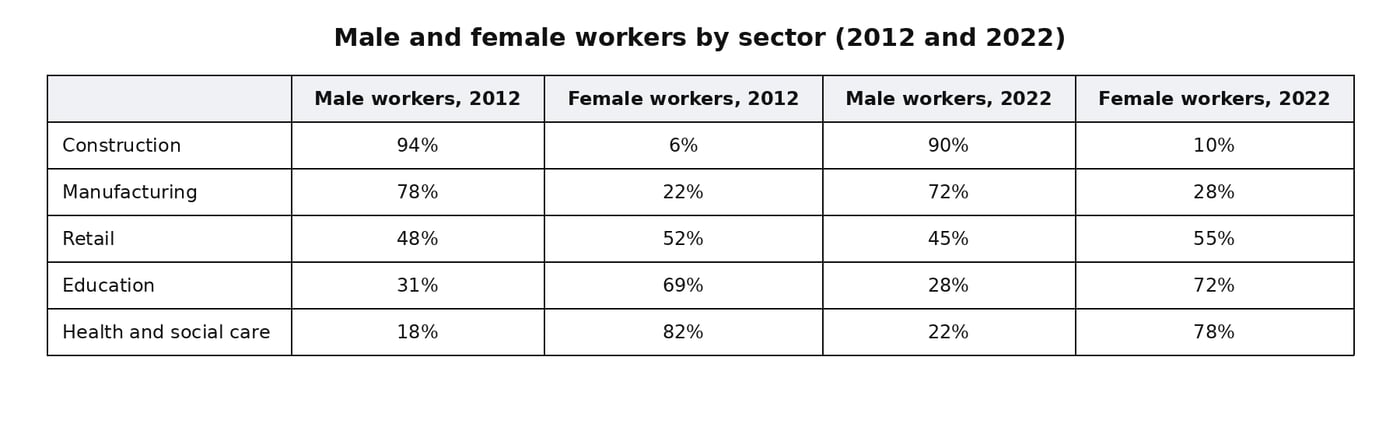
Student answer (Band 5.5)
The Illustration shows the percentage of male and female employees across five employment sector in 2012 and 2022.
Overall, in the five employment sector which consist construction, manufacturing, retail, education, and health and social care. The construction male workers attained the highest percentage in 2012 that reached 94%. However, on the same field the female workers obtained 6% which shows as the lowest number among the five employment sector.
In 2012, the male construction workers achieved 94% whereas the females workers are 6% in the identical field. However, the woman employees achieved the highest percentage in the sector of health and social care which is 82%. On the other hand, male employees got 18% in the same sector. In the same year, Education and retail woman workers achieved the increased number than the man workers. In 2022, the number changes but it has a same outcome and distribution identical in 2012.
Therefore, after 10 years the preferences of both gender does not change across five employment sectors.
AI examiner evaluation
| Criterion | Band |
|---|---|
| Task Achievement / Task Response | 5.5 |
| Coherence and Cohesion | 5.5 |
| Lexical Resource | 5.5 |
| Grammatical Range and Accuracy | 5.5 |
| Overall | 5.5 |
Task Achievement / Task Response: Band 5.5
You identify the main gender contrasts, including construction as the most male-dominated sector in 2012 and health and social care as the most female-dominated. However, the overview is incomplete and the claim that the “preferences” did not change is too broad: the proportions shifted in every sector, and health and social care became less female-dominated. The response gives several 2012 figures but reports almost no specific 2022 data, despite the task asking for comparisons across both years. It also overlooks the overall pattern that women’s shares rose in four sectors, while men’s share rose only in health and social care. Select the key changes and support the overview with accurate figures from both years.
Coherence and Cohesion: Band 5.5
The response has a recognisable paragraph structure, moving from an introduction and overview to details and a concluding statement. Some linking words, such as “However,” “On the other hand,” and “Therefore,” help signal relationships. Nevertheless, progression is weakened by repetition: the 2012 construction figures of 94% and 6% appear in both the overview and the detail paragraph. The final statement repeats the idea that the distribution stayed the same, rather than drawing together the actual changes. References such as “the same field” and “the same sector” are understandable but repetitive. Organise the body by comparing the main patterns across both years, and use linking and referencing to make those comparisons clear without restating information.
Lexical Resource: Band 5.5
You use relevant vocabulary for describing the table, including “percentage,” “employees,” “sector,” and “achieved,” and the reader can generally understand the intended comparisons. However, the range is limited and several choices are unnatural or imprecise for data reporting. “Preferences” suggests personal choices, whereas the table shows workforce proportions; “attained” and “achieved” are also awkward when describing percentages. There are repeated phrases such as “male workers” and “female workers,” and “the increased number” does not accurately describe a percentage share. Use precise terms such as “proportion,” “share,” “accounted for,” and “rose/fell,” while varying references to men and women. Check forms such as “employment sectors” and “women workers” for natural usage.
Grammatical Range and Accuracy: Band 5.5
You attempt both simple and more complex sentences, including a contrast with “whereas” and a relative clause beginning “which consist.” Meaning is usually recoverable, but errors in agreement, articles, plurals, and sentence construction are frequent enough to make some sentences awkward. For example, “five employment sector” should use a plural, and “which consist construction…” is an incomplete, poorly connected sentence. In “the females workers are 6%,” the article and plural form are incorrect, while “the number changes but it has a same outcome” has problems with tense and article use. The response also shifts between past and present when describing 2012 data. Practise accurate past-tense reporting and build complete sentences with clear subjects and verbs before adding complex clauses.
See this exact question answered at other band scores. The same prompt compared across bands.
Browse more IELTS Writing model answers or get your own writing scored by the same AI examiner.