Band 6.0 IELTS Writing Task 1 Model Answer
Overall Band Score: 6.0 · IELTS Predictions Nov 2026 · 2026-11-14
IELTS Writing Task 1 question
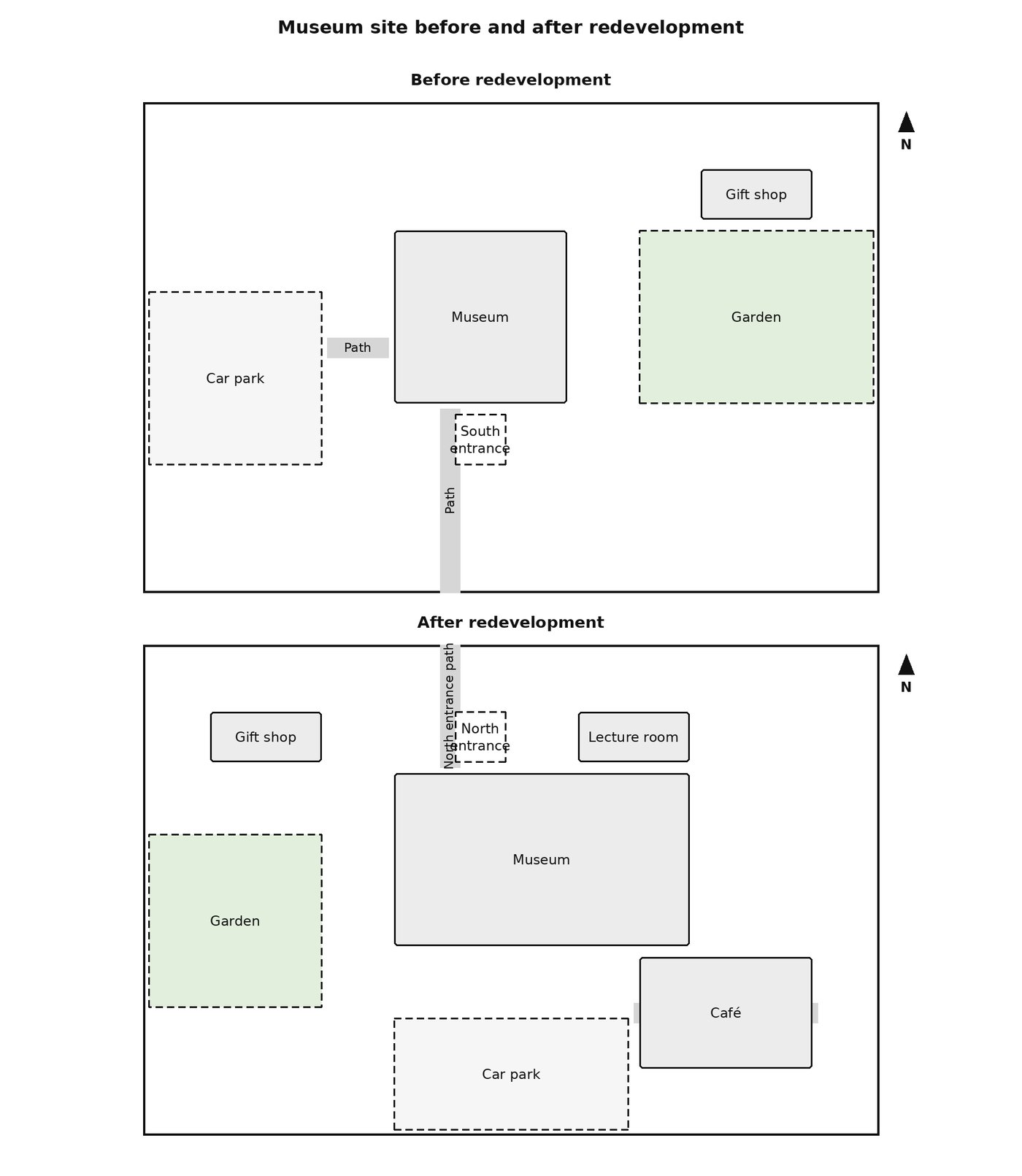
The plans below show a museum site before and after redevelopment, including changes to its buildings, entrance, parking, gardens and visitor facilities.
Summarise the information by selecting and reporting the main features, and make comparisons where relevant.
Student answer (Band 6.0)
The maps compare museum site before and after redevelopment. The major changes what can be noticed are the addition of cafe and lecture room in the map of after redevelopment. Besides that, there are some relocation of specific areas like garden, car park, gift shop and entrance path.
Before redevelopment map has four major elements and these are car park, museum, garden and gift shop. There is a path between car park and museum. The entrance path is in the south. The garden is located in the east side from the center of the map, while the car park is located in the west side but the position is a bit lower than the garden. The museum is located in the middle. The gift shop is located in the north side just above the garden.
The 2nd map illustrates the after redevelopment scenerio. The museum is still in the center portion of the map. Just above the museum in the nothern east section, there is a new addition which is a lecture room. The garden is now in west side and the car park is in south. Cafe is just beside the car park in the southern east side. The entrace is now in oposite of the older map like in north. There is a gift shop in the northern west side.
AI examiner evaluation
| Criterion | Band |
|---|---|
| Task Achievement / Task Response | 6.5 |
| Coherence and Cohesion | 6.5 |
| Lexical Resource | 6.0 |
| Grammatical Range and Accuracy | 5.5 |
| Overall | 6.0 |
Task Achievement / Task Response: Band 6.5
You identify the main transformation clearly: the museum remains central, while a café and lecture room are added and several facilities change position. Most locations are reported accurately, including the garden moving west, the car park moving south, and the entrance shifting from south to north. This covers the task well, and the opening gives a useful overview. However, some details are incomplete or imprecise: the lecture room is described as being in the “northern east section,” whereas the plan places it north of the museum; the paths are mentioned only briefly, and the north–south and east–west routes could be compared more clearly. A more complete overview of the site’s overall reorganisation, supported by precise descriptions of these features, would strengthen the response further.
Coherence and Cohesion: Band 6.5
The response has a clear overall arrangement: an introductory overview is followed by separate descriptions of the original and redeveloped plans. This makes the sequence easy to follow, and phrases such as “Before redevelopment” and “The 2nd map” help signal the shift between stages. The progression within each paragraph is generally understandable, although the descriptions sometimes read as a list of locations rather than a connected comparison. For example, the final paragraph moves from the lecture room to the garden, car park, café, entrance and gift shop without linking these changes to one another. Use more varied comparison links, such as “whereas,” “by contrast” and “in addition,” and group related relocations together. This would make cohesion less mechanical and the comparisons more integrated.
Lexical Resource: Band 6.0
You use an adequate range of vocabulary for describing a site plan, including “relocation,” “located,” “center portion” and “addition.” These choices communicate the main information, and the reader can generally understand the intended locations. However, some expressions are imprecise or awkward, such as “the major changes what can be noticed,” “in the north side,” and “in opposite of the older map.” There are also spelling errors in “scenerio,” “nothern” and “entrace,” which reduce accuracy. Aim for more natural map-description collocations, such as “the most notable changes,” “to the north of,” and “on the opposite side.” Greater precision in directional language would also help distinguish the lecture room’s position from the gift shop’s.
Grammatical Range and Accuracy: Band 5.5
You use a mixture of simple sentences and some longer structures, and most of the site changes remain understandable. For example, “The museum is still in the center portion of the map” is a clear basic sentence, while the sentence describing the garden and car park attempts to compare two locations. However, some grammatical errors recur. The opening phrase “The major changes what can be noticed are” lacks a correct clause structure; “Before redevelopment map has” needs an article, and “there are some relocation” has a number-agreement problem. Several location phrases also need grammatical adjustment, as in “in the east side from the center.” Practise accurate article use, singular/plural agreement and complete clause structures, while varying sentence patterns. These corrections would make the descriptions more fluent and precise.
See this exact question answered at other band scores. The same prompt compared across bands.
Browse more IELTS Writing model answers or get your own writing scored by the same AI examiner.