Band 5.5 IELTS Writing Task 1 Model Answer
Overall Band Score: 5.5 · IELTS Predictions Nov 2026 · 2026-11-15
IELTS Writing Task 1 question
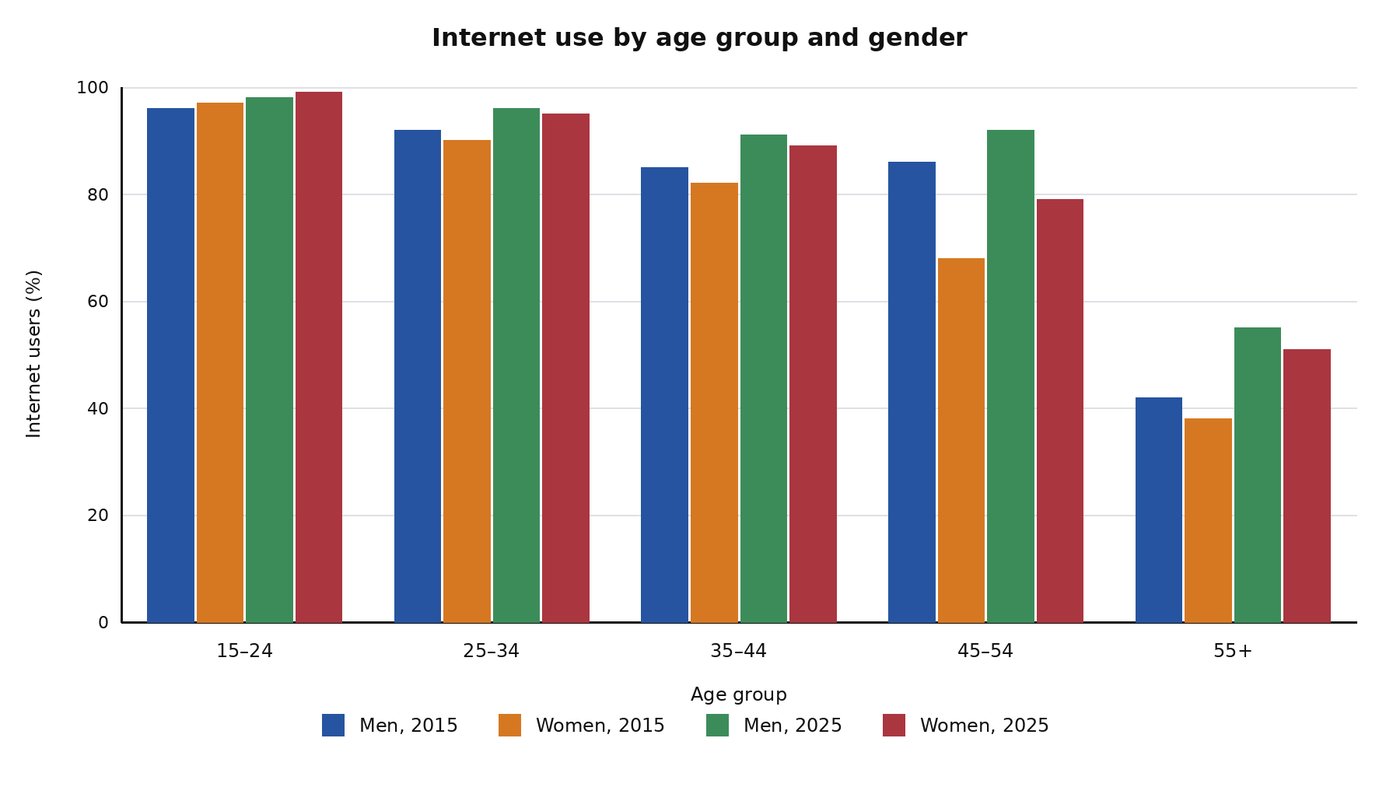
The chart below shows the proportions of men and women who accessed the internet in five age groups in one country in 2015 and 2025.
Summarise the information by selecting and reporting the main features, and make comparisons where relevant.
Student answer (Band 5.5)
The given bar chart presents the percentage of male and female who used the internet in different age groups in one nation in 2015 and 2025.
Overall, majority of younger age men and women was relied on internet in both years. In contrast, least percentage of internet users noticed in older age. Notably, majority of men have used more internet than women in both years.
In 2015, around 96% of men and 97% of women have accessed the internet, aged between 15 to 24. Similar pattern observed in 2025, where approximately 98% of male and 99% of female was noticed. Almost 90% and 96% of male used internet, while around 88% and 95% of women scroll the internet in 2015 and 2025 respectively who aged from 24 to 34. Roughly same internet usage was observed to reducing order in women and men who aged between 35 and 44.
Moreover, in 2015 major dropped observed in the usage internet in female to around 67%, which was lowest among 45 to 54 aged. People who aged more than 55 years had least interest to use internet, which was around 42% male and 38% female in 2015 and around 56% men and 51% women in 2025.
AI examiner evaluation
| Criterion | Band |
|---|---|
| Task Achievement / Task Response | 6.0 |
| Coherence and Cohesion | 6.0 |
| Lexical Resource | 5.5 |
| Grammatical Range and Accuracy | 5.0 |
| Overall | 5.5 |
Task Achievement / Task Response: Band 6.0
You identify the main pattern that internet use was highest among younger people and lowest among the over-55s, and you compare both years and genders. Several figures are reported accurately, including the 15–24 and 55+ groups. However, the overview claim that men used the internet more than women in both years is not supported: women are slightly ahead among 15–24-year-olds in both years, and also among 25–34s in 2015. Some figures for ages 25–34 are misreported, and the 35–44 comparison is left vague. The 45–54 group is only partly covered, despite its notable gender gap in 2015. A more precise overview and fuller reporting of these middle-age groups would strengthen the response.
Coherence and Cohesion: Band 6.0
The response has a clear overall structure: an introduction, an overview, and two paragraphs presenting details. The progression from younger groups to older groups is generally easy to follow, and phrases such as “In contrast” and “Moreover” help signal relationships. However, the detail paragraph becomes difficult to interpret where several figures are compressed into one sentence: “Almost 90% and 96% of male used internet” does not clearly identify which year or age group each figure refers to. The phrase “Roughly same internet usage” also leaves the comparison unclear. Use a more consistent order—age group, year, then men and women—and clearer linking or reference to make comparisons easier to track.
Lexical Resource: Band 5.5
You use relevant vocabulary for describing a chart, including “percentage,” “approximately,” “usage,” and “lowest,” and the meaning is generally understandable. However, several word choices and collocations are unnatural or imprecise, such as “majority of younger age men,” “relied on internet,” “major dropped observed,” and “scroll the internet.” These choices sometimes make the intended trend harder to understand. There is also repetition of “internet” and “around,” while some expressions do not fit formal data description. Aim for standard chart language and accurate collocations, such as “the proportion of users,” “fell sharply,” and “accessed the internet.” This would make the vocabulary more precise and natural.
Grammatical Range and Accuracy: Band 5.0
You attempt both simple and more complex sentence forms, including clauses beginning with “where” and “who,” and the overall message can usually be understood. However, errors in agreement, tense, articles, and sentence construction occur across the response. For example, “majority … was relied” has an incorrect verb pattern and agreement, while “Similar pattern observed” is missing an article and a finite verb. In “98% of male and 99% of female was noticed,” the subjects and verb do not agree, and the passive construction is unsuitable. The long sentence beginning “Almost 90% and 96%” also lacks a clear grammatical structure. Practise forming complete comparison sentences and checking subject–verb agreement and verb forms.
See this exact question answered at other band scores. The same prompt compared across bands.
Browse more IELTS Writing model answers or get your own writing scored by the same AI examiner.