Band 6.0 IELTS Writing Task 1 Model Answer
Overall Band Score: 6.0 · IELTS Predictions Nov 2026 · 2026-11-15
IELTS Writing Task 1 question
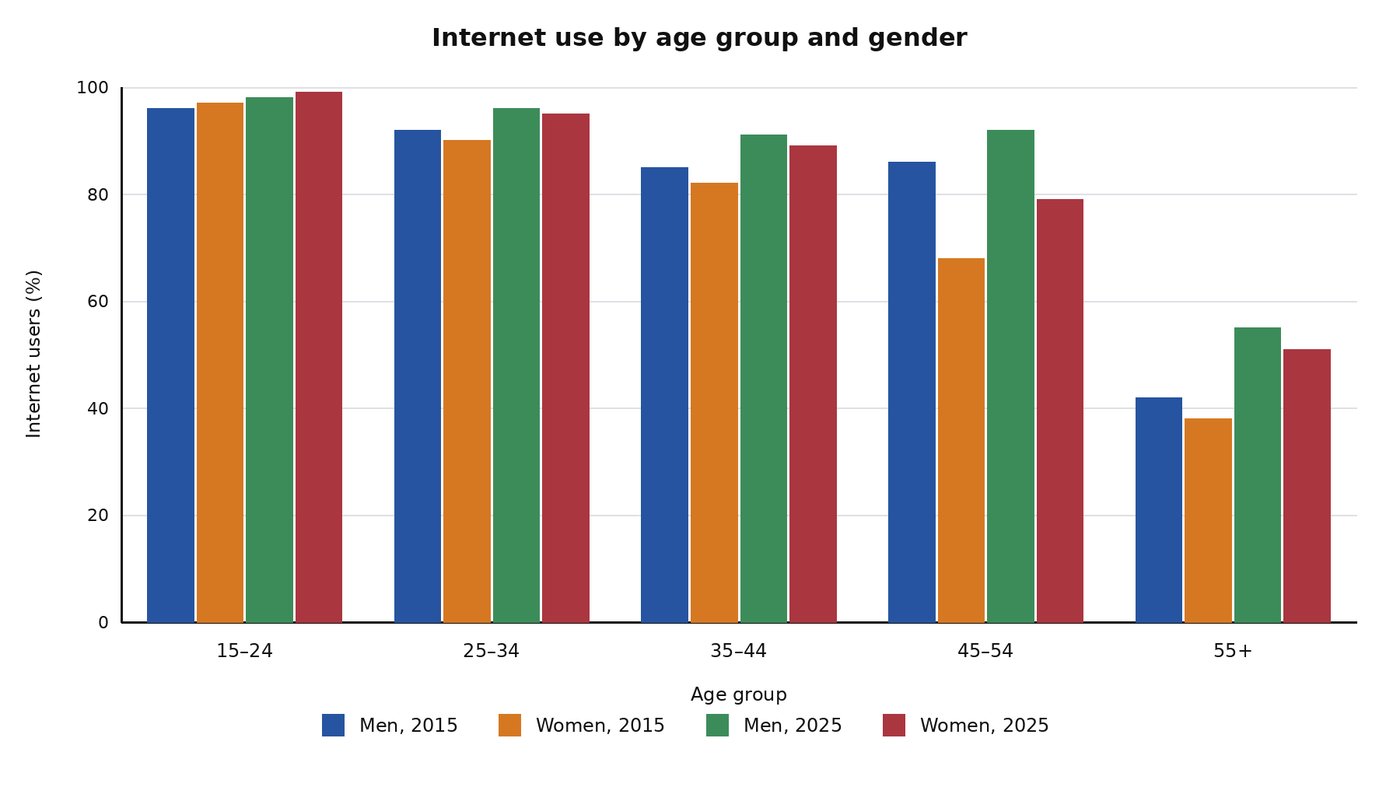
The chart below shows the proportions of men and women who accessed the internet in five age groups in one country in 2015 and 2025.
Summarise the information by selecting and reporting the main features, and make comparisons where relevant.
Student answer (Band 6.0)
The bar chart compares the percentage of residents in different genders who accessed the internet in five age groups in a country in the year 2015 and 2025.
Overall, it is clear that the 15-24 age group of women in 2025 accounted for the highest proportion of using the internet, while the age group of 55+ women had the lowest proportion in 2015.
In 2015, the age group of 15-25 experienced a slight higher proportion in female category, while the other four groups had the higher proportion in male. Moreover, there was a massive difference observe in the 45-54 age group in that year, where the male group recorded around 85%, more than 15% compared to the female.
In the year 2025, again women had the highest proportion in the age group of 15-24 and they had nearly 99%, while the category of man stood around 98%. On the other hand, in the 25-34 age group, man had higher proportion by around 2% compared to female. Additionally, the male group had higher proportion by more than 10% in the 45-54 age group, which recorded similarly in 2015. However, the 55+ age group witnessed the lowest proportion of using the internet compared to the other four categories in the both years.
AI examiner evaluation
| Criterion | Band |
|---|---|
| Task Achievement / Task Response | 5.5 |
| Coherence and Cohesion | 6.5 |
| Lexical Resource | 6.0 |
| Grammatical Range and Accuracy | 6.0 |
| Overall | 6.0 |
Task Achievement / Task Response: Band 5.5
You identify the chart’s broad pattern: the youngest group has the highest internet use, while the 55+ group is lowest, and you compare both years. However, some key details are inaccurate or unclear. In 2015, the 45–54 male figure was about 86%, not around 85% as a comparison with the female figure of 68% suggests a gap of more than 15 percentage points; more importantly, the 35–44 and 45–54 figures are close for men, while women’s use falls notably across these groups. Your overview also focuses on the highest and lowest single categories rather than summarising the general rise in use by 2025. Develop the overview and report the main changes more accurately, including the increases among older users.
Coherence and Cohesion: Band 6.5
The response has a clear overall arrangement: an introduction, an overview, and separate paragraphs for 2015 and 2025. This makes the comparison easy to follow, and linking expressions such as “Overall,” “Moreover,” and “On the other hand” help signal relationships. The progression is generally coherent, though some connections are mechanical or imprecise. For example, “which recorded similarly in 2015” does not clearly identify what was similar, and the final sentence repeats the point that the 55+ group was lowest, already stated in the overview. Group related comparisons more efficiently and use clearer references, such as naming the male–female gap directly. These refinements would make the cohesion more flexible and the progression more purposeful.
Lexical Resource: Band 6.0
You use an adequate range of chart-related vocabulary, including “percentage,” “proportion,” “recorded,” and “accounted for,” and the meaning is generally clear. There are also attempts at more descriptive language, such as “massive difference,” although this is too informal and imprecise for an academic report. Some word choices and collocations are awkward: “different genders” is less natural than “men and women,” and “proportion of using the internet” is not idiomatic. “Experienced a slight higher proportion” also uses an unsuitable word form and collocation. Aim for precise, neutral reporting language and vary “proportion” with terms such as “share” or “rate” where appropriate. This would improve accuracy and naturalness without requiring more elaborate vocabulary.
Grammatical Range and Accuracy: Band 6.0
You use a mix of simple and more complex sentence forms, including clauses introduced by “while,” “where,” and “which,” and most sentences remain understandable. Some grammatical errors persist, however. In “a slight higher proportion,” the comparative form should be “slightly higher”; “a massive difference observe” needs a correctly formed verb, such as “a difference was observed”; and “the category of man” has a number/agreement problem. The phrase “in the both years” also has an unnecessary article. These errors do not usually prevent the reader from understanding your comparisons, but they reduce accuracy. Check comparative forms, verb forms in passive constructions, singular/plural agreement, and article use when editing.
See this exact question answered at other band scores. The same prompt compared across bands.
Browse more IELTS Writing model answers or get your own writing scored by the same AI examiner.