Band 6.0 IELTS Writing Task 1 Model Answer
Overall Band Score: 6.0 · IELTS Predictions Nov 2026 · 2026-11-18
IELTS Writing Task 1 question
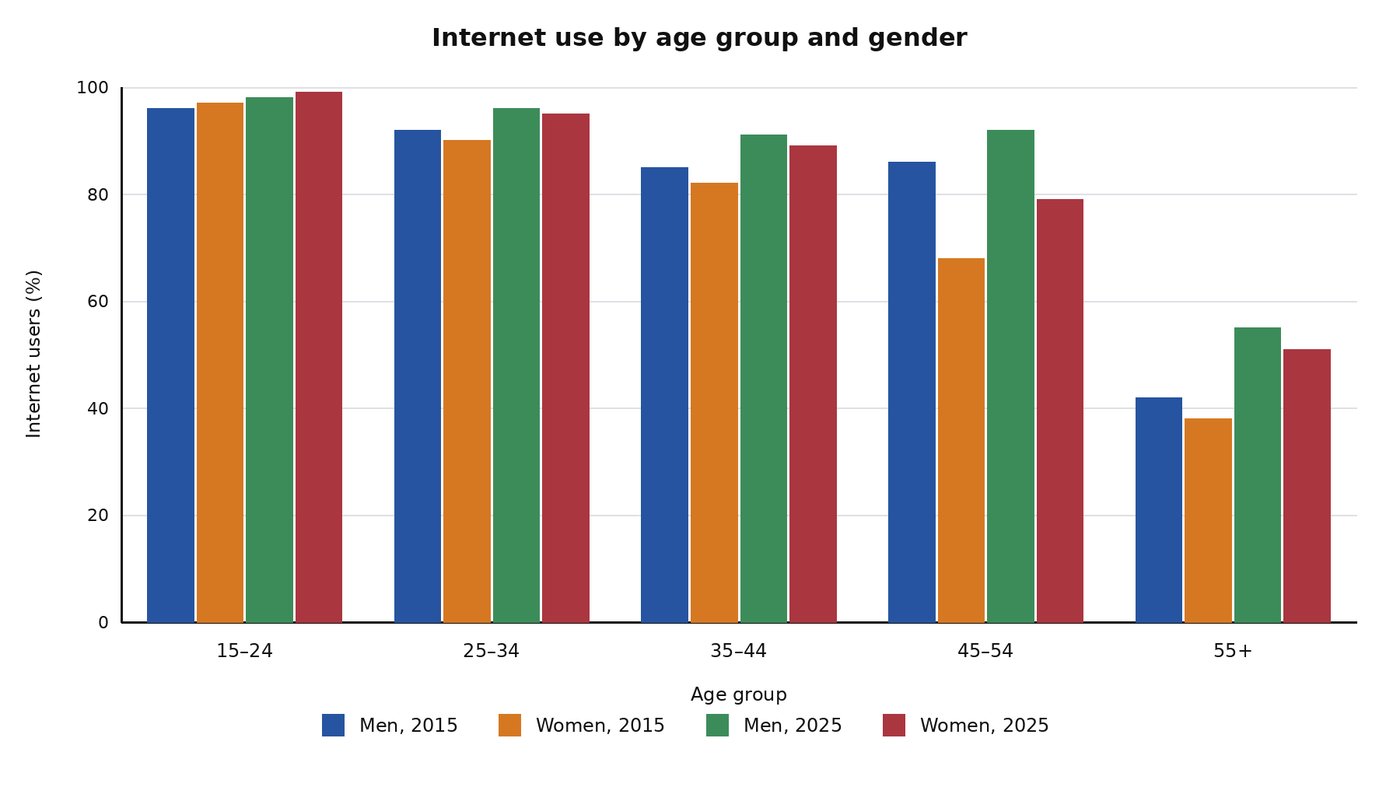
The chart below shows the proportions of men and women who accessed the internet in five age groups in one country in 2015 and 2025.
Summarise the information by selecting and reporting the main features, and make comparisons where relevant.
Student answer (Band 6.0)
The bar chart illustrates the proportion of men and women internet usage by five different age group in a country between 2015 to 2025.
Overall, in all age group internet accessed had increased with in a period of 10 year. The younger generation had more internet users with little gender disparity, while older generation had lower users with wider gender gap.
In 2015 women from the category of 15-24 age group had 96% access which rose to 99% in 2025; whereas men raised from 95% to 98%. In 25-34 age group men internet engagement rose from 90% to roughly 94%, in contrast women accounted lower enagement than men (89% and 93%). Similarly in the 35-44 category men had slightly more internet access than women.
The gender differences are more visible in from the age group of 45-54, where men had nearly 86% and women had 69% access in 2015 which rose to 96% and 79% in 2025. The 55 plus age group had gender gap as well as lower access to internet in comparison to other age groups.
AI examiner evaluation
| Criterion | Band |
|---|---|
| Task Achievement / Task Response | 6.5 |
| Coherence and Cohesion | 6.5 |
| Lexical Resource | 6.0 |
| Grammatical Range and Accuracy | 5.5 |
| Overall | 6.0 |
Task Achievement / Task Response: Band 6.5
You provide a relevant overview, identifying the broad rise in internet use and the contrast between high usage among younger people and lower usage among older people. Several comparisons are also useful, especially the 15–24 figures and the substantial gender gap in the 45–54 group. However, some reported figures are inaccurate: for example, men aged 15–24 were about 96% in 2015, not 95%; for ages 25–34, the figures were 92% and 90% in 2015, rising to 96% and 95% in 2025, rather than the values given. The 45–54 male figure in 2025 was about 92%, not 96%. The 35–44 and 55+ groups are not fully reported, so parts of the data remain underdeveloped.
Coherence and Cohesion: Band 6.5
The response has a clear overall structure: an introduction, an overview, and two detail paragraphs. The overview gives the reader a useful framework, and transitions such as “whereas,” “in contrast,” and “Similarly” help connect comparisons. This coherent arrangement is a strength. However, the final paragraph ends with a general statement about the 55+ group without giving its figures or comparing the changes between years, so the progression of detail feels incomplete. Some linking is also slightly awkward, as in “more visible in from the age group,” and the repeated age-group-by-age-group pattern could be organised more effectively by grouping the main trends across years or genders.
Lexical Resource: Band 6.0
You use a suitable range of vocabulary for describing a chart, including “proportion,” “gender disparity,” “rose,” and “in contrast.” These choices make the main comparisons understandable, and you attempt some less common expressions. However, several word combinations or forms are inaccurate or unnatural, such as “men and women internet usage,” “internet accessed had increased,” and “men internet engagement.” “Enagement” is also misspelled, and “lower users” is imprecise. Aim for standard chart language and accurate collocations, for example, “internet use among men and women” and “the proportion of users increased.” This would make the description more precise and fluent.
Grammatical Range and Accuracy: Band 5.5
You attempt a mix of simple and complex sentences, including a contrast clause with “whereas” and a sentence beginning “where men had…”. Meaning is generally recoverable, but some grammatical errors recur. The opening sentence has an unclear noun phrase (“the proportion of men and women internet usage”) and an incorrect time expression (“between 2015 to 2025”). There are also errors in agreement and verb forms, as in “in all age group internet accessed had increased” and “men raised from 95% to 98%.” Articles, plurals, and prepositions also need attention: “in a period of 10 year” should use a plural form. Practise accurate sentence patterns for describing changes and comparisons.
See this exact question answered at other band scores. The same prompt compared across bands.
Browse more IELTS Writing model answers or get your own writing scored by the same AI examiner.