Band 6.5 IELTS Writing Task 1 Model Answer
Overall Band Score: 6.5 · IELTS Predictions Nov 2026 · 2026-11-25
IELTS Writing Task 1 question
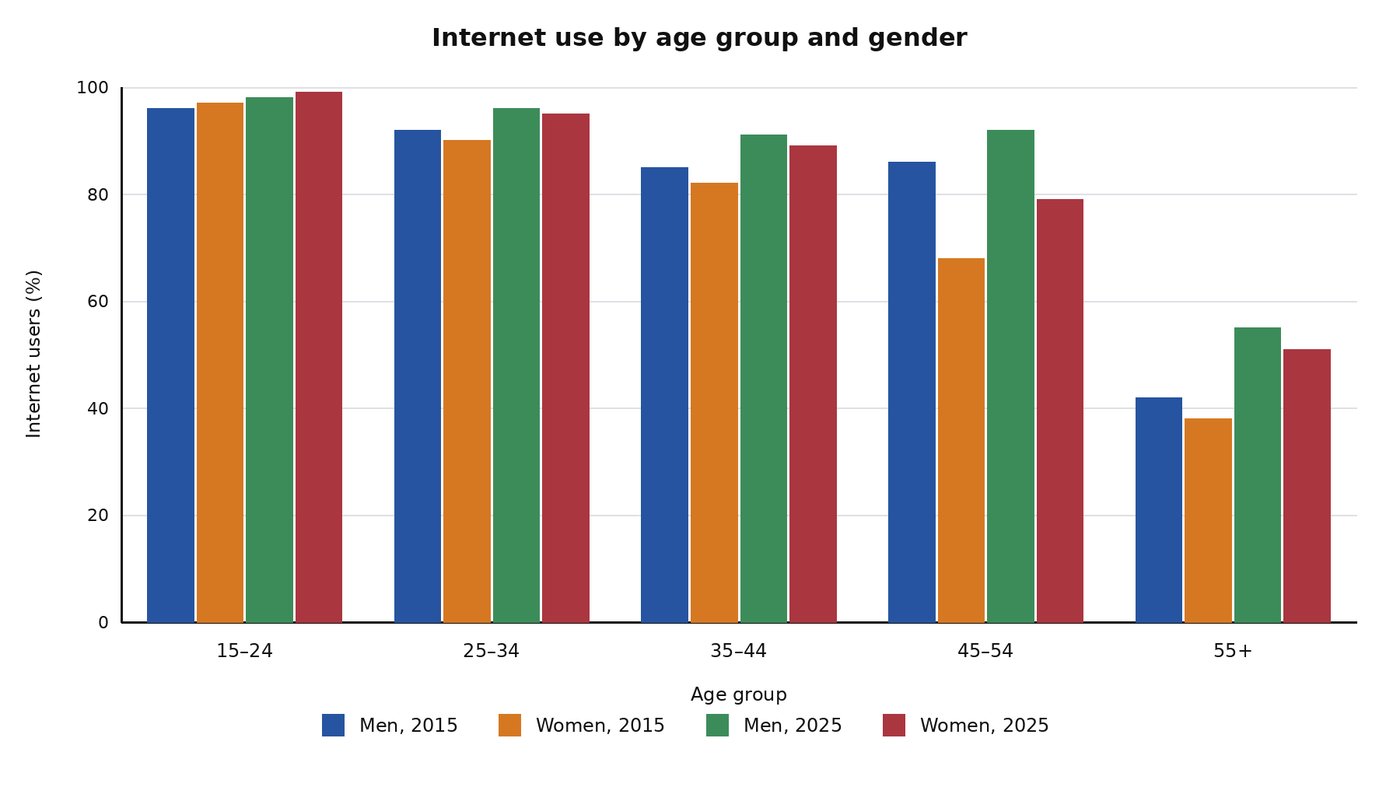
The chart below shows the proportions of men and women who accessed the internet in five age groups in one country in 2015 and 2025.
Summarise the information by selecting and reporting the main features, and make comparisons where relevant.
Student answer (Band 6.5)
The bar chart given illustrates the comparison of internet use by five age groups of both genders in 2015 and 2025 in a country.
Overall, proportion of internet use remained the highest among younger age groups especially below 24 years with an increasing trend in 2025 in both genders. Older age group above 55 years showed little interest in internet use.
In 2015 95% men and 97% women form age group 15-24 years, recorded to have accessed internet. This number rose to 98% and 99% respectively in 2025. Likewise, in age group 25-34 years, 91% men and 90% women used internet in 2015 with an increase to 95% and 94% respectively by 2025. Similarly, 83% males and 81% females, aged 35 to 44 years were found to be internet users in 2015. Their share climbed to 90% and 88% for men and women respectively by 2025.
Individuals of age 45--54 showed a notable disparity of internet use between males and females. Eighty-four percent males used internet in 2015, while this figure was much low (70%) for femlaes .The collected data revealed that this value rose to 90% and 78% for men and women respectively by 2025.
In contrast, internet use remained lowest in older people with age more than 55years. Fourt-one percent male and 38% females accessed internet in 2015, whease this percentage increased to 55%(men) and 53% (women) by 2025.
AI examiner evaluation
| Criterion | Band |
|---|---|
| Task Achievement / Task Response | 7.0 |
| Coherence and Cohesion | 7.0 |
| Lexical Resource | 6.0 |
| Grammatical Range and Accuracy | 6.0 |
| Overall | 6.5 |
Task Achievement / Task Response: Band 7.0
You provide a clear overview of the main pattern: internet use is generally higher among younger groups, rises by 2025, and is lowest among people aged 55 and over. The response also makes relevant comparisons across both genders and years, and most reported figures are close to the chart. However, a few values are less accurate: for example, men aged 45–54 are shown at about 86% in 2015 and 92% in 2025, rather than 84% and 90%; women aged 55+ reach about 51% in 2025, not 53%. The overview’s claim that older people showed “little interest” is also somewhat over-generalised, since use still exceeds half in 2025. More precise reporting and a neutral description of the figures would strengthen the response.
Coherence and Cohesion: Band 7.0
The response is organised in a clear sequence: an introduction, an overview, comparisons for the younger and middle age groups, and a final paragraph on the oldest group. Linking expressions such as “Likewise,” “Similarly,” and “In contrast” help readers follow the comparisons, and the progression from younger to older groups is logical. Some transitions are a little formulaic, however, and the repeated pattern of listing men and women for each year makes parts of the report feel mechanical. The overview could also connect more directly to the detailed comparisons by identifying the broad gender pattern or the especially large gap among older groups. Aim for more varied grouping of related data while retaining this clear paragraph structure.
Lexical Resource: Band 6.0
You use an adequate range of vocabulary for describing chart data, including “proportion,” “increasing trend,” “notable disparity,” and “climbed.” These choices help communicate comparisons and changes. Some word choices and collocations are less natural or imprecise, such as “little interest” for a measured rate of internet access and “this figure was much low.” There are also spelling errors, including “femlaes,” “Fourt-one,” and “whease,” which detract from accuracy even though the intended meaning is generally recoverable. Use standard chart-reporting language consistently, and proofread carefully for spelling and word forms. More precise terms for participation and percentage changes would improve flexibility and control.
Grammatical Range and Accuracy: Band 6.0
You use a mix of simple and more complex sentence forms, including the overview sentence with “especially” and the contrast introduced by “while.” Most comparisons remain understandable, and the response communicates the data despite some grammatical slips. Examples include the missing article in “proportion of internet use,” the awkward construction “95% men and 97% women form age group,” and the agreement issue in “Individuals … showed” followed by “this figure was much low.” Punctuation is also inconsistent, as in the missing space after “femlaes.” Work on articles, prepositions, sentence construction, and punctuation, then check each sentence for a complete and grammatically consistent comparison. This would make the varied structures more accurate.
See this exact question answered at other band scores. The same prompt compared across bands.
Browse more IELTS Writing model answers or get your own writing scored by the same AI examiner.