Band 5.5 IELTS Writing Task 1 Model Answer
Overall Band Score: 5.5 · IELTS Last Minute Nov 2026 · 2026-11-19
IELTS Writing Task 1 question
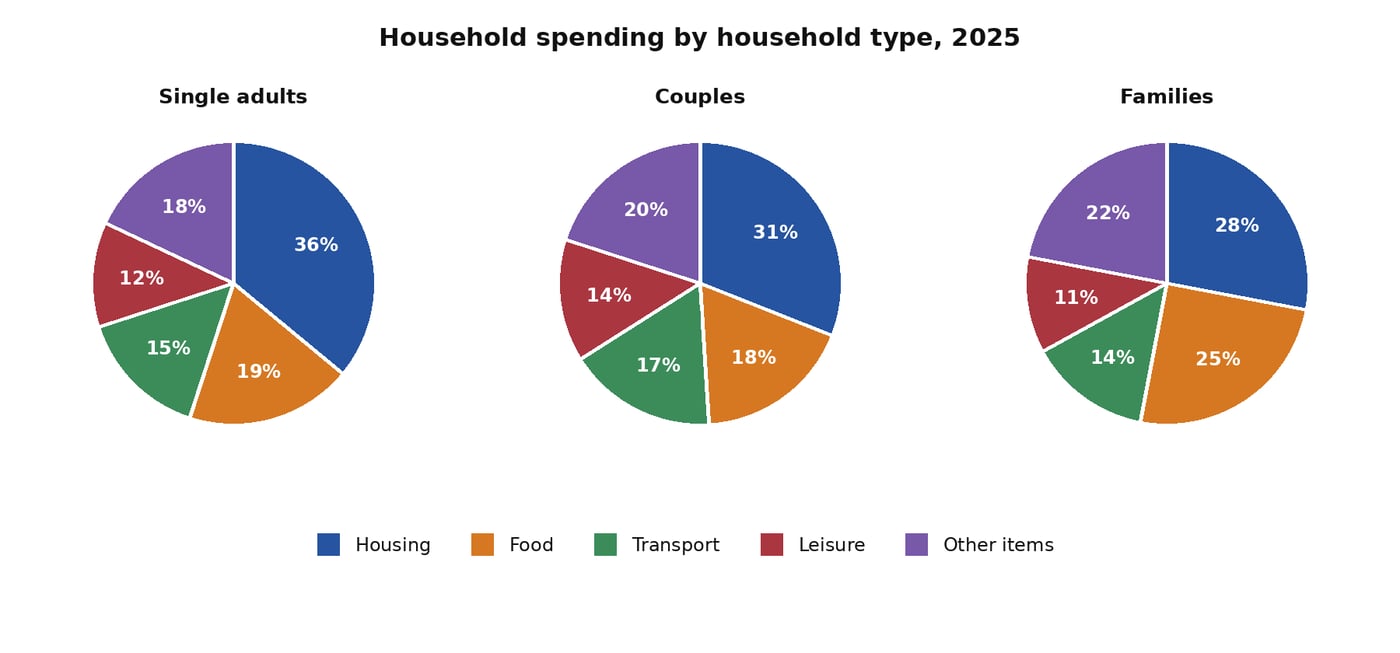
The pie charts below compare how single adults, couples and families in one country allocated their household spending across five categories in 2025.
Summarise the information by selecting and reporting the main features, and make comparisons where relevant.
Student answer (Band 5.5)
The given three pie charts compare the proportion of five different household expenditure spent by single adults, couples and families in one country in 2025.
Overall, it can be observed that Housing had the largest proportion of expenditure among three household types. Meanwhile, leisure spend recorded a lowest share.
Turning to the details, it is evident that Single Adults spent huge on Housing which accounted for 36%, followed by couples category and Families at 31% and 28% each share. Additionally, The second main expense was food , all three categories spent on food at 19%, 18% and 25% respectively.
Moreover, expenditure on transport by single Adults, couples and families which represented at below 20% share. unmarried people, married and families spent least on leisure shared a similar share at 12%, 14% and 11% respectively. Lastly, other iteams expense contributed to 18%,20% and 22% share of each .
AI examiner evaluation
| Criterion | Band |
|---|---|
| Task Achievement / Task Response | 5.5 |
| Coherence and Cohesion | 6.0 |
| Lexical Resource | 5.5 |
| Grammatical Range and Accuracy | 5.5 |
| Overall | 5.5 |
Task Achievement / Task Response: Band 5.5
You identify the chart’s subject and give a clear overview: housing takes the largest share across all three household types, while leisure is the smallest. You also report several accurate figures, including housing at 36%, 31% and 28%, and food at 19%, 18% and 25%. However, the response is under the required 150 words, which limits how fully you can develop the comparisons. Some details are also imprecise: transport is described only as “below 20%,” although the exact figures are available, and “the second main expense was food” is not true for couples, whose other-items share (20%) exceeds food (18%). Develop the overview and compare the categories more selectively and accurately.
Coherence and Cohesion: Band 6.0
The response has a recognisable structure, moving from an introduction and overview to details, and the paragraphs broadly group related information. Linking expressions such as “Overall,” “Additionally,” “Moreover” and “Lastly” help signal progression. However, some connections are mechanical or unclear. For example, “Moreover, expenditure on transport … which represented at below 20% share” does not form a complete, clear statement, and the shift to “unmarried people, married and families” makes the household groups harder to track. The final paragraph also combines transport, leisure and other items without clearly distinguishing their comparisons. Use clearer topic sentences and consistent labels for the three household types, and connect each comparison directly to its figures.
Lexical Resource: Band 5.5
You use relevant vocabulary for describing charts, including “proportion,” “accounted for,” “expense” and “share,” so the topic is generally clear. There is some attempt to vary wording, but several choices are inaccurate or unnatural, such as “spent huge on Housing,” “leisure spend recorded a lowest share” and “other iteams expense.” The spelling error in “iteams” and inconsistent capitalisation also reduce control. Some expressions, including “unmarried people” and “married,” are not precise substitutes for “single adults” and “couples” in this chart. Aim for accurate collocations and consistent category names; this will make the comparisons sound more natural and precise.
Grammatical Range and Accuracy: Band 5.5
You attempt both simple statements and longer structures, including “it can be observed that…” and “which accounted for 36%,” and the main message is usually understandable. However, some complex sentences are incomplete or awkwardly formed. For example, “expenditure on transport … which represented at below 20% share” lacks a clear main clause, while “all three categories spent on food at 19%, 18% and 25% respectively” has an unclear subject and an unnatural grammatical pattern. There are also errors with articles, agreement and punctuation, as in “a lowest share” and the spacing around commas. Build comparisons with complete clauses, check singular and plural forms, and use punctuation to separate ideas cleanly.
See this exact question answered at other band scores. The same prompt compared across bands.
Browse more IELTS Writing model answers or get your own writing scored by the same AI examiner.