Band 6.0 IELTS Writing Task 1 Model Answer
Overall Band Score: 6.0 · IELTS Last Minute Nov 2026 · 2026-11-21
IELTS Writing Task 1 question
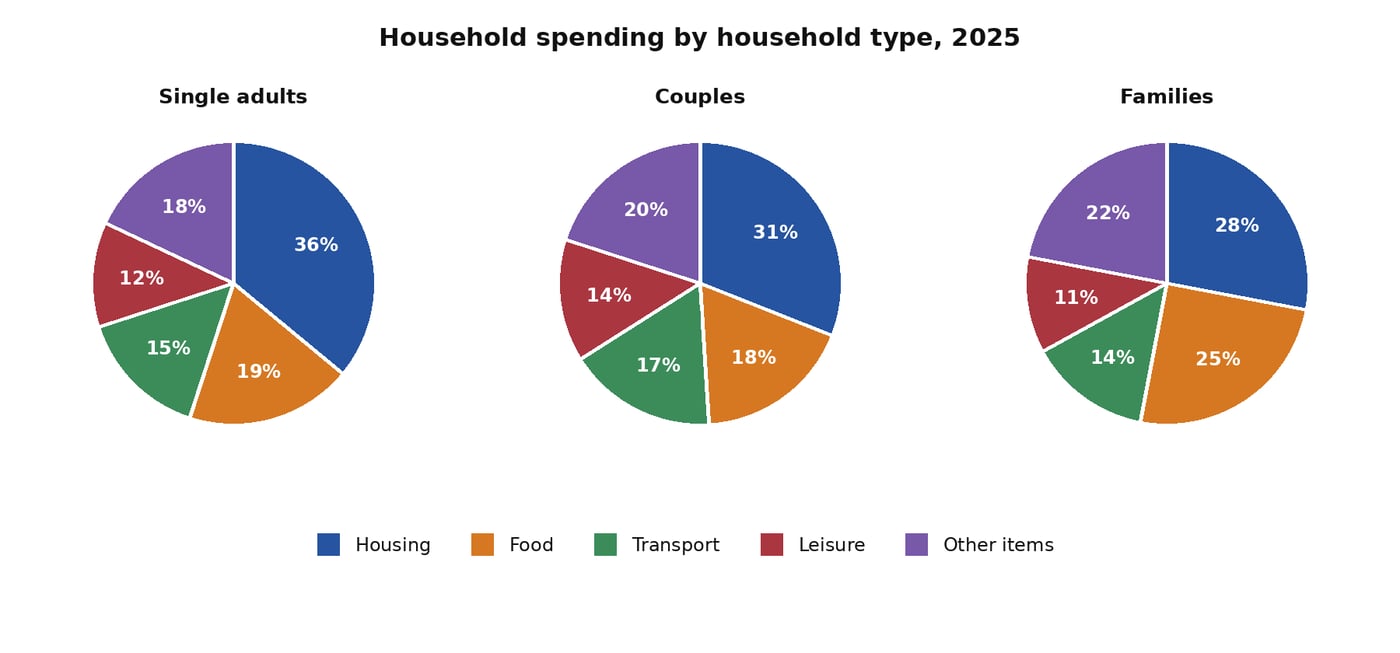
The pie charts below compare how single adults, couples and families in one country allocated their household spending across five categories in 2025.
Summarise the information by selecting and reporting the main features, and make comparisons where relevant.
Student answer (Band 6.0)
The pie charts compare the proportions of household spendings across five different categories in adults, couples and families in one country in 2025.
Overall, it is clear that housing accounted for the largest spending of income among all hosehold types especially in single adults whereas, lesisure accounted for the least spending paticularly in families.
Single adults spent most of their spending on housing 36% as compared to transport only 12%. The second most highest spending in this group is on food 19%, followed by other items and transport, 18% and 15%, respecctively.
Similarly, couples spent highest amount of spending on housing 32%,followed by second highest other items and food, 20% and 18%, respectively. The least amount of spending is spent on leisure 14% slightly higher than single adults .
Likewise families spent majority of their spending on housing accounted for 28 %, while only 11% is spent on leisure. In comparison to single adults and couples they spent little higher 25 % on food and 22% on other items whereas, only 14% is spent on transport.
AI examiner evaluation
| Criterion | Band |
|---|---|
| Task Achievement / Task Response | 6.5 |
| Coherence and Cohesion | 6.5 |
| Lexical Resource | 5.5 |
| Grammatical Range and Accuracy | 5.5 |
| Overall | 6.0 |
Task Achievement / Task Response: Band 6.5
The response identifies the main pattern accurately: housing is the largest category for all three household types, while leisure is the smallest, and it includes relevant comparisons across the groups. Most figures are reported correctly, including the single-adult and family data. However, couples’ housing is given as 32% rather than 31%, and the single-adult comparison says transport is 12%, although transport is 15% (12% is leisure). This also makes the overview’s claim that leisure is lowest particularly in families less precise, since leisure is lowest for every group. The overview and coverage are clear, but some comparisons could be developed more systematically to show how spending differs across all categories.
Coherence and Cohesion: Band 6.5
The response has a clear overall structure: an introduction, an overview, and separate paragraphs describing the three household types. Sequencing is generally easy to follow, and phrases such as “Similarly,” “Likewise,” and “In comparison” help connect the information. This gives the report a coherent progression. However, the repeated pattern of describing each group in turn makes some comparisons across groups less direct, and several linking phrases are used mechanically. For example, “followed by second highest other items and food” is difficult to process, while “whereas” joins details without a fully clear contrast. Grouping related categories or comparing the same category across household types would make the cohesion more flexible and the comparisons easier to follow.
Lexical Resource: Band 5.5
The response uses relevant vocabulary for describing charts, including “proportions,” “accounted for,” “followed by,” and “in comparison.” These choices show an adequate attempt to report rankings and contrasts. However, the range is limited by repeated and sometimes unnatural phrases such as “spent most of their spending,” “highest amount of spending,” and “least amount of spending is spent.” There are also noticeable spelling errors, including “hosehold,” “lesisure,” “paticularly,” and “respecctively,” which reduce accuracy and polish. Aim for concise, natural collocations and check spelling carefully. More precise terms such as “share,” “proportion,” and “expenditure” can help vary the wording without making the report sound repetitive.
Grammatical Range and Accuracy: Band 5.5
The report includes both simple statements and some attempts at more complex structures, such as “whereas only 11% is spent on leisure” and “In comparison to single adults and couples…”. The main information remains understandable, but grammatical control is uneven. For example, “The second most highest spending… is on food” has an incorrect comparative construction, and “couples spent highest amount” is missing an article. The sentence beginning “In comparison to single adults and couples they spent…” also needs clearer punctuation and a more controlled structure. There are some tense and agreement inconsistencies, including “only 11% is spent” alongside past-tense reporting. Practise accurate comparative forms and vary sentence structures while checking articles, punctuation, and tense consistency.
See this exact question answered at other band scores. The same prompt compared across bands.
Browse more IELTS Writing model answers or get your own writing scored by the same AI examiner.