Band 5.5 IELTS Writing Task 1 Model Answer
Overall Band Score: 5.5 · IELTS Last Minute Nov 2026 · 2026-11-23
IELTS Writing Task 1 question
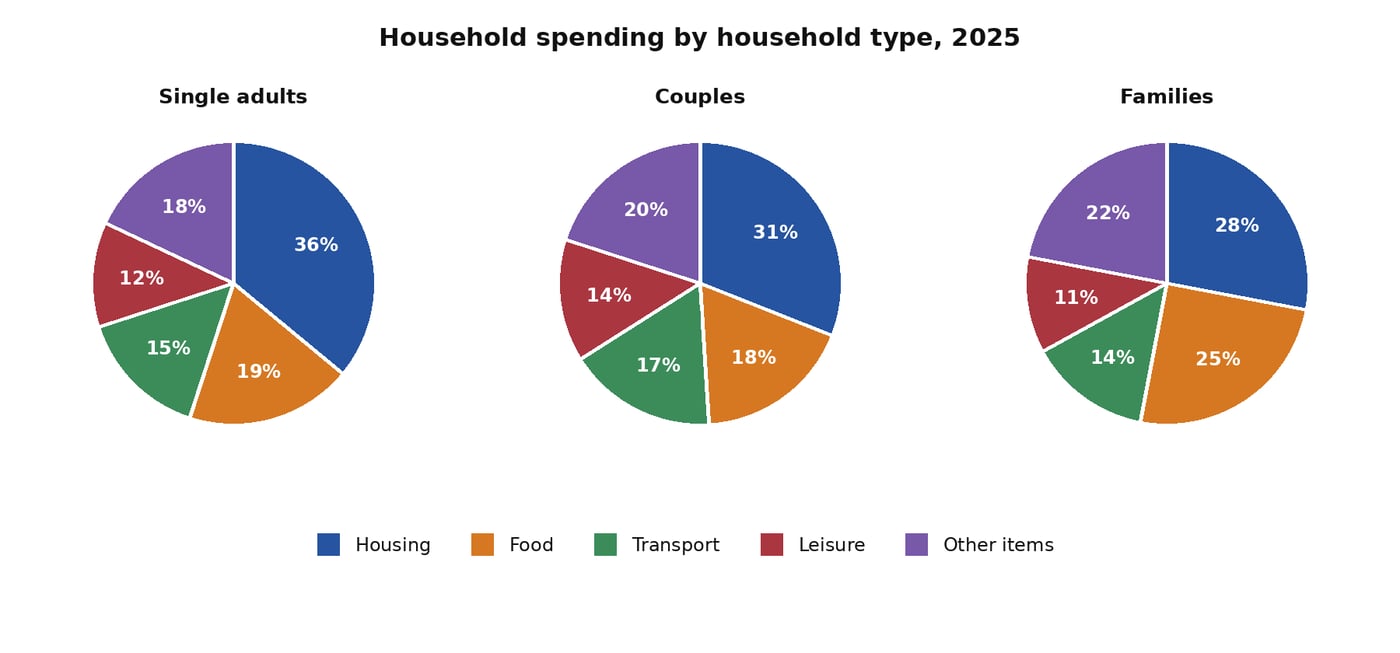
The pie charts below compare how single adults, couples and families in one country allocated their household spending across five categories in 2025.
Summarise the information by selecting and reporting the main features, and make comparisons where relevant.
Student answer (Band 5.5)
The pie charts illustrate the amount spending of adults, couples and families on transport, leasuire, housing, food and other items in 2025.
Overall, it is clear from the chart that a large proportion is accounted for housing from each catagory whereas a small ratio is used for leasuire and transport.
Overview, Adults are spending 36 percent which is higher than couple 31 percent as well as families 28 percent. Families overtakes 25 percent share of food than couples a minor portion 18 percent and singles 19 percent.Budge for traveling is almost same in each group rages 14 to 17 percent similarly leasuire 11 to 14 percent.
Other items are dominated in families 22 percent and than couples are 2 percent less where as singles are 4 percent lag behind than families.
All the three catagories have something higher than other such as families rank first in food and other items by comparision couples in transport and leisure while sdults in housing.
AI examiner evaluation
| Criterion | Band |
|---|---|
| Task Achievement / Task Response | 6.5 |
| Coherence and Cohesion | 5.5 |
| Lexical Resource | 5.5 |
| Grammatical Range and Accuracy | 5.0 |
| Overall | 5.5 |
Task Achievement / Task Response: Band 6.5
You identify the main pattern accurately: housing takes the largest share in all three household types, and you compare several categories using correct figures. For example, you report housing at 36% for single adults, 31% for couples and 28% for families, and note that families allocate the most to food and other items. This gives the response a clear overview and relevant comparisons. Some features are less fully explained, however: the statement that leisure and transport have a “small ratio” is broad, and the comparison of other items would be clearer if you gave the exact shares for all groups. To strengthen the summary further, select the most notable contrasts and explain them precisely rather than repeating the overview.
Coherence and Cohesion: Band 5.5
The response has an identifiable overall structure: an introduction, a general overview and further comparisons. The final sentence also attempts to bring the category leaders together. However, progression is not consistently clear because the overview is repeated in several places, and the paragraph beginning “Overview” combines food, transport, leisure and other items without a clear sequence. Linking words such as “whereas,” “similarly” and “than” are sometimes used inaccurately or leave the relationship between figures unclear. Organise the details by a consistent pattern—for example, housing and food first, then the remaining categories—and use one focused overview rather than several overlapping summary statements. This would make the comparisons easier to follow.
Lexical Resource: Band 5.5
You use relevant vocabulary for describing charts, including “proportion,” “share,” “dominated” and “rank first,” and the reader can generally understand the intended comparisons. However, word choice and spelling errors are noticeable and sometimes make the meaning less precise. Examples include “amount spending,” “catagory,” “leasuire,” “Budge for traveling” and “rages.” Some expressions are also unnatural for this task, such as “a small ratio is used” and “families overtakes 25 percent share of food.” Aim for accurate, conventional chart language such as “the proportion spent on,” “accounted for” and “ranged from.” Proofreading spelling and choosing natural collocations would make your vocabulary more reliable and precise.
Grammatical Range and Accuracy: Band 5.0
You attempt both simple statements and longer comparisons, including “Families overtakes 25 percent share of food than couples…” and the final sentence comparing which group leads each category. These attempts show some range, but control is inconsistent, and several sentence structures are difficult to follow. For example, “Families overtakes” has a subject–verb agreement error, while “couples a minor portion 18 percent” lacks a complete grammatical connection. The sentence beginning “Other items are dominated in families” also has an unclear construction. Use complete clauses with explicit verbs and comparison structures, such as “Families spend 25% on food, compared with 18% for couples.” Check agreement, articles and punctuation, and keep longer comparisons grammatically complete.
See this exact question answered at other band scores. The same prompt compared across bands.
Browse more IELTS Writing model answers or get your own writing scored by the same AI examiner.