Band 5.0 IELTS Writing Task 1 Model Answer
Overall Band Score: 5.0 · IELTS Last Minute Nov 2026 · 2026-11-23
IELTS Writing Task 1 question
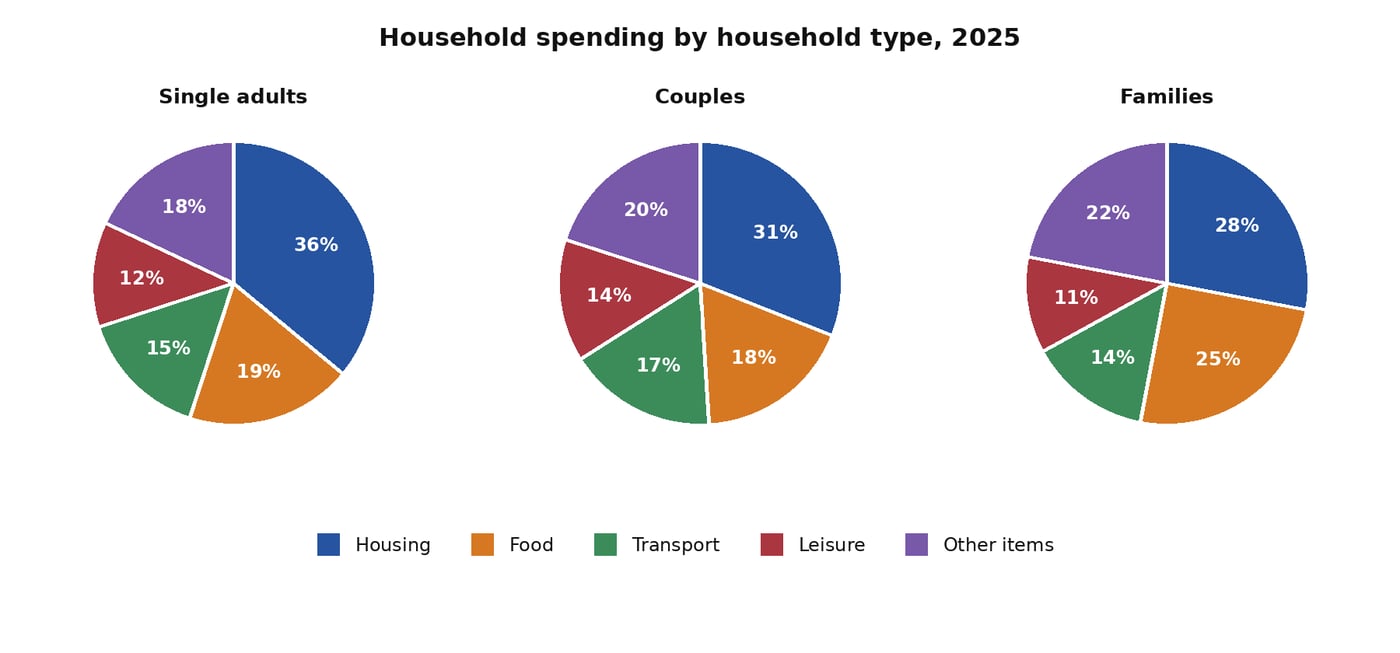
The pie charts below compare how single adults, couples and families in one country allocated their household spending across five categories in 2025.
Summarise the information by selecting and reporting the main features, and make comparisons where relevant.
Student answer (Band 5.0)
The pie chart illustrates the information about househoold spending by household type in 2025.
Firstly, there are three household in which single adults, couples and families. As, the household spending of single adults on housing, food, transport, leisure and other items are 36%, 19%, 15%, 12% and 18%. Moreover, couples spending on their household is 31% on housing, 18% on food, 17% on transport, 14% on leisure, and 20% on other items which is given in diagram.
Moving further with remaining details that some factors in household spending by familes are little bitt less from other two types like in housing there is 28%, food 25%, transport 14%, leisure 11% and spending on other items are 22%.
overall, the pie chart shows the household spending by different types of factors are not same but some things are near about that one figure like in leisure it is 12%,14% and 11% which is close to each other in all this factors.
AI examiner evaluation
| Criterion | Band |
|---|---|
| Task Achievement / Task Response | 5.0 |
| Coherence and Cohesion | 5.5 |
| Lexical Resource | 5.0 |
| Grammatical Range and Accuracy | 5.0 |
| Overall | 5.0 |
Task Achievement / Task Response: Band 5.0
You report the figures for all three household types accurately, including the main category values, so the reader can identify the chart’s data. However, the response mainly lists numbers rather than selecting and comparing the most important features. The overview is vague: saying spending is “not same” does not identify the clear pattern that housing takes the largest share for every household type, while leisure is the smallest. The claim that family spending is “a little bit less” than the other types is also too broad, since families spend more on food and other items than single adults or couples. A clearer overview and a few direct comparisons would make the summary more complete and developed.
Coherence and Cohesion: Band 5.5
The response has a basic sequence: it introduces the chart, gives figures for single adults and couples, then discusses families and ends with an overview. This provides some organisation, but the progression is not consistently clear. “Firstly,” “Moreover,” and “Moving further” signal stages without showing meaningful relationships between the data, and the final paragraph repeats the idea of similarity without drawing together the main patterns. Some sentences also contain several figures in a row, making comparisons difficult to follow. Grouping the information by notable patterns—for example, housing and food shares, then the smaller categories—and using clear comparison links such as “whereas” or “by contrast” would improve cohesion.
Lexical Resource: Band 5.0
You use relevant chart vocabulary, including “household spending,” “housing,” “transport,” and “leisure,” and the category labels are generally clear. However, the range is limited and several phrases are inaccurate or unnatural, which sometimes makes the meaning less precise. Examples include “three household,” “some factors in household spending,” and “near about that one figure.” There are also spelling errors such as “househoold,” “familes,” and “bitt.” Aim for precise reporting language and accurate collocations rather than repeating general phrases such as “spending on their household.” For instance, describe a category as accounting for a share, or say that figures are similar, while checking spelling carefully.
Grammatical Range and Accuracy: Band 5.0
Most of the response uses simple sentence patterns, and the figures are usually presented in a form the reader can understand. However, grammatical errors occur frequently, and attempts to connect ideas often produce faulty structures. For example, “there are three household in which single adults, couples and families” has a number-agreement problem and an incomplete construction; “As, the household spending … are” uses an unsuitable sentence opening and mismatched agreement; and “which is given in diagram” lacks a clear grammatical reference. The final sentence also has an unclear structure around “like in leisure it is…”. Practise complete sentences with a clear subject and verb, accurate singular/plural forms, and punctuation that separates the overview from supporting details.
See this exact question answered at other band scores. The same prompt compared across bands.
Browse more IELTS Writing model answers or get your own writing scored by the same AI examiner.