Band 5.0 IELTS Writing Task 1 Model Answer
Overall Band Score: 5.0 · IELTS Last Minute Nov 2026 · 2026-11-24
IELTS Writing Task 1 question
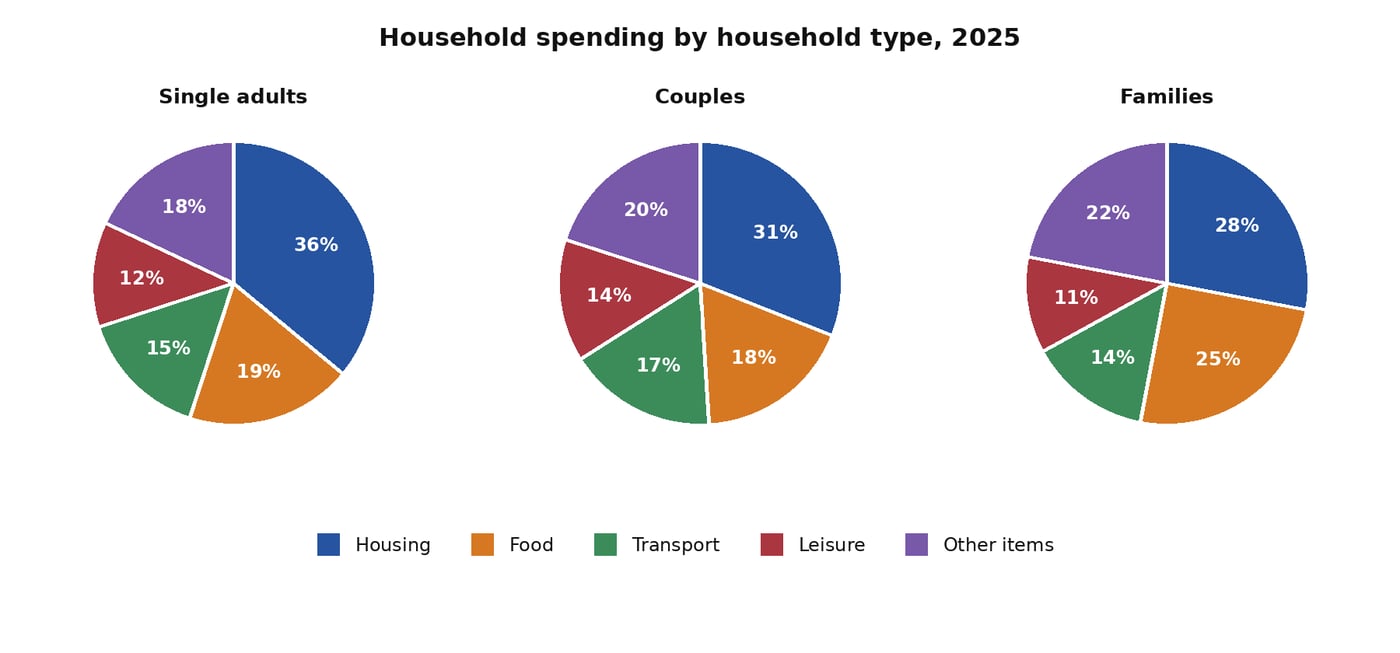
The pie charts below compare how single adults, couples and families in one country allocated their household spending across five categories in 2025.
Summarise the information by selecting and reporting the main features, and make comparisons where relevant.
Student answer (Band 5.0)
The pie chart shows the distribution of household spendings devoted to five different needs in a particular country in 2025.
Overall, it is observe that is category was dominant in all years while a least amont of money was allocated to other activities.
To begin with,allocating money on food represented the largest portion having with 28% in 2025.whereas on food spending it allocate 25%.
Moreover couples can spend 18% in food also in housing they spend 31% which is highe then the other activities.they often consumed just 14% for thier leisure , 17% on thier transport and 20% on the other activities.However accoring to the graph single adults can spend 36% of its household and 12% for entertaining purposes.they use their spending 15% on thier transportation.
Its seems that in all three categories they use less on their food but on household needs families consume less but single and couples uses significantly high and for thier entertainment they approximately spend less then the other activities.
AI examiner evaluation
| Criterion | Band |
|---|---|
| Task Achievement / Task Response | 4.5 |
| Coherence and Cohesion | 5.0 |
| Lexical Resource | 5.0 |
| Grammatical Range and Accuracy | 5.0 |
| Overall | 5.0 |
Task Achievement / Task Response: Band 4.5
You identify the chart’s topic and include several figures, such as 36% for single adults’ housing and 25% for families’ food. However, the overview is unclear and contains major misreadings: “this category was dominant in all years” does not identify the category, and “a least amount … was allocated to other activities” is inaccurate, since leisure is the smallest category for all three household types. The description also confuses categories—for example, the opening comparison says food was largest at 28%, when 28% is families’ housing share. Some relevant comparisons appear, but they are incomplete or contradictory, and several figures are not clearly linked to the correct household type. Select the main patterns accurately, then support them with clearly attributed data.
Coherence and Cohesion: Band 5.0
The response has a basic sequence: an introduction, an attempted overview, and further details about food, couples and single adults. This gives the reader some sense of the chart’s subject. However, progression is difficult to follow because the overview is vague and the body shifts between categories and household types without a consistent organising principle. Connectors such as “Moreover,” “However” and “To begin with” are used, but they do not always show a clear relationship between the ideas. The final sentence repeats broad claims rather than drawing the comparisons together. Grouping the information by category or household type, and using clear references such as “for families” or “by contrast,” would make the account easier to follow.
Lexical Resource: Band 5.0
You use some task-related vocabulary, including “distribution,” “allocated,” “portion” and “transportation,” so the reader can recognise that you are describing household spending. However, the range is limited and several choices are inaccurate or awkward, which sometimes makes the meaning unclear. “Household spendings” is not the natural form, while “other activities” does not accurately represent the chart’s “other items.” Phrases such as “spending it allocate” and “consumed just 14%” also show weak control of collocation and word form. Spelling errors, including “thier,” “accoring” and “highe,” further reduce clarity. Aim for precise category labels and repeat useful terms accurately rather than substituting unclear expressions.
Grammatical Range and Accuracy: Band 5.0
You attempt both simple and longer sentences, including a contrast with “whereas” and a sentence beginning “However,” but control is inconsistent. Errors in verb forms and sentence construction occur in examples such as “it is observe,” “it allocate 25%” and “single adults can spend 36% of its household.” Agreement and pronoun reference are also problematic in “single and couples uses,” while missing or misplaced punctuation creates run-on sentences, particularly around “2025.whereas” and “activities.they.” These errors sometimes make it difficult to identify who spends what. Practise accurate present-tense reporting patterns, such as “Families allocate…” and “Single adults spend…,” and separate complete sentences with appropriate punctuation.
See this exact question answered at other band scores. The same prompt compared across bands.
Browse more IELTS Writing model answers or get your own writing scored by the same AI examiner.