Band 5.5 IELTS Writing Task 1 Model Answer
Overall Band Score: 5.5 · IELTS Last Minute Nov 2026 · 2026-11-28
IELTS Writing Task 1 question
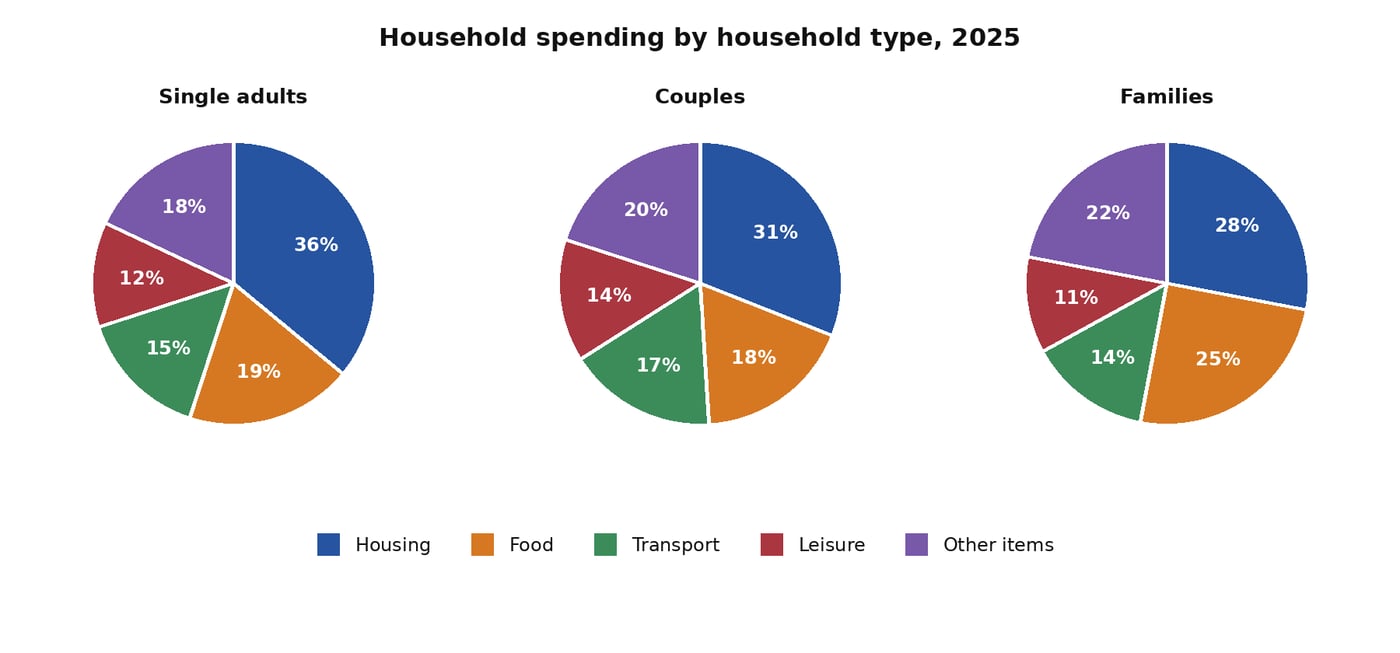
The pie charts below compare how single adults, couples and families in one country allocated their household spending across five categories in 2025.
Summarise the information by selecting and reporting the main features, and make comparisons where relevant.
Student answer (Band 5.5)
The pie charts given below illsustrate the percentage distributution of single, adults ,couples and familes in a country allocated thier household expenses across five sections in 2025.
Overall, is is crystal clear that housing spending accpunted for largest proprtion ,while leisure represented smallest proportion for all given catagories.
The proprtion of housing spending for house contributed 36% for adults. The percentage of housing decrese gradually it contributed 31% for couples and and for families is represted 28%
The proportion od leisure remains at lowest value for all 12% for single adults ,14 % couples and 11 % for families.
The other items for singles represented 18% , for couples 20% and its percentage is higher in families at 22%.
Transport spending also varies for all catagories. it contributed 15% adults,17% for couples and 14% for families.Food expenses also different for all catagories like 19% for adults and 17 % for couples and for families it
AI examiner evaluation
| Criterion | Band |
|---|---|
| Task Achievement / Task Response | 5.5 |
| Coherence and Cohesion | 5.5 |
| Lexical Resource | 5.0 |
| Grammatical Range and Accuracy | 5.0 |
| Overall | 5.5 |
Task Achievement / Task Response: Band 5.5
You identify the main pattern that housing takes the largest share and leisure the smallest, and you report several relevant figures for each household type. However, the overview is not fully accurate: leisure is not the smallest category for couples, where it is 14% compared with transport at 17% and food at 18%, but it is still the smallest share overall for each type. More importantly, the final food comparison is unfinished, and the couples’ food figure is given as 17% rather than 18%; the family figure of 25% is omitted. This leaves an important category incompletely reported and limits coverage. Check each figure against the chart and complete the comparison to make the summary more fully developed.
Coherence and Cohesion: Band 5.5
The response has a basic overall structure, with an opening, an overview and a sequence of details, and it groups information by spending category. This gives the reader some sense of how the figures relate. However, progression is weakened by the repeated pattern of listing values without clearly connecting or contrasting them. The final sentence stops after “for families it”, leaving the food comparison incomplete and disrupting the ending. Some transitions, such as “also varies” and “also different,” are repetitive, while the paragraph breaks do not clearly separate the overview from the detailed comparisons. Organise the body into clearer comparisons and use linking phrases to show changes across household types.
Lexical Resource: Band 5.0
You use relevant task vocabulary, including “percentage,” “proportion,” “housing spending,” and “household expenses,” so the topic is generally recognisable. However, the range is limited and several word-choice, spelling and form errors make the writing less clear, including “illsustrate,” “distributution,” “familes,” “accpunted,” and “catagories.” Some expressions are also unnatural, such as “housing spending for house contributed” and “its percentage is higher in families.” Aim for accurate, natural collocations such as “accounted for,” “the share allocated to,” and “was highest among families.” Proofreading spelling and avoiding repeated use of “proportion” would make your vocabulary more effective.
Grammatical Range and Accuracy: Band 5.0
You attempt both simple statements and longer comparisons, for example, “The percentage of housing decreases gradually…” and the sequence comparing housing shares across household types. However, sentence control is inconsistent, and errors often make relationships difficult to follow. Examples include “Overall, is is crystal clear,” “for families is represented 28%,” and “The proportion of leisure remains at lowest value,” where sentence structure, articles or verb forms are faulty. There are also run-on or poorly punctuated sequences, such as “for couples and and for families.” The final sentence is incomplete. Practise building accurate comparison sentences with a clear subject and verb, and check articles, agreement and punctuation before finishing.
See this exact question answered at other band scores. The same prompt compared across bands.
Browse more IELTS Writing model answers or get your own writing scored by the same AI examiner.