Band 5.5 IELTS Writing Task 1 Model Answer
Overall Band Score: 5.5 · IELTS Last Minute Nov 2026 · 2026-11-17
IELTS Writing Task 1 question
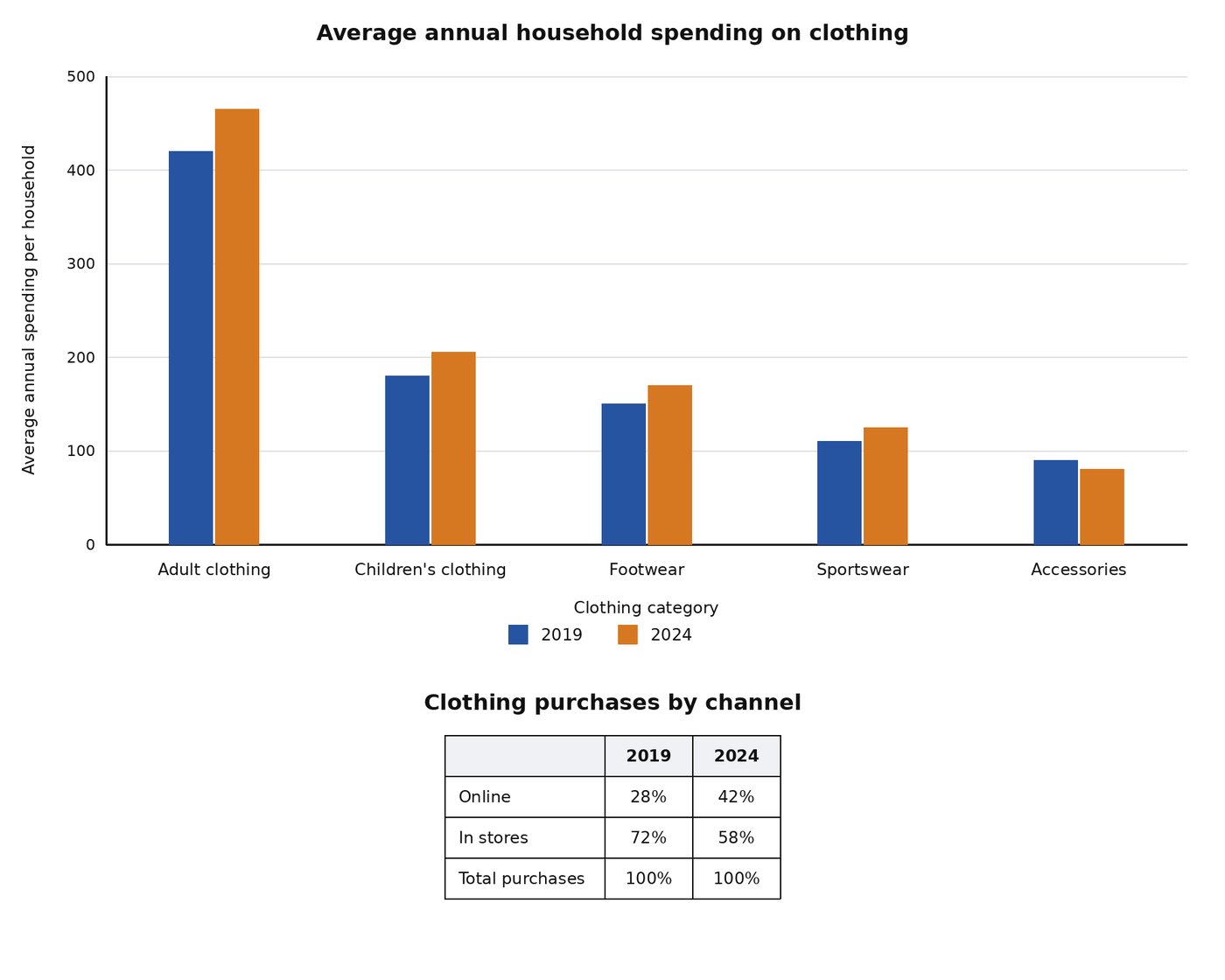
The chart below compares average annual household spending on five clothing categories in 2019 and 2024, while the table shows the proportions of clothing purchases made online and in stores in those years.
Summarise the information by selecting and reporting the main features, and make comparisons where relevant.
Student answer (Band 5.5)
The given bar chart compares an average yearly household expenses on five various clothing items during the duration of 2019 and 2024, on the other hand table illustrates the percentage of clothing purchases made online and in stores in those years. In both years, adult clothing recored highest number of annual spending, and in stores purchasing was main priority during both years.
In 2024, annual spending per household was higher in adult clothing, children's clothing, footwear and sportswear as compared to spending average annually per household in 2019. However, in 2019 the amount spent on accessories annually was higher than the annually spending in 2024.
In both years, higher percentage of citizen choosen was in stores purchasing as compared to shopping online. For some instant, the percentage of online purchasing rised to 14% and reached 42% in 2024 from 28% in 2019. In store purchasing dropped by 14% in 2024 as compared to 2019.
AI examiner evaluation
| Criterion | Band |
|---|---|
| Task Achievement / Task Response | 5.5 |
| Coherence and Cohesion | 5.5 |
| Lexical Resource | 5.5 |
| Grammatical Range and Accuracy | 5.5 |
| Overall | 5.5 |
Task Achievement / Task Response: Band 5.5
You identify the main overall patterns: adult clothing has the highest spending in both years, most purchases are in stores, and online purchasing rises while store purchasing falls. The comparisons for the four categories that increased and accessories that decreased are also accurate. However, the response gives no spending figures, so the scale of the differences is not clear, and the overview could better highlight that adult clothing spending is far above the other categories. The channel changes are reported accurately as 14 percentage points, but the category details remain underdeveloped. The response is 143 words, below the 150-word minimum; use the remaining space to include key figures and fuller comparisons.
Coherence and Cohesion: Band 5.5
The response has a basic, sensible sequence: an introduction and overview, followed by spending trends and then purchase-channel trends. This makes the main points possible to follow. However, the progression is limited, and several links between ideas are awkward or unclear. For example, “on the other hand” does not express a contrast between the chart and table, while “For some instant” is an inaccurate transition into the online figures. The second paragraph also lists categories without supporting values, so the comparison feels compressed. Use clear paragraphing and straightforward links such as “Meanwhile” or “By contrast,” and organise the details into a more deliberate comparison of spending and purchasing channels.
Lexical Resource: Band 5.5
You use some relevant task vocabulary, including “annual spending,” “percentage,” “online,” and “in stores,” and the reader can generally understand the intended comparisons. However, word choice and collocation are often inaccurate or unnatural, as in “five various clothing items,” “in stores purchasing was main priority,” and “higher percentage of citizen choosen.” There are also spelling and word-form errors, including “recored,” “choosen,” and “rised.” These issues make the description less precise and fluent. Aim for standard chart-reporting phrases such as “spending on five clothing categories,” “store purchases accounted for the larger share,” and “the proportion of online purchases rose.” Check spelling and use consistent terms for spending and purchases.
Grammatical Range and Accuracy: Band 5.5
You attempt some complex comparisons, including “as compared to spending average annually per household in 2019” and “as compared to 2019,” but sentence structures are often faulty or incomplete. The opening sentence has an unclear construction (“compares an average yearly household expenses”) and joins the chart and table with an unsuitable clause. Articles and agreement are also problematic in phrases such as “an average yearly household expenses” and “higher percentage of citizen.” The final sentence, “In store purchasing dropped by 14%,” is understandable, but the response relies heavily on similar simple statements and does not show a controlled range of structures. Practise accurate comparative clauses and check articles, plurals, and sentence boundaries.
See this exact question answered at other band scores. The same prompt compared across bands.
Browse more IELTS Writing model answers or get your own writing scored by the same AI examiner.