Band 5.5 IELTS Writing Task 1 Model Answer
Overall Band Score: 5.5 · IELTS Last Minute Nov 2026 · 2026-11-17
IELTS Writing Task 1 question
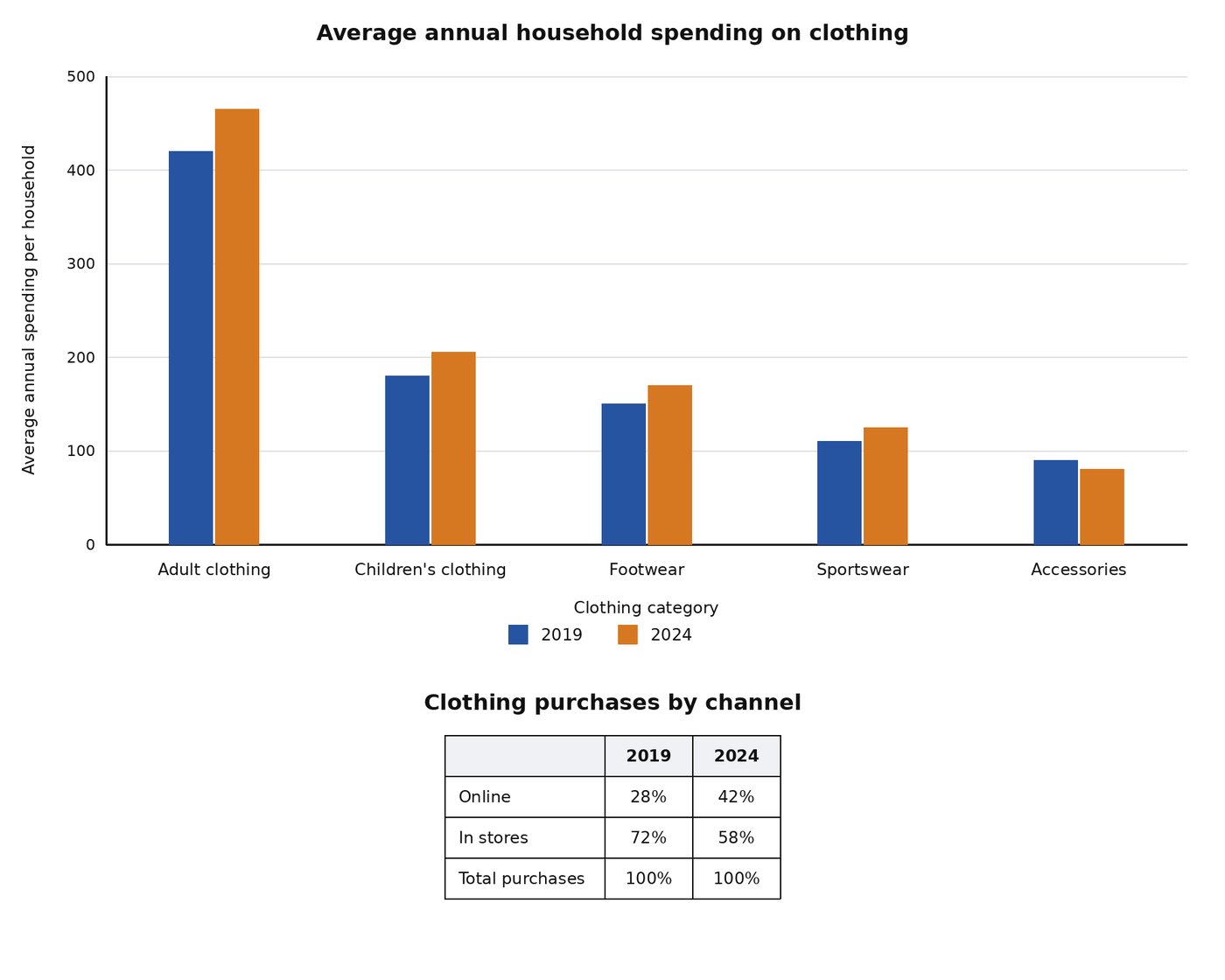
The chart below compares average annual household spending on five clothing categories in 2019 and 2024, while the table shows the proportions of clothing purchases made online and in stores in those years.
Summarise the information by selecting and reporting the main features, and make comparisons where relevant.
Student answer (Band 5.5)
The bar graph below illustrates average yearly household spending on five clothing categories between the 2019 and 2024 , while the table depicits the percentage of clothing purchases made online and stores in those years .
Overall , adult clothing recorded highest expenditure through out the year , while more people bought clothes in stores than online .
In the year 2024 , many people spend money on adult clothing by around 4500
followed by childrens clothing at 200, footwear at around 150 , accessories recorded lowest expenditure at around 95 .While in the year 2019 , vast majority of citizens spend their income on adult clothing than any other items by around 4200.
Accessories recorded lowest expenditure.
People who bought items in the store were many in both 2019 and 2024 respectively , by 72% and 58% as compared to online purchase which accounted for 28% in 2019 and 42% in 2024 respectively .
AI examiner evaluation
| Criterion | Band |
|---|---|
| Task Achievement / Task Response | 5.5 |
| Coherence and Cohesion | 6.0 |
| Lexical Resource | 5.5 |
| Grammatical Range and Accuracy | 5.5 |
| Overall | 5.5 |
Task Achievement / Task Response: Band 5.5
You identify the main contrast in the table: store purchases were higher than online purchases in both years, and you report the correct percentages. You also recognise that adult clothing had the highest spending and accessories the lowest. However, several chart figures are inaccurate or unclear: adult clothing spending was about £465 in 2024, not “4500,” and about £420 in 2019, not “4200.” The 2024 figures for footwear and accessories are also misreported or assigned unclearly; footwear was about £170 and accessories £80. The overview would be stronger if it highlighted the general rise in spending across most categories, alongside the fall in accessories spending, and the increase in online purchasing.
Coherence and Cohesion: Band 6.0
The response has a clear overall arrangement: an introduction, an overview, a paragraph about spending, and a final paragraph about purchasing channels. This makes the two visuals easy to distinguish. The channel comparison is presented in a logical order, with 2019 and 2024 figures for stores followed by those for online purchases. However, progression within the spending paragraph is less clear: the 2024 figures are listed first, then the 2019 comparison is added, and the final sentence repeats the point about accessories without giving its 2019 value. Some linking is mechanical, particularly the repeated “while” construction. Grouping the spending figures by category or comparing each year more systematically would make the relationships clearer.
Lexical Resource: Band 5.5
You use a reasonable range of task-related vocabulary, including “average yearly household spending,” “expenditure,” “percentage,” and “accounted for.” These choices generally communicate the topic, and “recorded lowest expenditure” conveys the intended ranking. However, some expressions are imprecise or do not fit the chart: “many people spend money” describes household spending as a number of people, while “vast majority of citizens” is not supported by the data. “Bought clothes in stores” is understandable but less precise than describing the proportion of purchases made in stores. There are also spelling errors, including “depicts” and “children’s.” Use concise chart language such as “spending on,” “the highest figure,” and “the share of purchases” to improve precision and naturalness.
Grammatical Range and Accuracy: Band 5.5
You attempt both simple and more complex sentence forms, including the opening sentence with “while” and the comparison beginning “People who bought items in the store…”. The main ideas remain understandable, but some grammatical errors reduce clarity. For example, “between the 2019 and 2024” uses an unnecessary article, and “adult clothing recorded highest expenditure” needs an article before “highest.” Tense and agreement are inconsistent in “many people spend” and “citizens spend,” where the past-time comparison calls for past forms. The sentence beginning “In the year 2024” also lacks a clear grammatical structure around its list of figures. Check articles, past-tense consistency, and sentence boundaries, and use complete, parallel clauses when comparing years.
See this exact question answered at other band scores. The same prompt compared across bands.
Browse more IELTS Writing model answers or get your own writing scored by the same AI examiner.