Band 5.0 IELTS Writing Task 1 Model Answer
Overall Band Score: 5.0 · IELTS Last Minute Nov 2026 · 2026-11-17
IELTS Writing Task 1 question
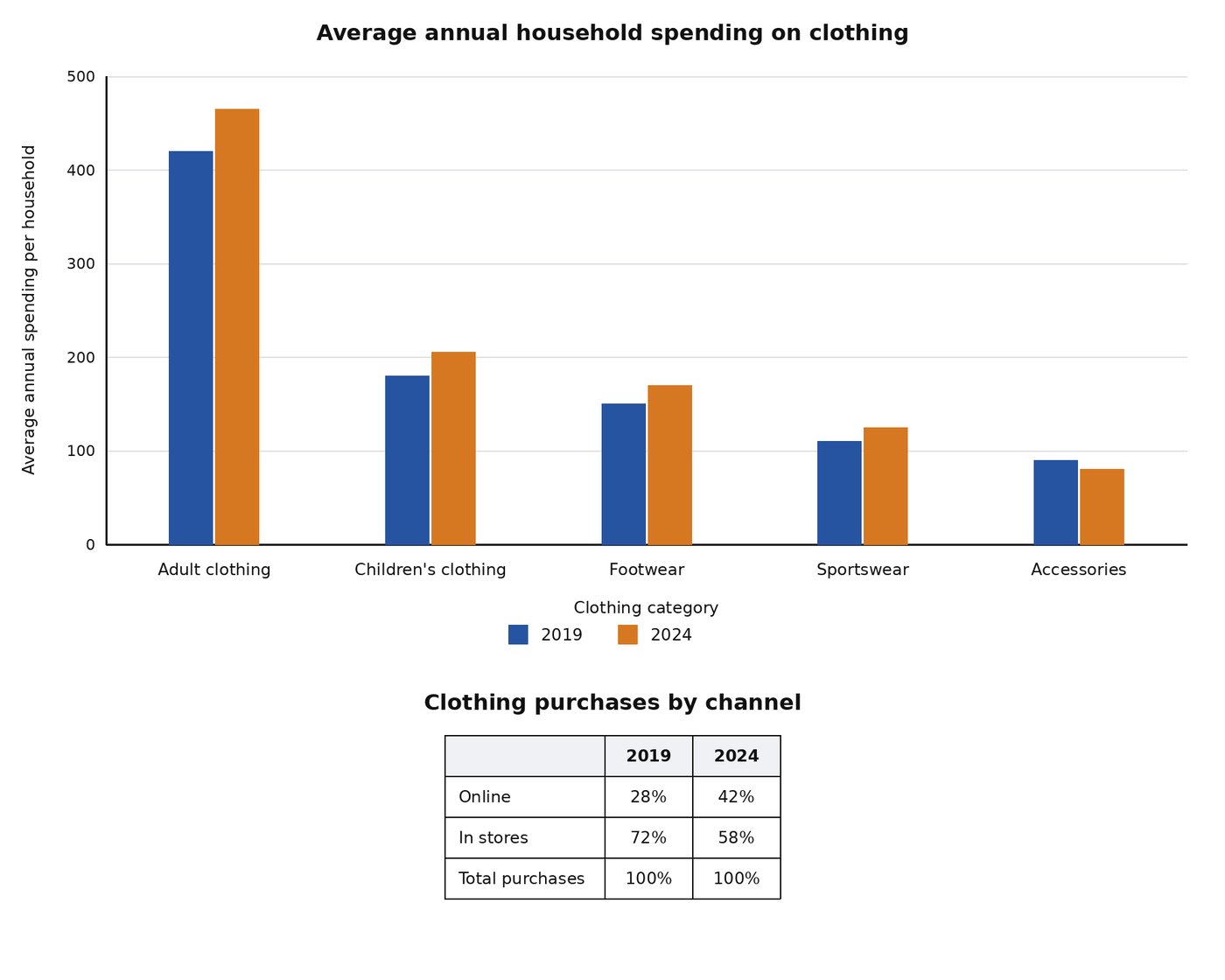
The chart below compares average annual household spending on five clothing categories in 2019 and 2024, while the table shows the proportions of clothing purchases made online and in stores in those years.
Summarise the information by selecting and reporting the main features, and make comparisons where relevant.
Student answer (Band 5.0)
The illastretion compare yearly expances in household for diffarent five categorise in 2019 and 2024. In this perticular thouse years most used platfroms are online and outlats stores.
Firstly we have adult clothing category which is highest spending item in 2019 annual number 410 spends and also 2024 annual number upto 450 spends. there is kids clothing buying in 2019 per 170 household however 2024 purchases almost 200 up household. thirdly thee is footwear in 2019 expancese 150 holders and 2024 there is 175 houses. forthly we have sportswear average expances in [redacted phone] household other hand 2024 sports shose buying 175 household and lastly we have accessories are most lowest spending in 2019 are 80 houses also 2024 purchases 70 househols. furthermore there is tow ways to purchases in this perticular channel one is online in 2019 have 28% clothing purchases and 2024 there is 42% in addition from store purchases in 2019 are 72% and 2024 has purchases 58%.
therefore comparisons to those years online purchasess highest in 2024 and from stores buying clothing highest in 2019 72%.
AI examiner evaluation
| Criterion | Band |
|---|---|
| Task Achievement / Task Response | 5.5 |
| Coherence and Cohesion | 5.5 |
| Lexical Resource | 4.5 |
| Grammatical Range and Accuracy | 4.5 |
| Overall | 5.0 |
Task Achievement / Task Response: Band 5.5
You cover both parts of the visual: spending across the five categories and the online/store proportions. The main pattern that adult clothing was the highest-spending category and accessories the lowest is present, and the channel figures are reported accurately. However, several category figures are noticeably misreported: for example, sportswear was about £110 and £125, not £150 and £175, while accessories were about £90 and £80, not £80 and £70. The overview is also limited; it would be clearer to state that spending rose in most categories, with accessories the exception, and that online purchasing increased as in-store purchasing declined. More accurate selection and comparison of the main trends would strengthen the response.
Coherence and Cohesion: Band 5.5
The response has a basic overall structure: an introduction, a paragraph describing the categories and channels, and a concluding comparison. Sequencing words such as “Firstly,” “thirdly,” and “lastly” help signal the order of information. However, the category paragraph becomes a long sequence of loosely connected statements, and the repeated “there is” constructions make progression mechanical. The shift from spending figures to purchase channels is not clearly marked, while “therefore” introduces a conclusion that largely repeats the channel figures rather than synthesising the main trends. Separate the spending data from the table, group related comparisons, and use clearer references such as “By contrast” or “Meanwhile” to show relationships between the figures.
Lexical Resource: Band 4.5
You use some task-related vocabulary, including “category,” “spending,” “online,” and “purchases,” so the topic is generally identifiable. However, the range is limited and several words or phrases are inaccurate or repeatedly used, which sometimes makes the meaning difficult to follow. Examples include “yearly expances,” “most used platfroms,” “410 spends,” and “from store purchases.” There are also frequent spelling errors, such as “illastretion,” “diffarent,” and “expancese.” Aim for precise, natural collocations for describing data, such as “annual household expenditure,” “spending amounted to,” and “purchases made in stores.” Check spelling carefully and avoid using “purchases” when you mean spending.
Grammatical Range and Accuracy: Band 4.5
The response attempts to use both simple statements and longer sentences, including a comparison introduced by “however” and a final sentence beginning “therefore.” However, sentence structures are often incomplete or difficult to interpret, and grammatical errors occur throughout. For example, “The illastretion compare yearly expances” lacks correct subject–verb agreement, while “in 2019 annual number 410 spends” has no clear grammatical structure. Articles, plurals, and prepositions are also frequently missing or incorrectly used, as in “in 2019 have 28% clothing purchases.” Punctuation does not consistently separate the many comparisons. Practise building complete sentences with a clear subject and verb, for example, “Households spent about £420 on adult clothing in 2019.” Then check tense, agreement, and sentence boundaries.
See this exact question answered at other band scores. The same prompt compared across bands.
Browse more IELTS Writing model answers or get your own writing scored by the same AI examiner.