Band 5.5 IELTS Writing Task 1 Model Answer
Overall Band Score: 5.5 · IELTS Last Minute Nov 2026 · 2026-11-17
IELTS Writing Task 1 question
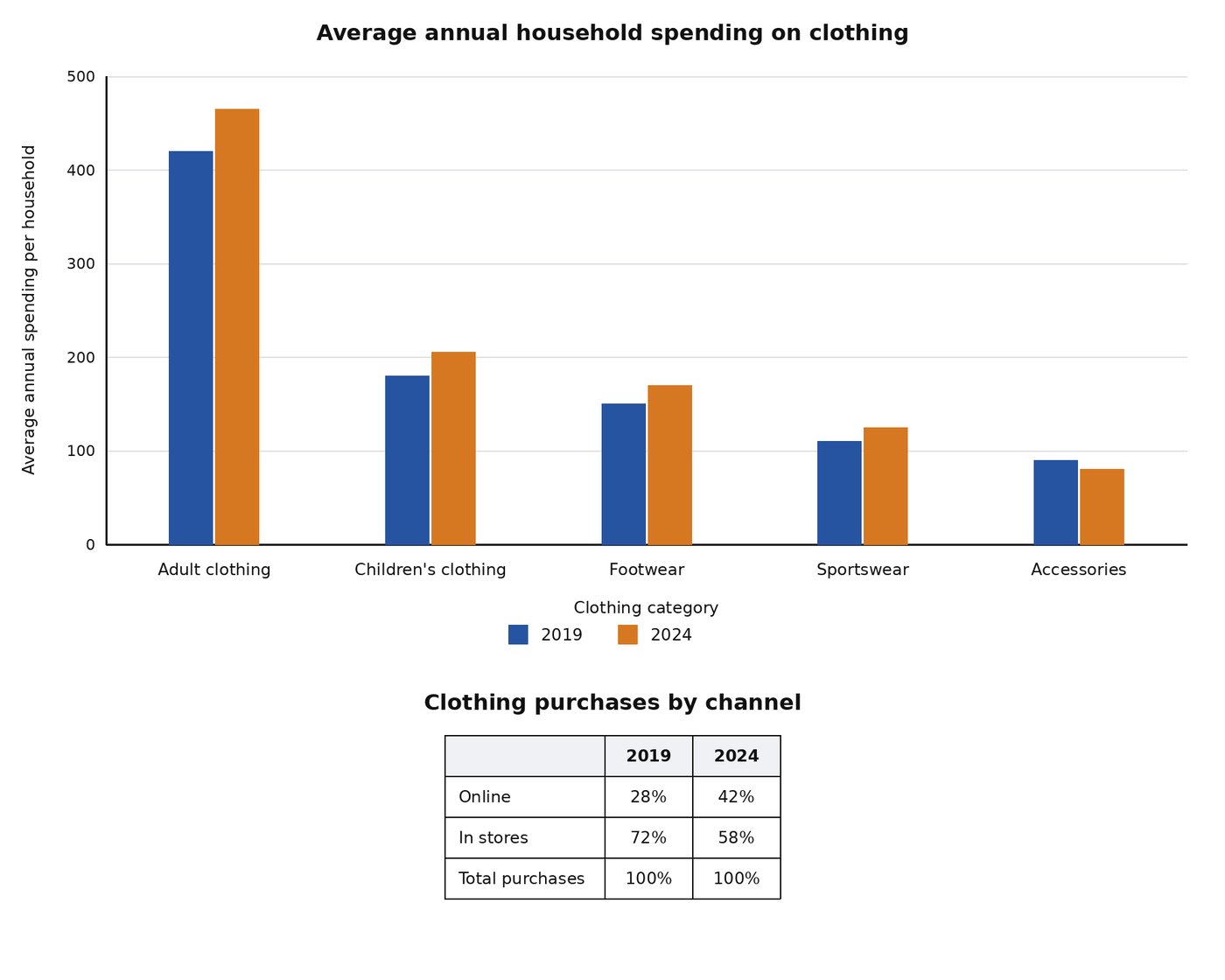
The chart below compares average annual household spending on five clothing categories in 2019 and 2024, while the table shows the proportions of clothing purchases made online and in stores in those years.
Summarise the information by selecting and reporting the main features, and make comparisons where relevant.
Student answer (Band 5.5)
The graph illustrates the average household spending in five group yearly in 2014 and 2024.while the table below shows the percentage of clothing purchased in-store and online.
Overall , the graph mentioned the spending in adult clothing remain higher in both years ,while the other three categories children clothing,footwear, sports wear amount used remain almost same.however the accessories are lowest in number.
On the other hand, table data explains the physical shopping of fabric collection that rise its percentage in both years as compare to online shopping but in 2019 biggest amount of customers buy clothes by visiting their physical outlets .
By checking the bar chart it can be seen that in in 2019 and 2024 more than 400 people use their spending in adult shopping.whereas ,average annual spending is not more than 200 in children clothing,foot wear and sports wear .
moreover,accessories remains lowest in figure that are not above than 100.
By checking the channels of shopping ,Online orders increased in 2024 as compare to 2019.that rise is from 28% to 42%.while in-store shopping decrease steadily from 74% in 2019 to 58% in 2024.
AI examiner evaluation
| Criterion | Band |
|---|---|
| Task Achievement / Task Response | 6.0 |
| Coherence and Cohesion | 5.5 |
| Lexical Resource | 5.0 |
| Grammatical Range and Accuracy | 5.0 |
| Overall | 5.5 |
Task Achievement / Task Response: Band 6.0
You cover both visuals and identify several important patterns: adult clothing has the highest spending, accessories the lowest, and online purchasing rises by 2024. However, some comparisons are unclear or inaccurate. The table shows in-store purchases falling from 72% to 58%, not rising in both years; your later figure of 74% for 2019 is also incorrect. The overview that children’s clothing, footwear and sportswear remain “almost same” overlooks their increases, and the claim that spending is “not more than 200” groups categories without clearly reporting the changes. To strengthen the response, give a precise overview of the main trends and support it with accurate comparisons across both years.
Coherence and Cohesion: Band 5.5
The response has a recognisable structure, with an introduction, an overview and separate discussion of the chart and table. This helps the reader distinguish the two visuals. However, progression is weakened by repeated openings such as “By checking the bar chart” and “By checking the channels of shopping,” and some linking phrases do not express the relationship accurately. For example, “On the other hand” introduces the table without a clear contrast, while “however” is used where the point about accessories is not really contrasting with the preceding statement. Organise the details into clearer comparisons, and use linking words only when their logical function is clear. More precise references to the years and categories would also improve flow.
Lexical Resource: Band 5.0
You use some relevant task vocabulary, including “average annual spending,” “percentage,” “online orders” and “in-store shopping,” so the topic is generally understandable. However, the range is limited and several word choices or collocations are awkward, such as “five group yearly,” “amount used,” “physical shopping of fabric collection” and “biggest amount of customers.” These expressions sometimes make the intended meaning difficult to follow. Use standard chart language consistently, such as “spending on clothing,” “share of purchases” and “the largest proportion of shoppers.” Check spelling and word forms too, including “sportswear” and “footwear.” More precise vocabulary would make the comparisons clearer and more natural.
Grammatical Range and Accuracy: Band 5.0
You attempt both simple and more complex sentences, including clauses introduced by “while” and “whereas,” but control is inconsistent. Errors in sentence boundaries and punctuation are especially noticeable: the opening joins two sentences as “2024.while,” and several later sentences begin with lowercase words after full stops. There are also problems with agreement and sentence construction, as in “the graph mentioned the spending … remain higher” and “that rise is from 28% to 42%.” Articles and plural forms are sometimes missing or unclear. Aim for complete, well-punctuated sentences, and check that subjects and verbs agree. A few carefully controlled complex comparisons would be more effective than longer, faulty constructions.
See this exact question answered at other band scores. The same prompt compared across bands.
Browse more IELTS Writing model answers or get your own writing scored by the same AI examiner.