Band 5.5 IELTS Writing Task 1 Model Answer
Overall Band Score: 5.5 · IELTS Last Minute Nov 2026 · 2026-11-18
IELTS Writing Task 1 question
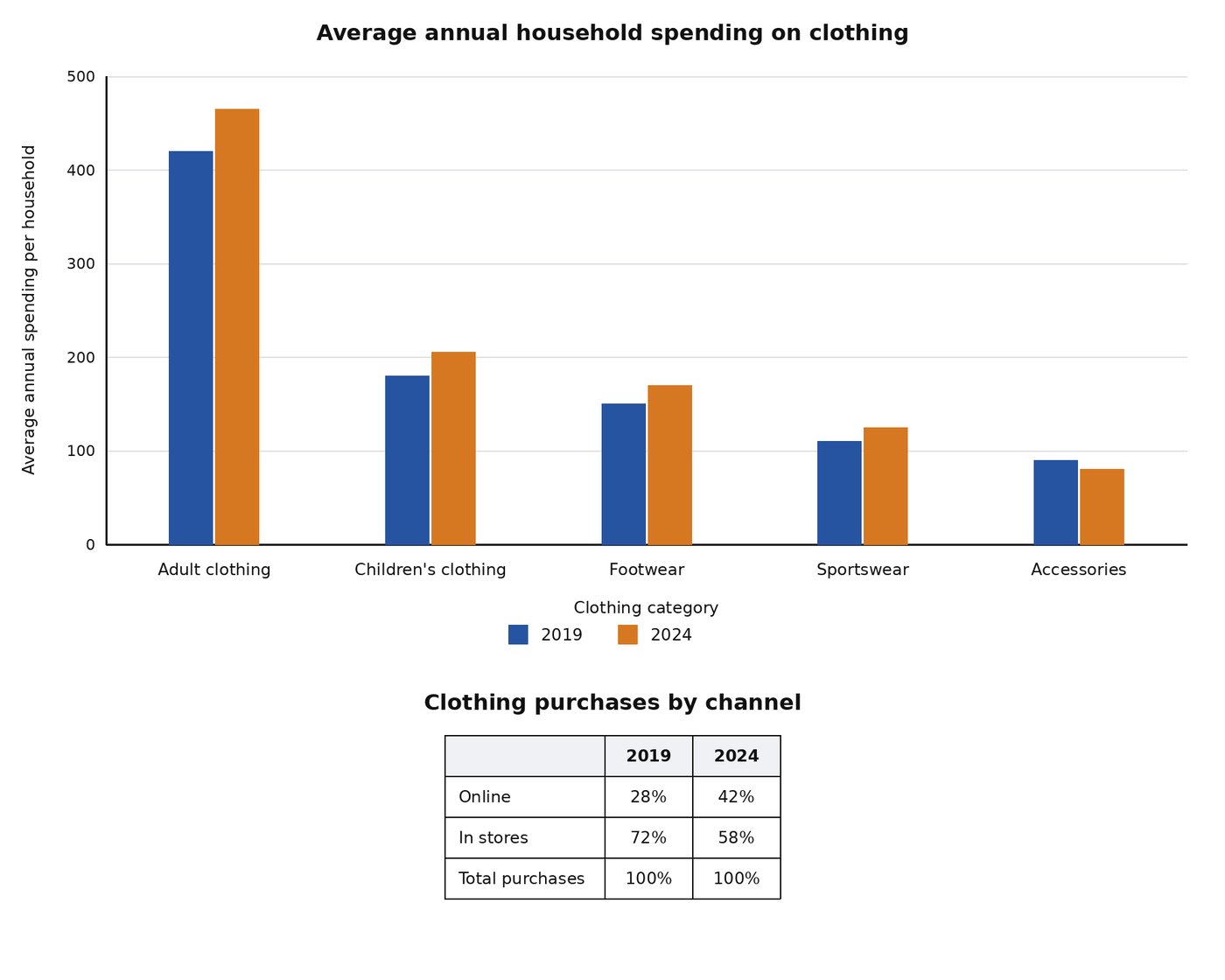
The chart below compares average annual household spending on five clothing categories in 2019 and 2024, while the table shows the proportions of clothing purchases made online and in stores in those years.
Summarise the information by selecting and reporting the main features, and make comparisons where relevant.
Student answer (Band 5.5)
The bar chart demonstrates and compares the average annual household spending on five diffrent clothing categories in the year 2019 and 2024 , while the tabular data shows the proportion and comparison of the clothing purchases made online and in stores in those years .
Overall we can see that majority of the expenses are made on adult clothing in both the year . least expenses are made on accessories in both the year . In 2019 only 28% of the total clothing purchase were made online while in 2024 42% of the total expenses were made online .
The average annual spending on adult clothing in both the year are similar around 420 in 2019 and approx 450 in 2024 . Spending on children's clothing are also similar 180 in 2019 and 200 in 2024 .
In 2019 the clothing purchase in store were 72% while it explicitly declined to 58% by the year 2024 .
In conlusion , it is clearly visible that average annual household spending on clothing in the year 2019 and 2024 do not have much difference and most of the buyers have shifted to online shopping .
AI examiner evaluation
| Criterion | Band |
|---|---|
| Task Achievement / Task Response | 6.0 |
| Coherence and Cohesion | 6.0 |
| Lexical Resource | 5.5 |
| Grammatical Range and Accuracy | 5.0 |
| Overall | 5.5 |
Task Achievement / Task Response: Band 6.0
You cover both the spending chart and the purchase-channel table, and your overview identifies two important features: adult clothing accounts for the highest spending, while accessories are lowest, and online purchasing rises as in-store purchasing falls. The figures you give for the two largest categories are broadly accurate. However, the report is uneven: it omits the changes in footwear and sportswear, and the conclusion that spending “do not have much difference” is too general because accessories actually decline while the other categories rise. Also, the 2024 adult-clothing figure is closer to £465 than “approx 450.” To strengthen the response, compare the remaining categories and summarise the overall spending pattern more precisely.
Coherence and Cohesion: Band 6.0
The response has a recognisable structure, moving from an introduction to an overview and then to supporting details. This makes the main message accessible, and phrases such as “Overall” and “In conclusion” signal the stages of the report. However, the body paragraphs do not develop the information in a fully logical sequence: the spending figures are split across short paragraphs, while the channel data is repeated in both the overview and a later paragraph. The final conclusion also restates the overview rather than adding a clear synthesis. Grouping the spending comparisons together, then discussing the online/in-store shift, would improve progression. Some linking is mechanical, and references such as “both the year” are not always clear.
Lexical Resource: Band 5.5
You use enough task-related vocabulary to communicate the main comparisons, including “average annual household spending,” “proportion,” “declined,” and “shifted to online shopping.” However, the range is somewhat repetitive, with “spending,” “clothing,” and “year” appearing frequently, and several word choices or collocations are imprecise. For example, “majority of the expenses are made on adult clothing” is less natural than saying that the highest spending was on adult clothing, while “total expenses were made online” confuses spending with purchases. There are also spelling errors such as “diffrent” and “conlusion.” More precise reporting verbs and accurate collocations would make the comparisons clearer and more fluent.
Grammatical Range and Accuracy: Band 5.0
You attempt both simple and more extended sentence forms, and the meaning is generally understandable. Some grammatical errors remain, particularly with agreement, articles, and sentence construction. For example, “the average annual spending … are similar” should use a singular verb, and “in both the year” needs a plural form or a different construction. The sentence beginning “Overall we can see that majority” is missing an article, while “spending … do not have much difference” has an incorrect verb form and awkward structure. Punctuation spacing is also inconsistent, with spaces before commas and full stops. Practise accurate comparison structures, such as “spending on X was …, compared with …,” and check agreement and articles during editing.
See this exact question answered at other band scores. The same prompt compared across bands.
Browse more IELTS Writing model answers or get your own writing scored by the same AI examiner.