Band 5.5 IELTS Writing Task 1 Model Answer
Overall Band Score: 5.5 · IELTS Last Minute Nov 2026 · 2026-11-20
IELTS Writing Task 1 question
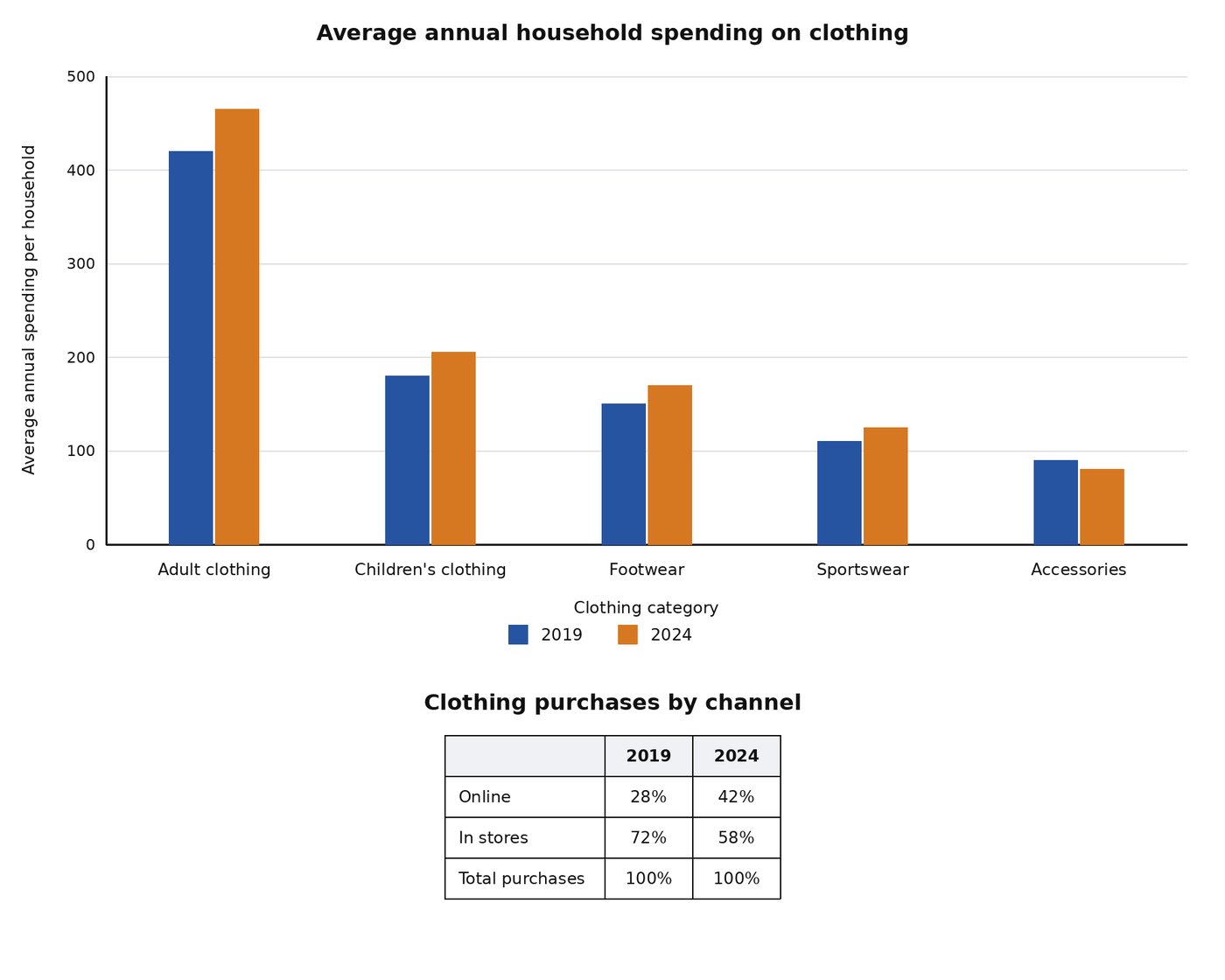
The chart below compares average annual household spending on five clothing categories in 2019 and 2024, while the table shows the proportions of clothing purchases made online and in stores in those years.
Summarise the information by selecting and reporting the main features, and make comparisons where relevant.
Student answer (Band 5.5)
The bar graph illustrates the yearly expenditure of household on five wearable categories namely adult clothing, children's clothing, footwear, sportswear and accessories of the year 2019 and 2024. The table depicts the platfrom for shopping clothes.
Overall, it is evident that majority of expenditure occurred on adult clothing. In all sector the expenditure increased from 2019 to 2024, but accessories sector spending reduced in 2024.
In 2019, around 410 were spend on adult clothing which surged to 460 in 2024. The individuals started to prefer the online platforms in 2024 at 42%, as compare to 28% in 2019. Therefore, it resulted to decrease in stores shopping in 2024 at 58%, whereas in 2019, it waa 72%. In three categories which are childern's clothing, footwear and sportswear all three sector recorded a increase in expentiure from 2019. The children's clothes with 180 ,in 2024 compare to 170 before. Sportswear with tiny surge from 110 in 2019 to 120 and footwear with 130 in past to 135 in 2024.
Accessories was the alone sector where the expenditure decreased from past from 90 in 20
AI examiner evaluation
| Criterion | Band |
|---|---|
| Task Achievement / Task Response | 5.5 |
| Coherence and Cohesion | 5.5 |
| Lexical Resource | 5.5 |
| Grammatical Range and Accuracy | 5.0 |
| Overall | 5.5 |
Task Achievement / Task Response: Band 5.5
You identify the main pattern that adult clothing accounts for the greatest spending and that accessories are the exception to the general rise. You also report the online and in-store proportions accurately, which covers both visuals. However, several figures are misreported: children’s clothing rises from about £180 to £205, not £180 to £170; footwear is about £150 to £170, not £130 to £135; and sportswear reaches about £125, rather than £120. The final sentence is cut off, so the accessories comparison is not completed. Give a concise overview of the main changes, then select and report the figures accurately; this would make the response more complete and clearer.
Coherence and Cohesion: Band 5.5
The response has a recognisable structure, with an introduction, an overview and a body paragraph, and it attempts to group related information. The contrast introduced by “but” is useful, and “whereas” helps compare the shopping channels. However, the progression becomes difficult to follow when spending figures and channel data are mixed in the same section, and the final sentence ends abruptly. Some links are also unclear, such as “Therefore, it resulted to decrease in stores shopping,” which does not clearly explain the relationship between the two percentages. Organise the body into a paragraph for spending and one for purchasing channels, and use direct comparisons to make the sequence easier to follow.
Lexical Resource: Band 5.5
You use relevant task vocabulary, including “expenditure,” “surged,” “reduced,” and “platforms,” and the reader can generally understand the intended comparisons. However, several word choices and collocations are inaccurate or awkward: “wearable categories” is not a natural label for clothing types, “the platform for shopping clothes” is imprecise, and “tiny surge” is informal. Spelling errors such as “platfrom,” “childern’s,” and “expentiure” also reduce accuracy. Aim for precise, conventional chart language and check spelling carefully. Phrases such as “clothing categories,” “online purchases,” and “a slight increase” would express the information more naturally and appropriately.
Grammatical Range and Accuracy: Band 5.0
You attempt a mixture of simple and more complex sentences, including comparisons with “whereas” and a contrast introduced by “but.” However, errors occur frequently and sometimes make relationships or figures hard to interpret. Examples include “the yearly expenditure of household,” “In all sector the expenditure increased,” and “The children's clothes with 180, in 2024 compare to 170 before,” where articles, agreement and sentence structure are not controlled. The final sentence is also incomplete. Practise building complete sentences with a clear subject and verb, for example, “Spending on children’s clothing rose from £180 in 2019 to £205 in 2024.” Check agreement, articles and punctuation when editing.
See this exact question answered at other band scores. The same prompt compared across bands.
Browse more IELTS Writing model answers or get your own writing scored by the same AI examiner.