Band 6.0 IELTS Writing Task 1 Model Answer
Overall Band Score: 6.0 · IELTS Last Minute Nov 2026 · 2026-11-27
IELTS Writing Task 1 question
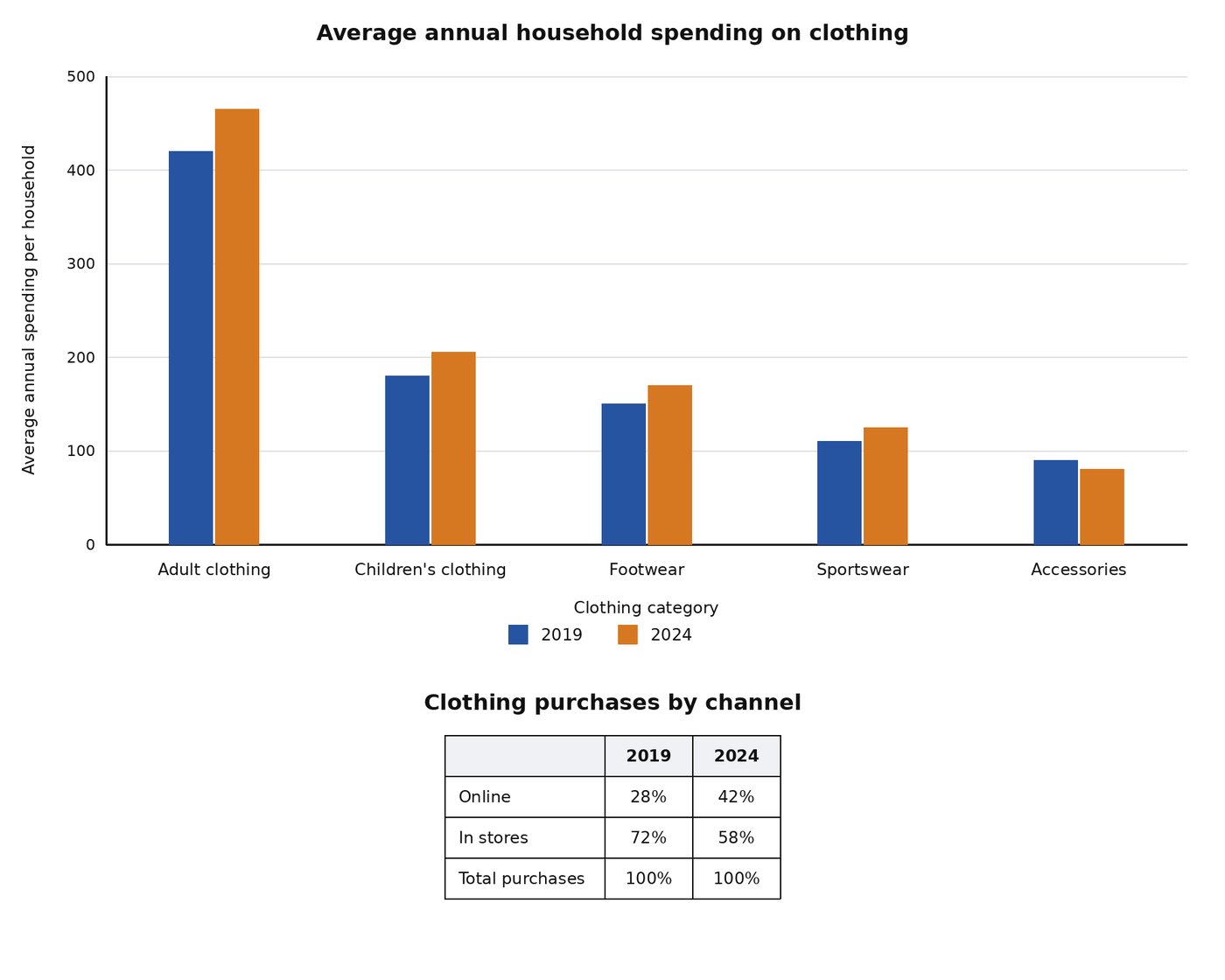
The chart below compares average annual household spending on five clothing categories in 2019 and 2024, while the table shows the proportions of clothing purchases made online and in stores in those years.
Summarise the information by selecting and reporting the main features, and make comparisons where relevant.
Student answer (Band 6.0)
The bar chart illustrates the average amount of money spent on five clothing categories (adult clothing, children's clothing, footwear, sportswear and accessories) in 2019 and 2024. The table provides information about percentages of two methods of shopping ( online and in stores)used by households in the same years.
Overall, the highest amount of money spent was on adult clothing in both 2019 and 2024, while the lowest amount of money spent was on acessories. People in general spent more money on shopping in 2020 compared to 2019 except for acessories where people spent slightly less money in 2024. Households preferred the in stores shopping in 2019, on the contrary they prefered online shopping in 2020.
Regarding the average amount of money spent on different categories, people tend to spend more money in 2024 compared to 2019 on all categories, but accessories. The highest amount of money was spent on adult's clothing in 2019 ( just above 400), and just under 500 in 2019. People spent moderate amount of money on Children's clothing, footwear and sportswear in both years (less than 200). On the contrary, the least amount of money was spent on accessories (just below 100) in both years.
Turning into the method of shopping, the highest proportion of people choosed to shop in stores in 2019 (72%), while only 28% shopped online. On the contrary, 58% of residents shoped online in 2024, meanwhile only 42% still go to stores for shopping.
AI examiner evaluation
| Criterion | Band |
|---|---|
| Task Achievement / Task Response | 5.5 |
| Coherence and Cohesion | 6.0 |
| Lexical Resource | 6.0 |
| Grammatical Range and Accuracy | 6.0 |
| Overall | 6.0 |
Task Achievement / Task Response: Band 5.5
You identify the main spending pattern: adult clothing is highest and accessories lowest, and spending rises in most categories while accessories decline. You also report the 2019 channel split accurately. However, there are important inaccuracies and unclear comparisons: the overview says households preferred online shopping in 2020, although the data are for 2024, and the final paragraph reverses the 2024 figures, giving 58% for stores and 42% online instead of the opposite. The adult-clothing comparison also says “just under 500 in 2019,” rather than describing 2024, and several category figures are only broadly summarised. These errors weaken coverage of the key features; check each year and channel against the table and make the overview precise.
Coherence and Cohesion: Band 6.0
The response has a recognisable structure, moving from an introduction to an overview, then spending details and channel data. Paragraphing helps the reader distinguish the two visuals, and linking phrases such as “Overall” and “Regarding” signal the stages of the report. However, cohesion is sometimes mechanical or confusing: “On the contrary” is used where a simple contrast or comparison would be clearer, and the repeated “People spent…” phrasing makes the spending paragraph less fluent. The incorrect year and channel figures also disrupt the progression because the overview conflicts with the final paragraph. Use a consistent sequence—overview, spending comparisons, then channel changes—and connect related figures directly.
Lexical Resource: Band 6.0
You use an adequate range of task-related vocabulary, including “average amount,” “proportion,” “categories,” and “in stores,” so the main information is generally understandable. There are also attempts at more formal reporting language, such as “illustrates” and “provides information.” However, some choices are repetitive or imprecise: “amount of money spent” appears several times, while “moderate amount” is vague for the middle categories. Spelling errors such as “acessories,” “prefered,” “choosed,” and “shoped” reduce accuracy. Some phrases are also awkward, including “preferred the in stores shopping.” Aim for concise chart language such as “expenditure,” “accounted for,” and “shopping channel,” and proofread spelling and collocations.
Grammatical Range and Accuracy: Band 6.0
You use a mix of simple sentences and longer structures, including contrast clauses with “while” and “except for,” and most meanings remain clear. Some grammatical errors persist, however. Tense and year references are inconsistent: “they prefered” and “residents shoped” do not maintain accurate past-tense reporting, while the text refers to 2020 instead of 2024. There are also errors in sentence construction and articles, for example “People spent moderate amount” should be “People spent a moderate amount,” and “the in stores shopping” is not a well-formed noun phrase. Punctuation spacing is inconsistent, as in “( just above 400).” Review past-tense forms, articles, and sentence phrasing to make the report more controlled.
See this exact question answered at other band scores. The same prompt compared across bands.
Browse more IELTS Writing model answers or get your own writing scored by the same AI examiner.