Band 5.5 IELTS Writing Task 1 Model Answer
Overall Band Score: 5.5 · IELTS Predictions Nov 2026 · 2026-11-25
IELTS Writing Task 1 question
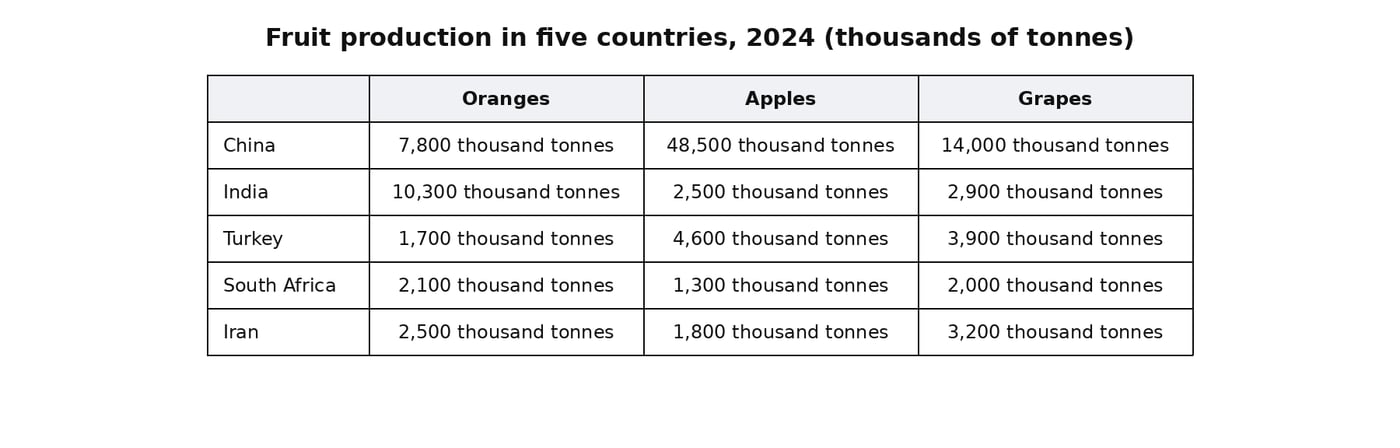
The table below shows how much oranges, apples and grapes are produced in five countries.
Summarise the information by selecting and reporting the main features, and make comparisons where relevant.
Student answer (Band 5.5)
The table shows the fruits which are Oranges, Apples,Grapes are produce in five different countries namely, China,India,Turkey,South Africa and Iran in 2024.
Overall, Oranges was produced higher in India. The production of Apples and Grapes was in China. Wherease, Lower production was noted in South Africa in Apple and Grapes. Oranges was the least produced in Turkey.
To begin with, India was the highest producer for Oranges which was at 10,300 tonnes. Followed by China and South Afrrica, Iran was 7,800, 2,100 and 2,500 tonnes of orange fruit in 2024. The least production noted in Turkey was at 1,700 tonnes.
China was the highest producer for the apples and grapes was at 48,000 and 14,000 tonnes respectively. By the contrast, turkey was the second highest country who produced 4,600 and 3,900 tonnes apples and grapes. Followed by India was the third highest country for the production of apples was at 2,500 tonnes and similery Iran was produced 3,200 tonnes of grapes. South Africa was the only country who produced leaast amount of apples and grapes waas 1,300 and 2,000 tonnes in 2024.
AI examiner evaluation
| Criterion | Band |
|---|---|
| Task Achievement / Task Response | 6.0 |
| Coherence and Cohesion | 6.0 |
| Lexical Resource | 5.5 |
| Grammatical Range and Accuracy | 5.0 |
| Overall | 5.5 |
Task Achievement / Task Response: Band 6.0
You identify the main patterns: India leads orange production, China leads apples and grapes, and South Africa has the lowest figures for apples and grapes. Most reported figures are accurate, including India’s 10,300 tonnes of oranges and South Africa’s 1,300 and 2,000 tonnes. However, China’s apple figure is given as 48,000 rather than 48,500, and the sentence listing orange producers does not clearly match each country to its figure. The overview also says China produced the most apples and grapes without highlighting the very large gap in apple production. To strengthen the report, present comparisons more precisely and ensure every figure is clearly assigned to the correct country and fruit.
Coherence and Cohesion: Band 6.0
The response has a clear overall arrangement: an introduction, an overview, and separate paragraphs for oranges and the other fruits. This makes the main categories easy to follow. However, some links between ideas are mechanical or unclear. For example, “Followed by China and South Afrrica, Iran was 7,800, 2,100 and 2,500 tonnes” does not clearly show which value belongs to which country, while “By the contrast” and repeated “Followed by” constructions interrupt the flow. The final paragraph also combines several comparisons in long sentences. Use linking phrases more selectively and structure each comparison so the country, fruit, and figure are unmistakably connected.
Lexical Resource: Band 5.5
You use relevant task vocabulary such as “highest producer,” “production,” and “least produced,” and the reader can generally understand the comparisons. However, the range is somewhat repetitive, particularly through repeated use of “producer,” “production,” and “Followed by.” Several word-choice and spelling problems reduce precision, including “the fruits which are … are produce,” “By the contrast,” “similery,” and “leaast.” Some expressions, such as “the only country who produced,” are also awkward for describing countries and data. Aim for accurate, natural reporting language, for example “accounted for,” “ranked second,” and “the lowest output,” while checking spelling and collocations carefully.
Grammatical Range and Accuracy: Band 5.0
You attempt both simple statements and longer comparative sentences, and the overall meaning is usually recoverable. However, some sentence structures are incomplete or difficult to control. The opening sentence, “The table shows the fruits which are … are produce,” has an unclear clause structure, and “Overall, Oranges was produced higher in India” has problems with agreement and sentence construction. In “China was the highest producer for the apples and grapes was at…,” the subject and verb do not agree, and the comparison is not formed clearly. Use a wider range of accurately controlled sentences, checking subject–verb agreement, articles, and how clauses are joined. Shorter, complete sentences would help make the data relationships clearer.
See this exact question answered at other band scores. The same prompt compared across bands.
Browse more IELTS Writing model answers or get your own writing scored by the same AI examiner.