Band 5.5 IELTS Writing Task 1 Model Answer
Overall Band Score: 5.5 · IELTS Last Minute Nov 2026 · 2026-11-17
IELTS Writing Task 1 question
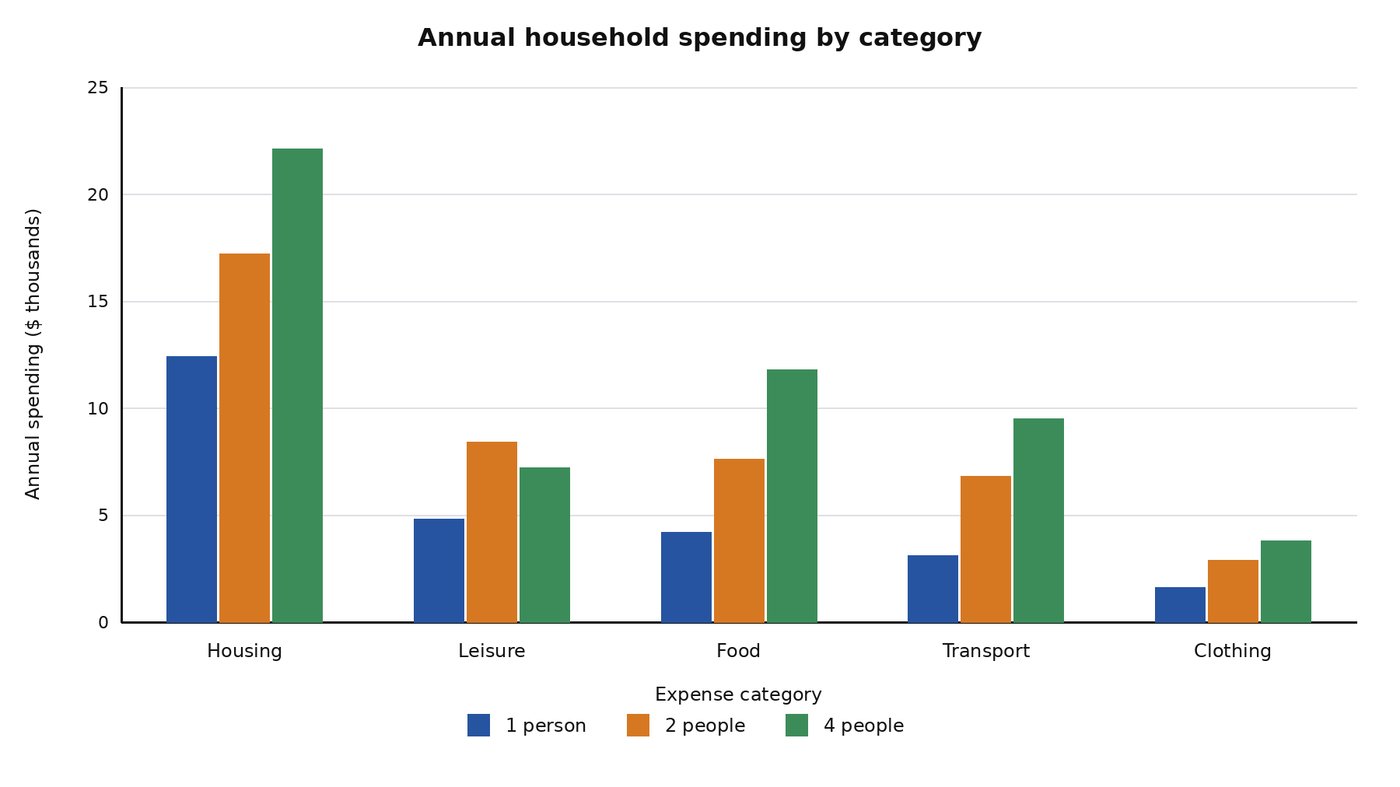
The chart below shows annual spending by households of three different sizes on five categories in one country.
Summarise the information by selecting and reporting the main features, and make comparisons where relevant.
Student answer (Band 5.5)
The presented bar graph compares the anual spending by household of three diffrent size on five categories such as Housing, Leisure, Food, Transport, and Clothing, in one country.
Overall, housing accounted for largest expenditure across all categories, followes by leisure, food and transport. while clothing requires lowest money. Evidently, it is enough to make it clear that more people from household requires the more budget.
single person spend highest money on housing at 12 thousands dollers annually and lowest amount on clothing at $1 thousand. The other categories like lesure, food nd transport accounted for $4 thousands, $3 thousands and $2 thousand, respectively, Similarly, two people in household spend most on housing at $17,000, followed by leisure and food at $7000, $6000, respectively. on the other hand, least amount contrinutes in clothing and transport at approximately $5000, $2000.
Furthermore, household of four people demands more budget than other households. In contrast, single person household spend less than other households. well, the four people in family use more in housing and food at $23,000, $12,000, and spend less in clothing, leisure and transport at $4000, $6000, $9000. Although, four people spend loest on clothing is is highest among other household. Lastly, in leisure two people spend most followed by four people and single people.
AI examiner evaluation
| Criterion | Band |
|---|---|
| Task Achievement / Task Response | 6.0 |
| Coherence and Cohesion | 6.0 |
| Lexical Resource | 5.5 |
| Grammatical Range and Accuracy | 5.0 |
| Overall | 5.5 |
Task Achievement / Task Response: Band 6.0
You identify the main categories and compare all three household sizes, and your overview correctly notes that housing is the largest expense and clothing the smallest. You also capture the broad pattern that four-person households generally spend more, and your final comparison correctly says leisure spending is highest for two people. However, the overview is partly inaccurate: leisure is not consistently the second-largest category, since food exceeds it for four-person households. Several figures and comparisons are also misreported. For example, two-person transport is about $6,800, not $2,000, and clothing is about $2,900, not $5,000; one-person transport is about $3,100, not $2,000. Select the key comparisons more carefully and report values consistently to make the summary more reliable.
Coherence and Cohesion: Band 6.0
The response has a recognisable structure: an introduction, an overview, and paragraphs describing the household groups. This gives the reader a general route through the information, and phrases such as “Furthermore” and “In contrast” show an attempt to connect comparisons. However, progression is not always clear because the account shifts between categories and household sizes, and some links are mechanical or confusing. The sentence beginning “Overall” lists leisure, food and transport in a way that conflicts with the four-person data, while “Similarly” introduces a comparison that does not clearly follow. The final paragraph repeats that larger households spend more after this has already been stated. Organise the details by category or household size, and use linking phrases only when the relationship is precise.
Lexical Resource: Band 5.5
You use a relevant range of task vocabulary, including “accounted for,” “expenditure,” “annually,” and “followed by,” so the reader can understand that you are describing spending patterns. There are also attempts at more formal phrasing, such as “demands more budget.” However, several word choices and collocations are inaccurate or unnatural, including “requires the more budget,” “lowest money,” and “least amount contributes.” Spelling errors such as “anual,” “diffrent,” “dollers,” and “contrinutes” are noticeable and reduce precision. Some category descriptions are also vague, for example “use more in housing and food.” Aim for standard collocations such as “spent the most on” and “expenditure was lowest for,” and check spelling carefully.
Grammatical Range and Accuracy: Band 5.0
You attempt a mixture of simple statements and longer sentences, including comparisons introduced by “while,” “although,” and “followed by.” This shows some range, and the main message is generally understandable. However, errors in agreement, articles, sentence boundaries, and verb forms occur across the response. For example, “single person spend” needs a singular verb, and “more people from household requires” has problems with both agreement and sentence construction. Several sentences begin with lowercase words after full stops, while “Although, four people spend loest…” is an incomplete or awkwardly joined clause. The sentence “Although, four people spend loest on clothing is is highest…” also combines ideas without a clear grammatical structure. Use shorter, complete sentences when comparing figures, and check subject–verb agreement and punctuation.
See this exact question answered at other band scores. The same prompt compared across bands.
Browse more IELTS Writing model answers or get your own writing scored by the same AI examiner.