Band 6.0 IELTS Writing Task 1 Model Answer
Overall Band Score: 6.0 · IELTS Last Minute Nov 2026 · 2026-11-20
IELTS Writing Task 1 question
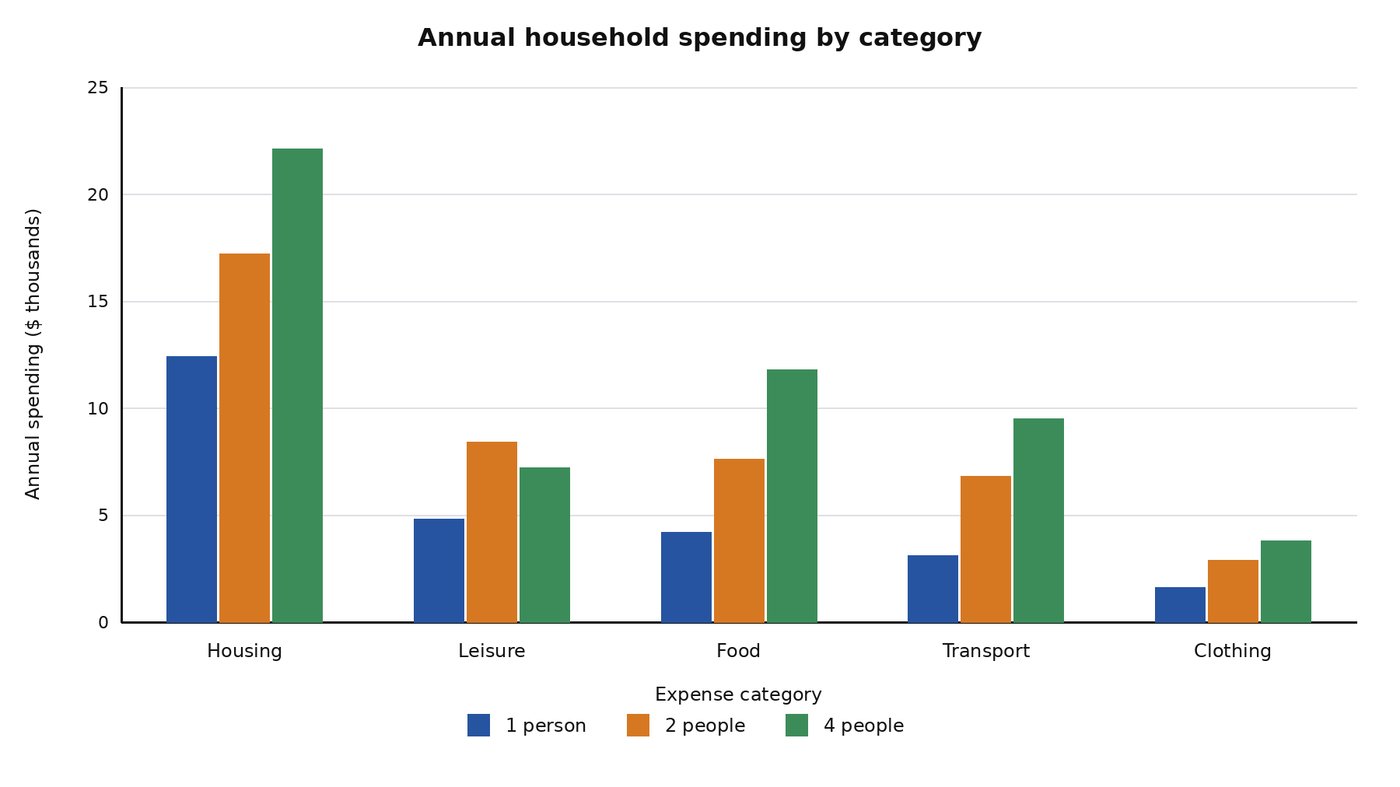
The chart below shows annual spending by households of three different sizes on five categories in one country.
Summarise the information by selecting and reporting the main features, and make comparisons where relevant.
Student answer (Band 6.0)
The bar graph illustrates the yearly spending of three households which are 1 person, 2 people and 4 pople on five sectors namely, housing, leisure, food, transport and clothing. The data is quatnified in numbers.
Overall, it is evident that major of the expendtiure occurred in the housing as compare to the remaining four sector, followed by food. The least expense sector was wearable.
To begin with all the three goups spend highly on the housing sector, thr gorup of 4 pople spent roughly 23000, followed by 2nd group with 17000 and group 1 with 13000. In the food and the transport categories, 4 people spend more, as comapred 2 person group. On the food group 3 spend approximately 12000, whereas 2 people spends around 7000 and lastly, single individual spent 4000. On leisure sectorn, 2 folks spent the most with 8000, followed by 4 people with 7000 and one perosn with 5000 expendtiure. In the transport category, 4 pople group spend 8000, closly backed by 2 pople wiyh 7000 and with 3000 group 1 stands.
Clothing sector has a tiny difference in all groups, Group of poeple spent 3000, a bit more with 3500 are done group 2 and group of 4 people spent 4000 in this sector.
AI examiner evaluation
| Criterion | Band |
|---|---|
| Task Achievement / Task Response | 6.5 |
| Coherence and Cohesion | 6.5 |
| Lexical Resource | 5.0 |
| Grammatical Range and Accuracy | 5.0 |
| Overall | 6.0 |
Task Achievement / Task Response: Band 6.5
You provide a clear overview by identifying housing as the largest spending category and clothing as the smallest, and you support this with relevant comparisons across household sizes. Most figures and rankings are broadly accurate: for example, four-person households spend the most on housing and food, while two-person households spend the most on leisure. Some details are less fully or accurately reported. The transport figures for four-person households are given as 8,000 rather than about 9,500, and the clothing comparison says the two-person figure is 3,500, rather than about 2,900. The overview also says food is second overall, although this is not true for every household size. More precise comparisons and a consistently accurate overview would strengthen the response.
Coherence and Cohesion: Band 6.5
The response has a recognisable structure: an introduction, an overview, and paragraphs describing the category figures. The information generally progresses from the largest category to smaller ones, and phrases such as “followed by” and “whereas” help signal comparisons. This gives the report an overall coherent arrangement. However, the grouping of details is somewhat uneven: food and transport are discussed together, then leisure is covered separately, and transport is repeated. Some transitions are awkward or unclear, as in “In the food and the transport categories, 4 people spend more, as compared 2 person group.” Organising the body more consistently by category, and using clearer links between comparisons, would make the progression smoother and less repetitive.
Lexical Resource: Band 5.0
You use enough task-related vocabulary to communicate the main categories and comparisons, including “yearly spending,” “followed by,” and “tiny difference.” However, the range and control are limited, and several word choices or collocations are unnatural or inaccurate: “major of the expenditure,” “wearable” for clothing, and “the data is quantified in numbers.” Repeated use of “group” and “spent” also makes the description less flexible. There are noticeable spelling errors, including “pople,” “quatnified,” “expendtiure,” and “comapred,” which can distract the reader. Use standard chart language such as “the largest expenditure,” “clothing,” and “spending was approximately,” and proofread carefully for spelling and word forms.
Grammatical Range and Accuracy: Band 5.0
You attempt both simple and more complex sentences, including comparisons with “whereas” and participial phrasing such as “followed by 2nd group.” The overall meaning is usually recoverable, but grammatical control is inconsistent, and errors sometimes make relationships difficult to follow. Examples include “three households which are 1 person, 2 people and 4 people,” “all the three groups spend highly,” and “as compared 2 person group,” where sentence structure, agreement, or required grammatical forms are missing. There are also problems with articles and plurals, as in “the remaining four sector.” Aim for complete, direct sentence patterns—for example, “Four-person households spent about…”—and check subject–verb agreement, articles, and plural forms.
See this exact question answered at other band scores. The same prompt compared across bands.
Browse more IELTS Writing model answers or get your own writing scored by the same AI examiner.