Band 6.0 IELTS Writing Task 1 Model Answer
Overall Band Score: 6.0 · IELTS Last Minute Nov 2026 · 2026-11-20
IELTS Writing Task 1 question
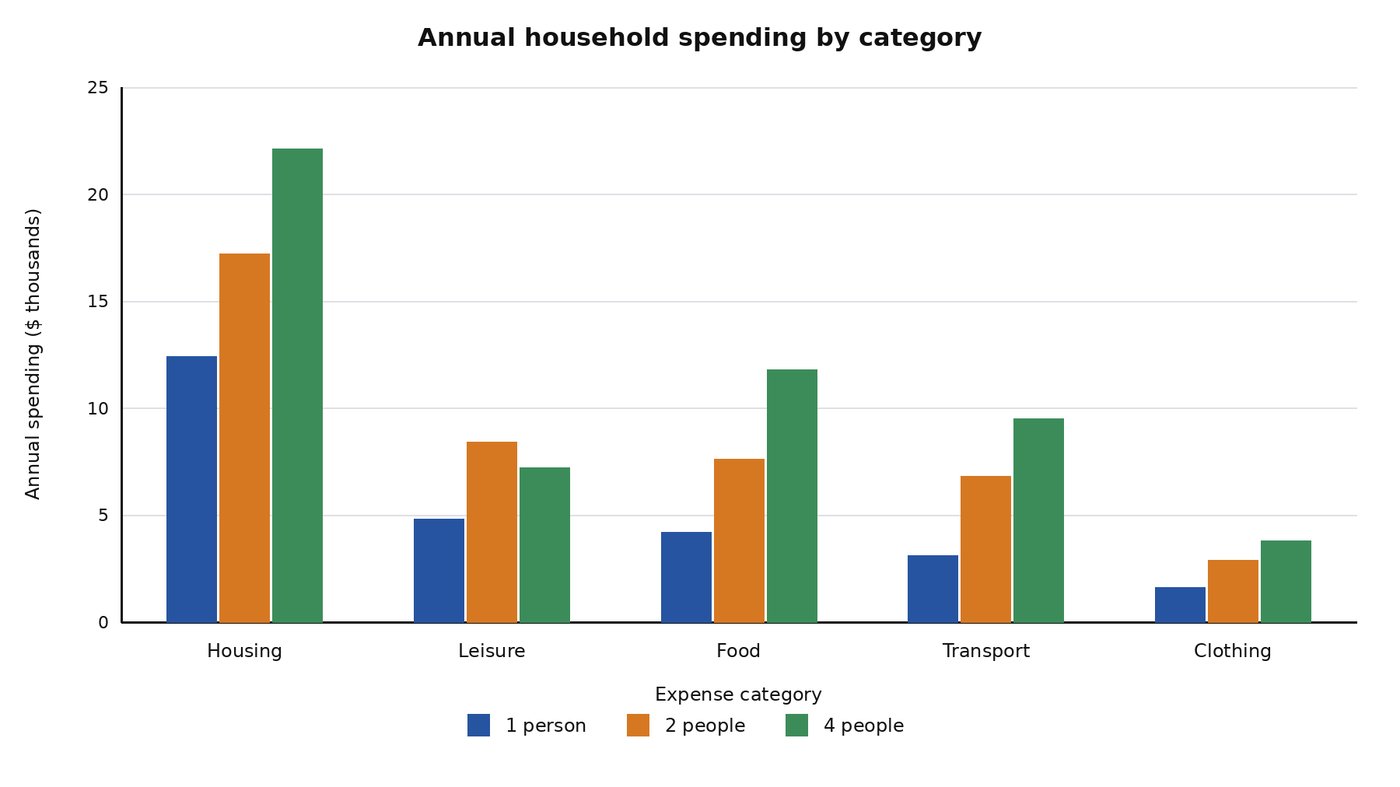
The chart below shows annual spending by households of three different sizes on five categories in one country.
Summarise the information by selecting and reporting the main features, and make comparisons where relevant.
Student answer (Band 6.0)
The bar chart compares the annual household spending by three different category ( 1 person, 2 people and 4 people) on five different categories in one country.
Overall, it can be observed that Housing expenditure was the major expense in three different family size. Meanwhile, Three different family size spent lowest on clothing category.
Turning to the details, it is evident that three different family size spent huge on housing . Single adults expend about $ 13,000 every year , followed by couples and family at approximately $17,000 and $ 23,000 annually. Food was also the main expense and single adults and 2 people paid less amount on food at $ 4,000 and $ 7,000 respectively. Similarly, Family of 4 people spend maximum on food at above $10,000 every year.
Remaining the other expense caregories, 4 people incur most on transport at $9,000 , whereas single adults and 2 people spent less below $7,000annually. Apart from that, spending by 2 people and 4 people had higher expenditure as compared to single adults which was accounted for below $10,000 year. Clothing recorded a negligible spending , single adults,2 peopleand 4 people spend less on clothing at below$5,000 each per year.
AI examiner evaluation
| Criterion | Band |
|---|---|
| Task Achievement / Task Response | 6.0 |
| Coherence and Cohesion | 6.5 |
| Lexical Resource | 5.5 |
| Grammatical Range and Accuracy | 5.5 |
| Overall | 6.0 |
Task Achievement / Task Response: Band 6.0
You provide a clear overview of the main patterns: housing is the largest expense for all three household sizes, while clothing is the smallest. You also include relevant comparisons, such as housing rising from about $13,000 for one person to roughly $23,000 for four, and the four-person household spending the most on food and transport. However, some details are incomplete or unclear. The statement that food was “also the main expense” is misleading because it is second only for the four-person household and is not a leading category for the smaller households. The comparison of leisure spending is not reported, and the final sentence about spending by two- and four-person households is too vague to identify the category. More precise selection and explanation of these details would make the summary more complete.
Coherence and Cohesion: Band 6.5
The response has a coherent overall structure: an introduction, a brief overview, and two paragraphs of supporting details. The progression from the largest categories to the remaining expenses is generally easy to follow, and phrases such as “Overall,” “Turning to the details,” and “Apart from that” help signal movement between points. This meets the lower-band expectations and shows some features of stronger organisation. However, the final detail paragraph becomes difficult to follow because “spending by 2 people and 4 people had higher expenditure” does not specify what category is being compared. Some linking phrases also feel mechanical or do not clearly connect the ideas. Grouping comparisons by category and using clearer references would strengthen the progression.
Lexical Resource: Band 5.5
You use a reasonable range of task-related vocabulary, including “expenditure,” “annually,” “recorded,” and “negligible,” and the reader can generally understand the comparisons. There are also attempts to vary wording rather than repeat “spending” throughout. However, several choices are inaccurate or unnatural, such as “spent huge on housing,” “paid less amount on food,” and “Remaining the other expense caregories.” “Family size” is also repeatedly used where “household” or “household size” would be more precise. Spelling and spacing problems, including “caregories” and “peopleand,” further reduce control. Aim for accurate collocations and consistent category terms; this will make the vocabulary more precise and natural.
Grammatical Range and Accuracy: Band 5.5
You attempt both simple and more complex sentence forms, including the overview sentence beginning “Meanwhile” and the comparison introduced by “whereas.” Most of the intended meaning remains understandable, but some grammatical errors recur. For example, “three different family size” needs a plural form, and “Family of 4 people spend” has a subject–verb agreement error. Verb forms are also inconsistent: “expend” and “spend” are used where past-tense reporting would be more appropriate, while “was accounted for” does not fit its sentence structure. Articles and punctuation are sometimes missing or misplaced, as in “Clothing recorded a negligible spending” and the inconsistent spacing around commas and dollar signs. More careful editing of agreement, tense, and sentence boundaries would improve accuracy.
See this exact question answered at other band scores. The same prompt compared across bands.
Browse more IELTS Writing model answers or get your own writing scored by the same AI examiner.